Covid kept canceling Amsterdam on me. More than five years and a pile of rebooked tickets later, I finally made it, with Freed and Yvonne along for the victory lap.
After more than five years of Covid cancellations and rebooked tickets, Nancy finally made it to Amsterdam in August 2023 with her son Freed and Yvonne. They took the free ferry across the IJ, stayed in the A'DAM Tower, ate stroopwafels and croissants, and learned why the Damrak's canal houses lean: they stand on wooden piles driven through soft peat to a sand layer about 12 to 13 meters down, and piles that dry out or decay settle unevenly.
For more than five years, Amsterdam kept winning.
Five years, a pandemic, one city
I booked it. Covid canceled it. I booked it again. I collected airline credits the way some people collect fridge magnets. It took more than five years of stubbornness, one pandemic and a small mountain of rebooked tickets before I finally crossed customs into the Netherlands, and it felt less like an arrival than a victory lap.
I did not take the victory lap alone. I brought two of my favorite travel buddies, my son Freed and Yvonne, which is the correct way to celebrate beating a city at its own game.
A quirky trio
On paper we did not match. Each of us came to Amsterdam wanting something different from it, and somehow we still hustled through a whirlwind of a trip in no time. We went all in: spontaneous dance-offs on boats as we slid under bridges, elevator karaoke at our hotel, bakery adventures, and the iconic sights we had all waited years to stand in front of.
Old Europe, revised
Freed did not know what Amsterdam was. In his head it was old Europe, all cobblestones and castles. Then we walked him down the Red Light District. What a shock.
Amsterdam in summer is not a city you get to yourself, and we did not try. We walked Zeedijk under strings of rainbow flags, browsed the floating flower market on the Singel (in business on its barges since 1862) and went out after dark along the canals, where neon reflects off the black water and the whole neighborhood seems to be out for a walk at once. We embraced the crowds.
Across the IJ
Behind Centraal Station, away from the postcard side of the city, a blue-and-white ferry crosses the IJ to Amsterdam Noord every few minutes. We squeezed onto the open deck with commuters and their bikes, under a sky that could not decide whether to rain. On the far bank: the white wedge of the EYE Film Museum and, beside it, the A'DAM Tower, where we were staying. The famous Lookout and its swing sat on the roof above our hotel, and we never once went up. The elevator, on the other hand, got a full karaoke set.
The ferry costs nothing. It has cost nothing since 1912, when the city council made the old steam ferry free for everyone, and Noord threw a party about it. More than a century later it is still the best free ride in town.
Croissants, cheese and the munchies
We ate like people who had been waiting five years, because we had. A stroopwafel the size of a saucer, in a paper cone. A bakery counter of almond croissants, ham-and-cheese croissants and double-chocolate hazelnut ones. Bubbles by the canals. One shop's wall of munchies, stacked floor to ceiling with more flavors of Pringles and Takis than I knew existed.
And cheese wheels. Freed spent the entire trip brainstorming how to get one.
Why the houses dance
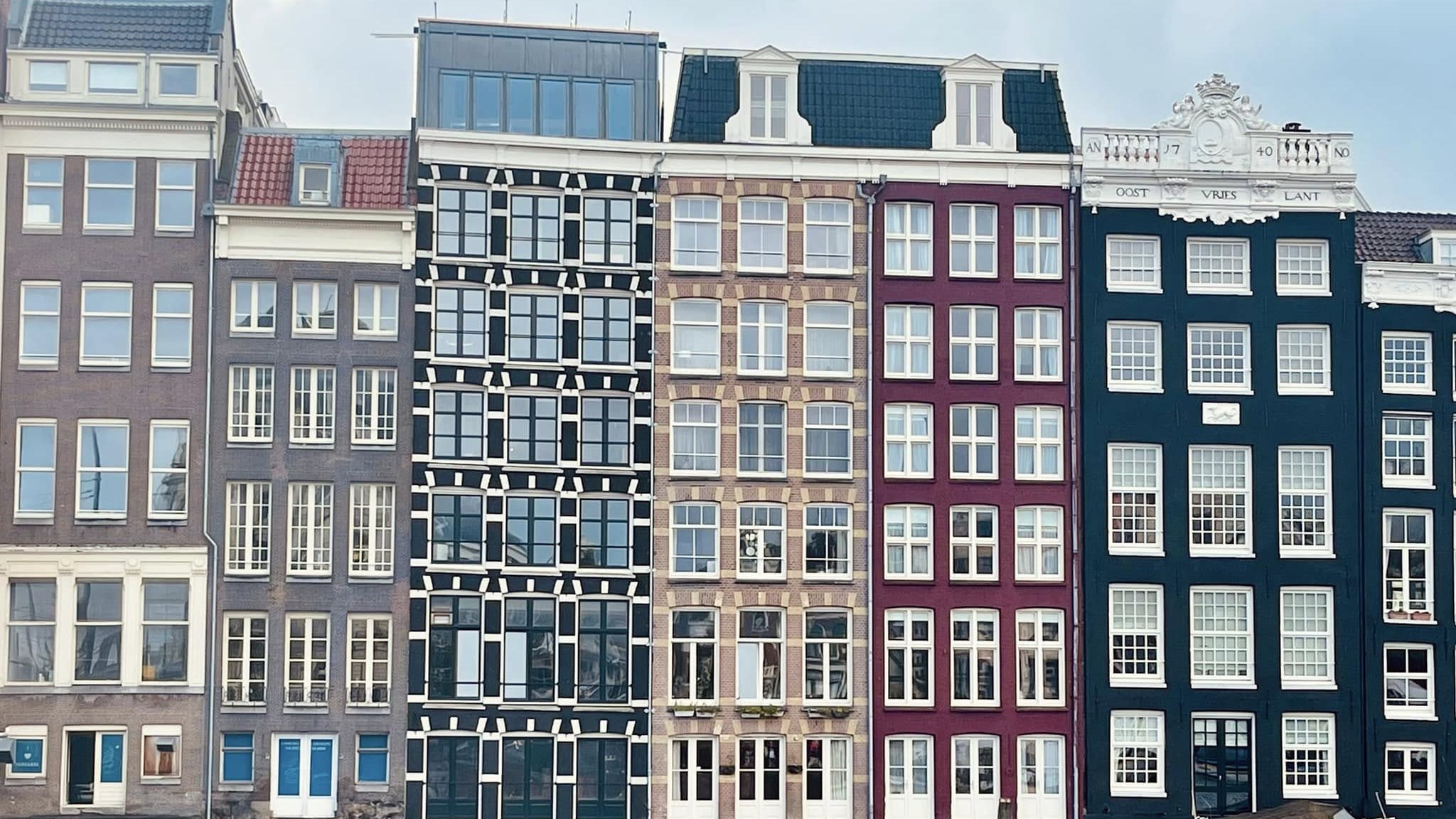
Stand on the Damrak and look across the water at the row of old canal houses. They lean. Not one or two of them: the whole row tilts this way and that, shoulder against shoulder, like a line of friends after a very good night. Locals call them the dancing houses. The reason they dance is underneath them.
Amsterdam was built on a bog. The top layers of the ground are soft peat and clay, closer to a wet sponge than to soil, and nothing heavy will stay put on them. So for centuries builders drove long tree trunks straight down through the mush until they hit a firm layer of sand, roughly twelve to thirteen meters below the street, and set the houses on top. The Royal Palace on Dam Square, built as the city hall, stands on 13,659 of them, all driven in 1648. Dutch schoolchildren learn the number.
Here is the trick: wood rots when air reaches it, so a timber pile lasts only as long as it stays under the groundwater. Keep it wet and it can hold a house for centuries. Let the water drop and fungi move in and eat it, a problem the Dutch call paalrot, pile rot. Even fully submerged, some piles, pine especially, are slowly digested by bacteria that do not need oxygen at all. Piles do not fail evenly. One corner loses its footing a little faster than the next, the house settles toward the weak side, and four hundred years of that turns a straight row of houses into a dance floor.
Some of the lean is on purpose. Many canal houses were built tipping slightly forward so that goods hauled up the facade by the hoisting beam at the top would not bang into the bricks on the way. But the wobble you see on the Damrak is mostly the ground, quietly winning.
If you go
- Take the free ferry. Head out the back of Centraal Station to the IJ side and look for the Buiksloterweg ferry (F3). It runs around the clock, leaves every few minutes and needs no ticket. Bikes ride free too.
- A'DAM Lookout is on top of the A'DAM Tower, a two-minute walk from the Buiksloterweg landing, next to the EYE Film Museum. The "Over the Edge" swing has been both an add-on and part of the standard ticket over the years, so check the Lookout's own site. There is a hotel in the tower too. We stayed there and still never went up. Learn from us.
- See the dancing houses from the Damrak side of the water, a few minutes' walk from Centraal Station toward Dam Square.
- The Royal Palace on Dam Square is open to visitors when it is not hosting state events. Check the palace calendar first.
- The floating flower market sits on the Singel between Koningsplein and Muntplein. These days it sells more bulbs and souvenirs than bouquets; buy bulbs, and check your home country's import rules before you pack them.
Homeward
We flew home on KLM, and the crew surprised us with a thoughtful little token as we left, a heartfelt goodbye from a city that had made me wait so long to love it.
A city that stands on a forest of tree trunks, kept upright only because it never lets them dry out, knows a thing or two about patience. So, it turns out, do I.
Until next time, Amsterdam.
Then we walked him down the Red Light District. What a shock.
Is the ferry from Amsterdam Centraal to Noord free?
Yes. The GVB ferries across the IJ are free for pedestrians and cyclists, and have been since 1912. The Buiksloterweg ferry runs around the clock from behind Centraal Station.
Why do Amsterdam's canal houses lean?
They stand on wooden piles driven through soft peat and clay to a firm sand layer about 12 to 13 meters down. Piles that dry out above the groundwater rot, and some decay even under water, so houses settle unevenly and tilt. Some facades were also built leaning forward on purpose for hoisting goods.
How many wooden piles hold up the Royal Palace in Amsterdam?
13,659, driven in 1648 when the building went up as the city hall.
Where is Amsterdam's floating flower market?
On the Singel canal between Koningsplein and Muntplein, where its stalls have stood on barges since 1862.
How do you get to A'DAM Lookout?
Take the free Buiksloterweg ferry from behind Centraal Station. The A'DAM Tower is a two-minute walk from the landing, next to the EYE Film Museum.

Traveled with
Every story carries its receipts. Something out of date? Tell the editor and the "Last updated" line changes when we fix it.



Spot a fact that's off? A name we misspelled? Tell us. It gets fixed within 24 hours.
hello@thatlayover.life →