An extended Bali layover after 24+ hours of flying: a lake temple, the thousand-year-old water system behind Jatiluwih's rice terraces, a sweet owl, and an attack by a pheasant (which was not a pheasant).
Nancy Carleton and her husband Jay spent an extended layover in Bali in February 2024, visiting Pura Ulun Danu Beratan on Lake Bratan and the Jatiluwih rice terraces. Both belong to the subak system, Balinese farmer cooperatives that share irrigation water and coordinate planting through water temples; UNESCO dates it to the 9th century and listed it in 2012. Synchronized flooding drowns rice pests, and balancing that against limited water produces near-maximal harvests without central planning, a 2017 PNAS study found. Reported first-hand for That Layover Life.
I would like the record to show that I am fine, and that the pheasant started it.
The pheasant (which was not a pheasant)
It is ok. I am ok. Jay will eventually stop laughing. I hope.
Jay had the long lens out, which is how there is a complete photographic record of the incident: a reach, a grab, a face full of furious speckled wing, and a thin red line down my forearm. Of everything we saw in Bali, this was Jay's favorite part. He has not said so out loud. He has not needed to.
In the interest of accuracy, and because I have been calling it a pheasant ever since: the bird in the photos is a helmeted guineafowl. Bare bony crest on the head, red wattles, a slate-gray body covered in white polka dots. Guineafowl are native to Africa and are kept as poultry far beyond it, which explains what one was doing strolling the grass in Bali. It does not explain the attitude.
A layover with legs
Bali was a delightfully extended layover. After 24+ hours of plane travel, it was a very welcome chance to breathe and stretch our legs, and we spent those legs on brilliant sunsets and spicy local fare, a sweet owl we doted on shamelessly, and the floral offerings we tried our hands at making.
Those offerings are canang, small trays folded from palm leaf and filled with flower petals, set out every day on doorsteps, shrines, dashboards and sidewalks across the island. Making one yourself is humbling. Ours were beautiful. They were also very clearly made by beginners.
Then there were the famous gates. Did you know there can be hours of wait, and that it costs money to get into heaven? Nobody tells you that part.
How a lake runs the rice
Two of our stops turned out to be the same story told at two different altitudes.
The first was Pura Ulun Danu Beratan, the temple with the tiered thatched towers that seem to float on Lake Bratan in the central highlands. It is a lake temple, dedicated to Dewi Danu, the goddess of water, lakes and rivers. That is not decoration. Lake Bratan is one of the lakes that matter most for irrigation, and downstream of it sit many smaller water temples, each belonging to a single irrigation association called a subak.
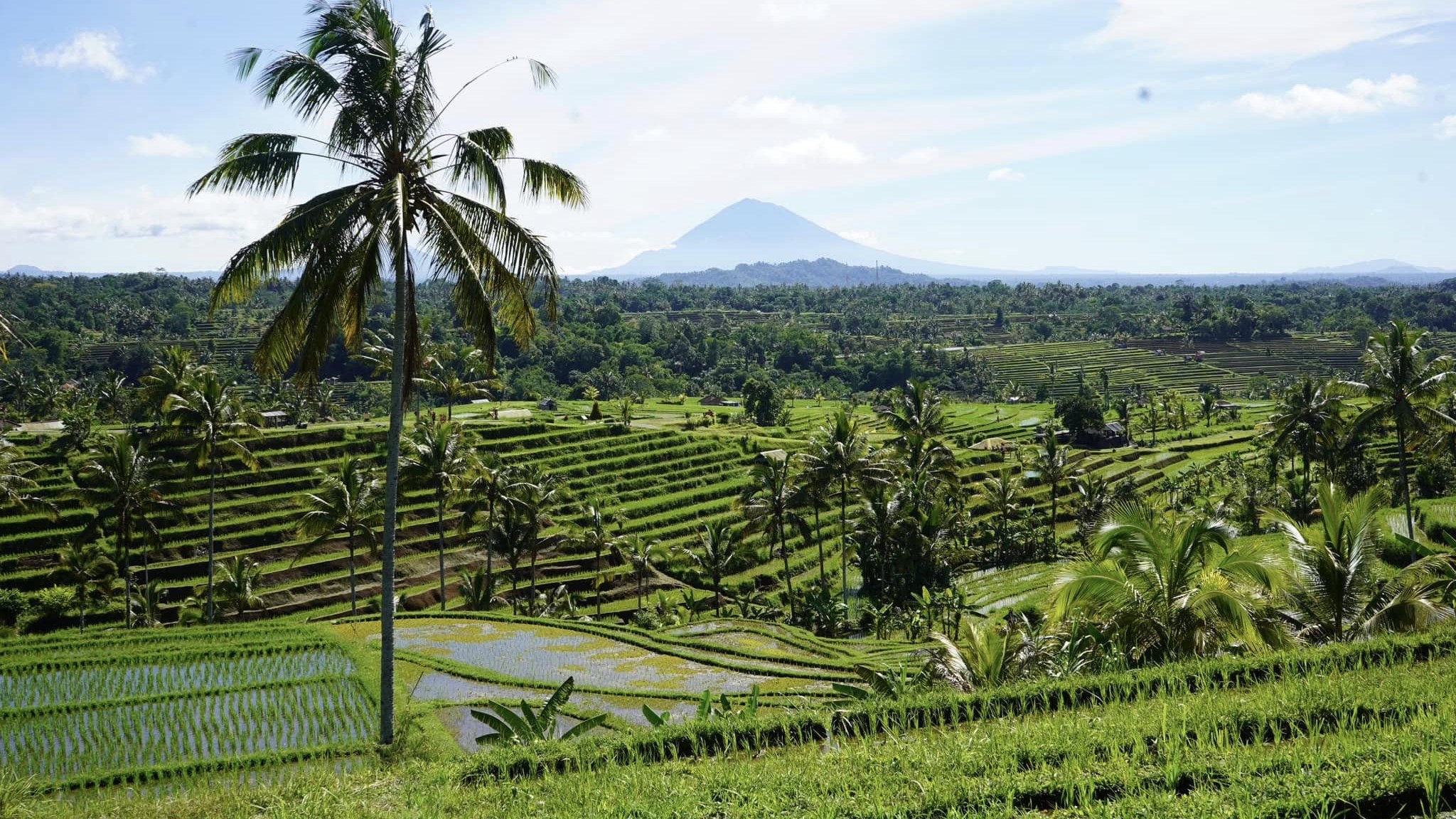
The second was Jatiluwih, where terraces step down the slopes in every shade of green and the paddies hold the sky in their standing water. The farmers we watched, bent double under woven conical hats, are working inside a system that is more than a thousand years old.
Here is how it works. A subak is a cooperative of farmers who share water from a single source, through canals and weirs. Bali has around 1,200 of them, each with somewhere between 50 and 400 farmers. UNESCO dates the system to the 9th century, and in 2012 listed it as a World Heritage cultural landscape, framed around Tri Hita Karana, a Balinese philosophy of harmony between the spirit world, people and nature. Water temple rituals are where that harmony gets scheduled.
The scheduling is the clever part. Rice pests spread from field to field, and fields planted at different times keep them fed. When neighboring farmers plant at the same moment and flood at the same moment, the pests drown. But there is never enough water for every terrace to flood at once, and the upstream farmers always get it first. In 2017, researchers led by the anthropologist Stephen Lansing showed in the journal PNAS that farmers balancing those two pressures, pests on one side and water on the other, arrive at planting patterns that produce close to maximal harvests, with no central planner telling anyone what to do. The patchwork you see from the Jatiluwih road is not random. It is a thousand years of neighbors negotiating, written in rice.
The generational work and cultivated beauty of those terraces was the thing I kept coming back to. Every terrace edge is someone's maintenance. Every flooded paddy is an agreement.
If you go
- Jatiluwih is in Tabanan, in central-west Bali, inside the UNESCO-listed subak landscape. There is an entrance fee for visitors and walking paths along the terraces. Stay on the paths: the terrace walls are working infrastructure, not a viewing platform.
- Pura Ulun Danu Beratan sits on Lake Bratan in the highlands, and the two pair well in one long day. Morning light on the lake is worth the early start.
- Temples expect modest dress. Cover shoulders and knees, and expect to wear a sarong and sash.
- Heaven's gates: if they are on your list, go early and budget the wait. Heaven runs a queue.
- The guineafowl: do not pick it up. Learn from me.
The point of the long way round
So here's to the unexpected moments, the chance encounters, and the pheasants that remind us of the joy (and occasional terror) in the journey. Even when the pheasant turns out to be a guineafowl. Especially then.
It is a thousand years of neighbors negotiating, written in rice.
How does the subak system work?
A subak is a cooperative of farmers who share water from one source through canals and weirs. Bali has about 1,200 of them. Neighbors coordinate planting and flooding through water temples, so pests drown in synchronized floods while scarce water is shared from upstream to downstream.
Is Jatiluwih a UNESCO World Heritage site?
Yes. Jatiluwih lies within the subak landscape listed by UNESCO in 2012 as the Cultural Landscape of Bali Province: the Subak System as a Manifestation of the Tri Hita Karana Philosophy.
What is Pura Ulun Danu Beratan dedicated to?
It is a lake temple on Lake Bratan, used for offerings to Dewi Danu, the goddess of water, lakes and rivers. Lake Bratan is important for irrigation, and subak water temples sit downstream of it.
What is a canang sari?
A small daily offering made from a folded palm-leaf tray filled with flower petals, placed on doorsteps, shrines and streets across Bali.
What is Tri Hita Karana?
A Balinese philosophy of harmony between the spirit world, people and nature. UNESCO describes the subak landscape as its manifestation.
Sources used in reporting this story:
- Cultural Landscape of Bali Province: the Subak System, UNESCO World Heritage Centre, on the subak's age, scale and Tri Hita Karana
- Adaptive self-organization of Bali's ancient rice terraces, Lansing et al., PNAS 2017
- IIASA news release on the PNAS study, 12 June 2017
- Pura Ulun Danu Bratan, BASAbali heritage dictionary, on Dewi Danu and the downstream subak temples
- Field trip to Jatiluwih, Japan National Institute for Environmental Studies
- Helmeted Guineafowl, BirdForum Opus
No links in this story are affiliate links.

Traveled with
Every story carries its receipts. Something out of date? Tell the editor and the "Last updated" line changes when we fix it.



Spot a fact that's off? A name we misspelled? Tell us. It gets fixed within 24 hours.
hello@thatlayover.life →