Brazil was knocked out nine days before the final, and São Paulo still roared. How a country writes the World Cup into its office hours, why the shirt is yellow, and what came next: road trips, açaí and samba on the trails of Ilhabela.
During the 2022 World Cup, Brazil's federal government published match-day working hours for public servants (Portaria 9.763/2022): no office hours for noon games, and early finishes for 1 p.m. and 4 p.m. games, with hours paid back by May 31, 2023. São Paulo state issued a similar decree, and many private employers followed suit. Brazil went out to Croatia on penalties in the quarterfinals, and Argentina beat France in the final on December 18. Ilhabela, an island municipality on São Paulo's north coast reached by a 24-hour state ferry from São Sebastião, is about 85 percent protected by the Parque Estadual de Ilhabela.
The Brazilian government publishes its World Cup office hours in the official gazette, and I did not understand why until I heard a city of twenty million people score at the same time.
The loudest place I have ever watched a game
Watching the 2022 Copa do Mundo from Brazil was akin to a religious experience, and like any religion, it had a dress code. Jay wore yellow. I wore the blue away shirt and green-and-yellow glitter eyeliner, because if you are going to be a convert, be a convert.
We watched Brazil play Switzerland at the iFood Arena Brasileira fan fest in a tropical downpour, in plastic ponchos, under a screen the size of a building. We watched Brazil play Cameroon on a giant outdoor screen at Arena Renaissance, wedged between office towers. We watched the USMNT from a bar, at a long table of Americans in stars and stripes. Different rooms, same religion.
The energy. The camaraderie. The intensity. The music. When the Seleção scored, it did not happen in one room. It happened across the whole city at once: people cheering, dancing, and leaning on their car horns in a single wave that rolled down the avenues and kept going. It is electrifying, and slightly alarming the first time, because you have no idea where it is coming from. It is coming from everywhere.
The country takes the afternoon off, in writing
The reason the whole city reacts at once is that the whole city is watching at once, and that is not an accident. It is policy.
On November 11, 2022, Brazil's Ministry of Economy published Portaria 9.763 in the Diário Oficial da União, setting working hours for federal agencies on Seleção match days. For a game at noon Brasília time, the guidance was no office hours at all. For a 1 p.m. kickoff, the workday ended at 11 a.m. For a 4 p.m. kickoff, it ended at 2 p.m. The rules were technically optional, essential services kept running, and nothing was free: every hour not worked had to be paid back between December 1, 2022 and May 31, 2023, at no more than two extra hours a day.
The state of São Paulo issued its own decree the day before, letting state employees leave at 2 p.m. for 4 p.m. games and at 11 a.m. for the 1 p.m. game. Banks published match-day opening hours. And while the federal rules only cover public servants, private companies tend to borrow them for their own staff, which is how a ministerial memo turns into a whole metropolis clocking out together.
Our Switzerland game was a Monday, kicking off at 1 p.m. Under the federal guidance, that workday ended at 11 a.m., which explains how a fan fest could be full on a Monday lunchtime, in the rain, with nobody calling in sick. So when the ball went in, twenty million people were already sitting down. The horns were basically scheduled.
Why the shirt is yellow
The nickname in my hashtags, Seleção Canarinho, means "little canary," and the yellow behind it is younger than you would think.
Until 1950, Brazil played in white. Then it lost the World Cup final to Uruguay at the Maracanã, at home, and the white shirt took a share of the blame. In 1953 the Rio newspaper Correio da Manhã ran a national contest, backed by the national federation, to design a new kit. The one rule was that it had to use all four colors of the flag. The winner was Aldyr Garcia Schlee, a 19-year-old illustrator from the Uruguayan border who, by most accounts, had a soft spot for Uruguay. His design, a yellow shirt with green trim, blue shorts and white socks, made its World Cup debut in 1954.
Every one of Brazil's five World Cup titles came after the switch. Arguably the most famous uniform in sport was invented to get over a loss, by a fan of the team that caused it.
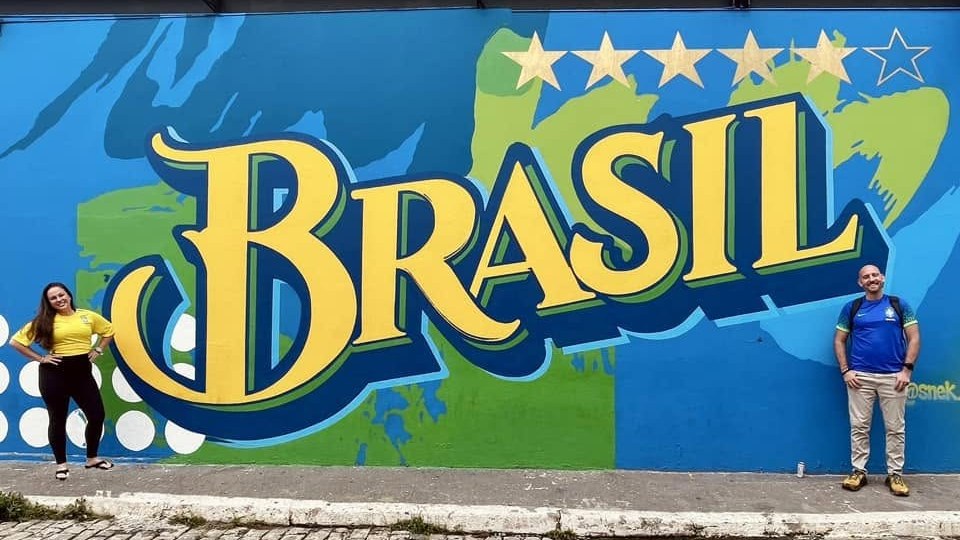
The titles are worn as five stars above the crest, and the city paints them everywhere. We stood under a giant BRASIL mural with five gold stars across the top and a sixth drawn in outline, empty, waiting. The country's word for that sixth title is the hexa, and in 2022 everyone was saving a space for it.
The final, minus the home team
Here is the twist: by the final on December 18, Brazil was already gone. Croatia knocked the Seleção out in the quarterfinals on December 9, on penalties, after a 1-1 draw through extra time.
That left Brazilians with Argentina against France, at noon on a Sunday, and an awkward choice. Argentina is the great rival. Argentina also had Messi, chasing the one trophy he did not have. One survey found about a third of Brazilians called Argentina their second choice, while 60 percent did not want them to win. Argentina won on penalties, and the arguments about whether that was good news went on well past the final whistle.
My own teams were no help. Denmark went out in the group stage. The USMNT went out in the round of 16, to the Netherlands. I had the full set of early exits and watched the final anyway, and it still felt like the whole city was in it together. That is the part I keep: sports can pull people together beautifully even when nobody's own team is on the field. Four years until the next one could not come soon enough.
Jay's tournament shirt summed it up in four words: Cerveja & Bandeira & Batuque & Torcida. Beer, the flag, the drums, and the crowd. That is the whole recipe.
Then we went to the beach
In the weeks after the final, we started spending our weekends getting out of the city. Road trips, açaí bowls, sunsets, and samba music: those were our first weekends exploring the coast of São Paulo state, trekking in the jungle, and doing long runs on trails with music playing.
One of those weekends was Ilhabela. It is an island municipality off the north coast, reached by ferry from São Sebastião, and most of it is not town at all. The Parque Estadual de Ilhabela, created in 1977, protects about 85 percent of the municipality: some 27,000 hectares of Atlantic Forest across twelve islands. That forest is also where all of the island's drinking water comes from. Which explains why a place about 210 km from one of the biggest cities on earth still feels like jungle the moment you leave the coast road.
The beaches face the channel and the mainland mountains, and the sunsets land right on the water. Açaí comes in a plastic cup with sliced banana and crushed peanuts, eaten standing at a beach stall. Somebody has planted a driftwood signpost in the shallows, every board hand-painted: "Água salgada, alma lavada." Salt water, washed soul. A beach bar's sign agreed: "Perto do mar a gente é mais feliz." Near the sea, we're happier. Jay found a life-size breaching humpback sculpture on the waterfront and did his best impression of its fins. Nobody had to explain the island to us twice.
If you go
- Match days in Brazil. Look for the government's match-day hours before you plan anything practical. In 2022, federal offices, the state of São Paulo and the banks all published shortened hours for Seleção games. Expect errands to stop and bars to fill.
- The Ilhabela ferry. The state-run balsa from São Sebastião runs 24 hours a day, roughly every 30 minutes from 5:30 a.m. to 11:30 p.m. and hourly overnight. The crossing itself takes about 20 to 30 minutes. Cyclists ride free, and by most reports so do foot passengers. Cars pay once, on the São Sebastião side, for the round trip.
- The ferry line. On busy days the wait can run to hours (state figures once showed three and a half to five hours at peak). Check the live wait time on the state infrastructure department's site, and book a scheduled crossing if you are driving in high season. Card payment has not been accepted at the ferry ticket booths, so carry cash.
- The island fee. Vehicles entering Ilhabela also pay a municipal environmental preservation fee (TPA), separate from the ferry.
- Bring repellent. Ilhabela is known for borrachudos, tiny biting black flies whose larvae need clean, fast-moving water, which an island full of rivers and waterfalls supplies in bulk. They are most active in the early morning and late afternoon near forest and streams.
- Castelhanos. The wild beaches are on the island's east side, inside the park. The 17 km park road to Castelhanos needs a 4x4 and has controlled entry.
Now accepting visitors
A city of twenty million can rearrange its whole workday around ninety minutes of soccer, and an island a few hours down the road can keep 85 percent of itself as forest. Brazil is very good at deciding what matters and then actually doing it. We missed everyone, and we said so: now accepting visitors.
Different rooms, same religion.
Do Brazilians get time off work to watch the World Cup?
Public servants do, by decree. In 2022 the federal government set no office hours for noon games and early finishes for afternoon games, with the hours made up later. Many private companies follow the same schedule.
Why does Brazil wear yellow?
After losing the 1950 final at home in white, Brazil held a 1953 newspaper contest for a new kit using all four flag colors. Aldyr Garcia Schlee's yellow design debuted at the 1954 World Cup.
Who knocked Brazil out of the 2022 World Cup?
Croatia, on penalties, in the quarterfinals on December 9, 2022.
How do you get to Ilhabela?
By state ferry from São Sebastião. It runs 24 hours a day and the crossing takes about 20 to 30 minutes.
How much of Ilhabela is protected?
About 85 percent of the municipality is inside the Parque Estadual de Ilhabela.

Traveled with
Every story carries its receipts. Something out of date? Tell the editor and the "Last updated" line changes when we fix it.



Spot a fact that's off? A name we misspelled? Tell us. It gets fixed within 24 hours.
hello@thatlayover.life →