A Brazilian holiday for a revolutionary dentist, a childhood World Cup crush, and a wine lodge in Uruguay with exactly two guests.
Nancy Carleton and her husband Jay spent Brazil's Tiradentes long weekend in Uruguay in April 2023. They flew into Montevideo, drove east to a small wine lodge between Garzón and José Ignacio that they had entirely to themselves, and explored Punta del Este, the town where the Río de la Plata officially becomes the Atlantic. The Atlantic is also why Pinot Noir grows in coastal Maldonado: sea breezes and poor granite soils keep the grapes cool and slow.
Nobody in Brazil could tell us how you are supposed to celebrate a revolutionary dentist.
A day off for a dentist
Tiradentes, every April 21, honors Joaquim José da Silva Xavier, a man who pulled teeth (among several other jobs) and helped plot Brazil's first organized break from Portugal. The Portuguese crown hanged him for it in Rio de Janeiro in 1792. "Tiradentes" literally means tooth-puller.
When we asked what people actually do on the holiday, the answer was consistent: enjoy the long weekend.
So we did. In 2023 it landed on a Friday, and Jay and I headed south for a break from São Paulo.
A confession about the World Cup
Long before I was a world traveler, I picked Uruguay in every World Cup. The USA never made it far, and I thought Uruguay had a cute name. That was the entire scouting report.
It turns out I backed a winner by accident. Uruguay, a country of about 3.4 million people, won the very first World Cup at home in 1930, then won again in 1950 by beating Brazil 2-1 at the Maracanã in Rio, the upset Brazilians still call the Maracanazo. Which is an awkward allegiance to carry around when you live in Brazil.
A fact I did not know as a kid: the best World Cup finish the US men have ever managed was a semifinal at that same 1930 tournament. In Uruguay.
The fastest passport control of our lives
We flew into Montevideo, Uruguay's capital, and cleared passport control faster than we ever have anywhere. The rental car was waiting, with no problems. Then we drove east through a beautiful rural landscape that looked like Northern California, or Bend, Oregon, to the Luz Culinary Wine Lodge.
Two guests, one lodge
At check-in we were elated to find out we had the place entirely to ourselves.
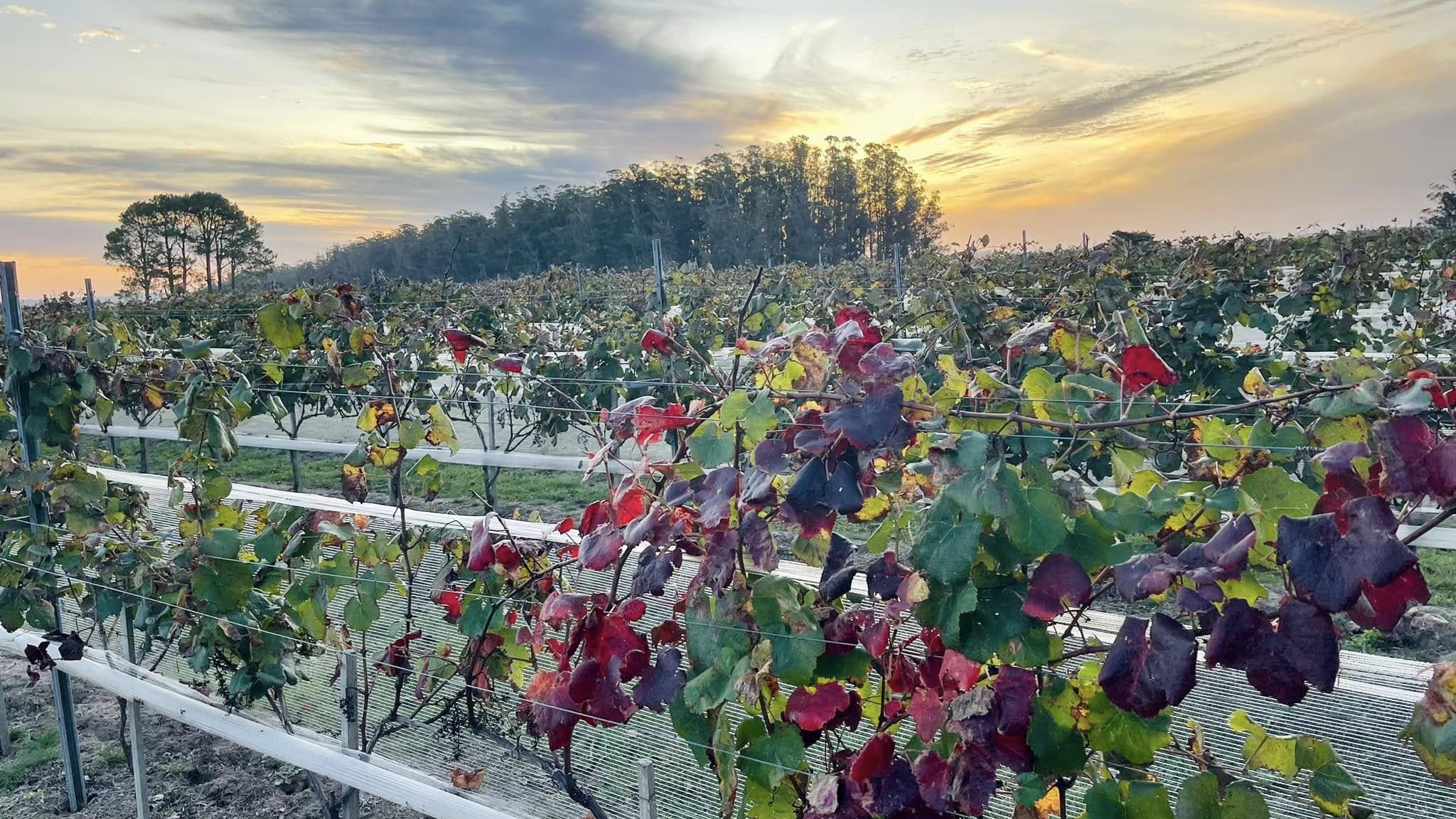
Luz is small, a handful of suites set among vineyards, olive groves and pine forest on the road between Garzón and José Ignacio, and for one long weekend it was ours. Glorious sunsets. Vineyards, or as Jay awkwardly says, "wine yards." Stunningly delicious food. And the Atlantic Ocean, a short drive down the road.
Where the river runs out
The nearby beach town of Punta del Este has a job most towns don't: it is where the Río de la Plata officially stops being a river.
In 1961 Uruguay and Argentina agreed, and in 1973 wrote into a treaty, that the river's outer limit is an imaginary straight line running from Punta del Este across to Punta Rasa, at Cabo San Antonio in Argentina. Behind that line is river. Beyond it is the South Atlantic. You can see the difference on either side of the peninsula: Playa Mansa ("tame") faces the river and stays calm, while Playa Brava ("fierce") takes the open ocean head on. Near the tip, five concrete fingertips stick out of the Brava sand, as if someone is being swallowed by the beach. That is La Mano, the Hand, made in 1982 by the Chilean sculptor Mario Irarrázabal, and it is one of the most photographed things in town. We added to the count.
That same ocean is the reason the "wine yards" around Luz exist at all. Most Uruguayan wine comes from the flat, fertile clay country near Montevideo, and the national grape is Tannat, a dark, heavy, tannic red. Maldonado, the department around Punta del Este, is a newcomer to wine. Its vineyards sit roughly 15 to 20 kilometers from the Atlantic on poor, fast-draining soils of weathered granite. Cool sea breezes take the edge off the summer heat, so the grapes ripen slowly and hold on to their acidity, while the thin soil keeps the vines from overproducing. That is the recipe for fussy, cool-climate grapes like Pinot Noir and Albariño, which Maldonado's winemakers now grow alongside the Tannat.
In other words, the Atlantic is the air conditioning.
Punta del Este
Punta del Este itself was a beach town with eclectic shops, European-inspired architecture, real local charm and ocean views in every direction we looked.
If you go
- Getting in. US passport holders do not need a visa for Uruguay for stays of up to 90 days.
- Getting there. Fly into Montevideo (Carrasco). Luz says it is just under two hours' drive from there, or about 55 minutes from Punta del Este's own airport.
- Driving. We rented a car at the Montevideo airport with zero drama, and it is the easy way to reach a countryside lodge and still get to the coast.
- When. Tiradentes is April 21 every year, so Brazil-based travelers get a long weekend whenever it falls on a Friday or a Monday. Summer, December through February, is peak season in Punta del Este. We went in late April and had a whole lodge to ourselves.
- Where we stayed. Luz Culinary Wine Lodge, between Garzón and José Ignacio in Maldonado. It opened in 2021, has only a handful of suites, and changes its menu daily. It is not a budget stay, so check current rates.
The best-kept secret on the Atlantic
We only know a handful of people who have discovered Uruguay, and we never seem to see an ad for it anywhere. Our working theory is that the locals prefer it that way: a whole country nestled between the Atlantic and open countryside, offering about as perfect a weekend as exists, and in no particular hurry to tell anyone.
Sorry, Uruguay. I'm telling.
Signing off, Old Man Jay and his young, adventure-seeking wife, who drags him along (willingly).
That was the entire scouting report. In other words, the Atlantic is the air conditioning.
Do US citizens need a visa for Uruguay?
No, not for stays of up to 90 days, according to the Embassy of Uruguay in the United States.
Where does the Río de la Plata end?
At an imaginary straight line from Punta del Este, Uruguay, to Punta Rasa at Cabo San Antonio, Argentina. Uruguay and Argentina agreed the line in 1961 and fixed it in the 1973 Treaty of the Río de la Plata.
Does Uruguay make Pinot Noir?
Yes. The coastal Maldonado region, cooled by Atlantic breezes and planted on poor granite soils, grows Pinot Noir and Albariño alongside Uruguay's signature Tannat.
How many World Cups has Uruguay won?
Two: in 1930, as hosts of the first World Cup, and in 1950, beating Brazil 2-1 at the Maracanã in Rio.
What is Tiradentes Day?
A Brazilian national holiday on April 21 honoring Joaquim José da Silva Xavier, nicknamed Tiradentes (tooth-puller), who was hanged in Rio de Janeiro in 1792 for plotting independence from Portugal.

Traveled with
Every story carries its receipts. Something out of date? Tell the editor and the "Last updated" line changes when we fix it.



Spot a fact that's off? A name we misspelled? Tell us. It gets fixed within 24 hours.
hello@thatlayover.life →