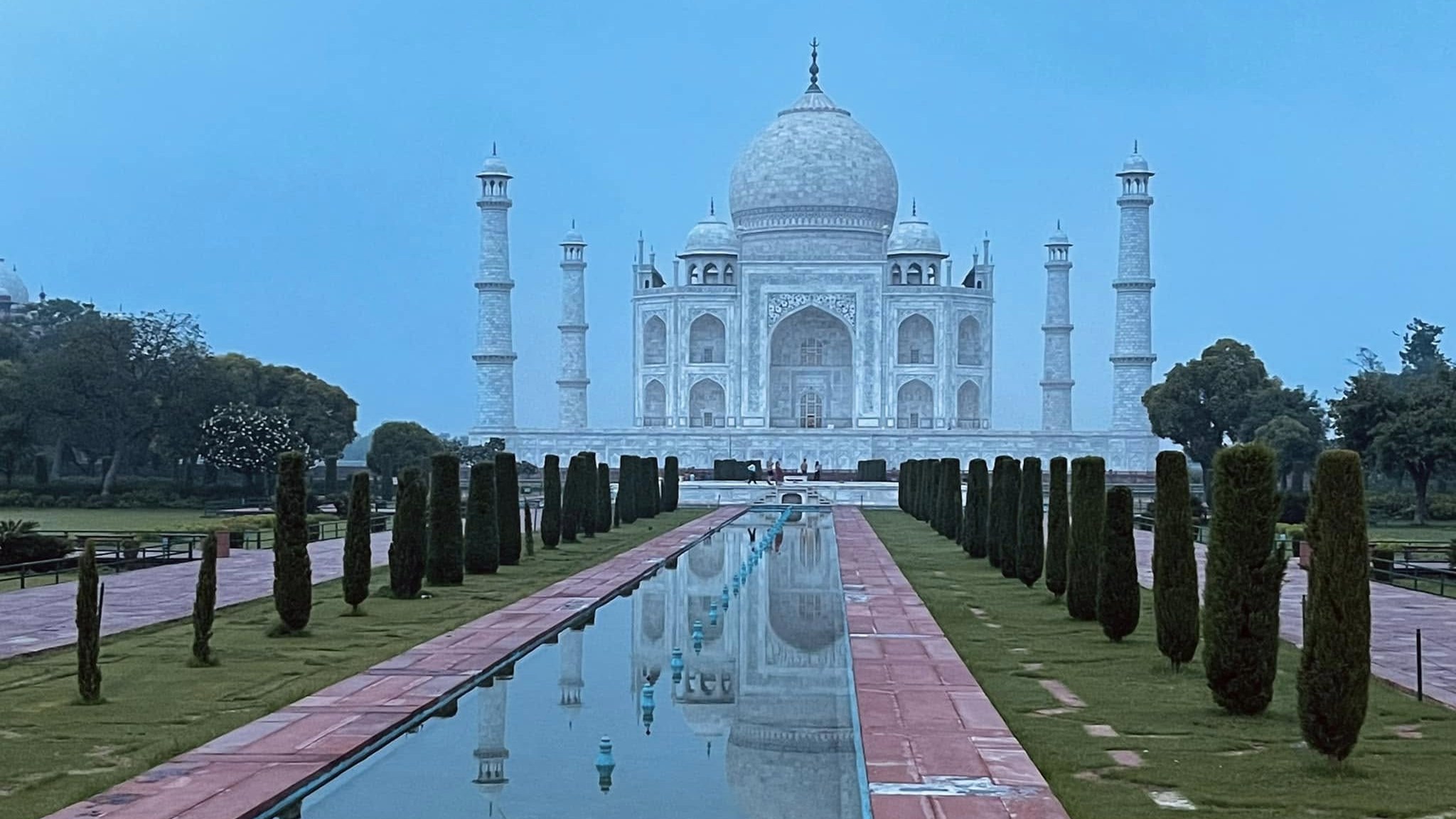
A hotel booked only for its pillows, a sunrise drive to Agra, a Taj Mahal with a complicated love story, and the stone-inlay trick that makes its flowers bloom forever. Plus: so much vegetarian food.
Nancy Carleton and her husband Jay drove to Agra for sunrise at the Taj Mahal in July 2022, on a weekend in India after flying in from Vietnam. The Taj Mahal is the tomb Shah Jahan built for his wife Mumtaz Mahal, who died in 1631; UNESCO dates the mausoleum to 1632 to 1648. Two smaller tombs in its forecourt are traditionally those of two of his other wives. Its stone flowers are pietra dura, or parchin kari: semi-precious stones cut by hand and set into carved white marble, a technique first used on a large Mughal scale at the nearby tomb of Itimad-ud-Daulah, the Baby Taj. Reported first-hand for That Layover Life.
I booked us a hotel room in India so that we could walk in, take the pillows, and leave.
The most confused I have ever seen my husband
We came off our flight from Vietnam and I steered Jay into the lobby of a hotel I had booked. We walked in. We borrowed the pillows and blankets. And then, before he had fully processed any of it, I scurried him back out and into a private car, pointed at Agra, so we could be at the Taj Mahal for sunrise.
That face he made in the lobby is perhaps the most confused I have ever seen my husband. I stand by the plan. The pillows came with us.
Let's be real: there are lots of photos in my phone from our weekend in India, but 99 percent of them are of curry-based foods and of water buffalo in the distance (insert the VeggieTales water buffalo song here), which I attempted to chase, unsuccessfully.
A few highlights made it through.
Come on, man
Did you know the Taj Mahal is a mausoleum? Shah Jahan, the Mughal emperor, built it for his wife Mumtaz Mahal after she died in 1631, giving birth to their fourteenth child. Construction started the next year, and UNESCO dates the main tomb to 1648, with the gateway, mosque, guest house and courtyards finished by 1653.
Come on, man! Cartier. Trips. Flowers. Don't wait until she's gone to make the grand gesture.
It is a pretty building nonetheless. And I owe you a correction, because the joke I had queued up about the other wives turns out to be better than I knew. Mumtaz was not Shah Jahan's only wife, and she was not his first. He married Kandahari Begum before her and Akbarabadi Mahal after her. Court chroniclers went out of their way to record that the other marriages had little more than the status of marriage.
So I had been hoping the other wives were OK with their less elaborate resting places. Here's the twist: two of the emperor's other wives were given tombs inside the Taj Mahal complex. They sit in the forecourt you walk through on the way in, two small red sandstone tombs, each in its own walled garden, built as miniature copies of the big one. Neither carries an inscription naming who is buried there, so the identification rests on tradition. Still. Imagine spending eternity in the lobby of your co-wife's mausoleum.
Watching it from the window
From Agra Fort, a couple of kilometers up the Yamuna, you can see the Taj floating in the haze across the river bend. That view has a story attached. In 1658 Shah Jahan's son Aurangzeb (also Mumtaz's son) took the throne and locked his father up in the fort, where he spent his last eight years. Tradition puts him in the Musamman Burj, an octagonal marble tower with a balcony facing the Taj. He died there in 1666 and was buried next to her.
The fort's current residents were less sentimental. A pair of macaques had claimed the wall by the gate and were not taking questions.
How the flowers stay in bloom
The flowers on the Taj Mahal are not painted. They are stone, set into stone, and that is why they still look the way they did in 1648.
The technique is called pietra dura in Italian, "hard stone," and in Mughal India it became parchin kari, which means roughly "driven in." It was not invented for the Taj. Across the river, the tomb Empress Nur Jahan built for her father between 1622 and 1628 (the "Baby Taj," and yes, more on the peacock in a minute) was the first Mughal building finished in white marble and the first to use this inlay on a large scale. Her father was Mumtaz Mahal's grandfather, so the Taj learned its craft from a family tomb.
Here is how it works. The base is white Makrana marble. A master traces the design, and the outline is carved down into the marble with fine chisels, so each petal and leaf becomes a shallow pocket. Separately, a lapidary slices semi-precious stone (carnelian, lapis lazuli, jasper, agate, malachite) into thin pieces and grinds each one by hand against a spinning abrasive wheel until it matches its pocket exactly. One flower can take a dozen pieces, each a different stone, chosen so the natural grain reads as shading. The pieces are laid into the carved base dry first to check the fit, then set in place one by one, and the whole surface is polished flat. Done well, you cannot feel the seams with a fingertip.
The wheel is the part you can still watch. In Agra I watched a row of artisans sitting cross-legged at long workbenches, each spinning a stone grinding wheel with a bow drawn back and forth like a violin, shaping slivers of stone no bigger than a fingernail, a bowl of water at their elbow. The craft is the same one the Taj was built with, and Agra has never stopped doing it. A seventeenth-century court poet, Kalim, wrote that the Taj's flowers would stay in bloom forever. He was right, because they are rocks.
Where my plant eaters at?
I've been a member of the veggie murder club for 24 years and I have never in my life had so many food options as I did this weekend. Curries, obviously. But also the tasting menu at Indian Accent in New Delhi, a fixture on Asia's 50 Best Restaurants list, which served pani puri as a flight: five puffed shells on a wooden paddle, each balanced over its own little glass of flavored water. A vada pav slider on a skewer. A tiny clay cup of something golden and spiced. A dome of chocolate with fig and cherry, and a scoop of pink sorbet in a pressure cooker the size of a teacup.
We even checked out the Taco Bell menu out of curiosity. Taco Bell India launched in 2010 with half its menu vegetarian, and from where we stood, that share had only gone up. Keep calm and curry on.
Peacocks, and everything else in color
For my Copenhagen crew: you will understand my enthusiasm at finding a peacock perched in front of the Baby Taj. When I lived in Denmark, a baby peacock was born at Tivoli, and I visited it daily. Daily. Tivoli's peacocks wander the paths like they own the place, and its oldest theater raises a peacock-tail curtain, so the obsession had a support system. Then, at the market, I found a hundred-year-old British parchment with a peacock hand-painted on it. India agrees with me, for the record: the peacock has been its national bird since 1963 and is protected under the country's top tier of wildlife law.
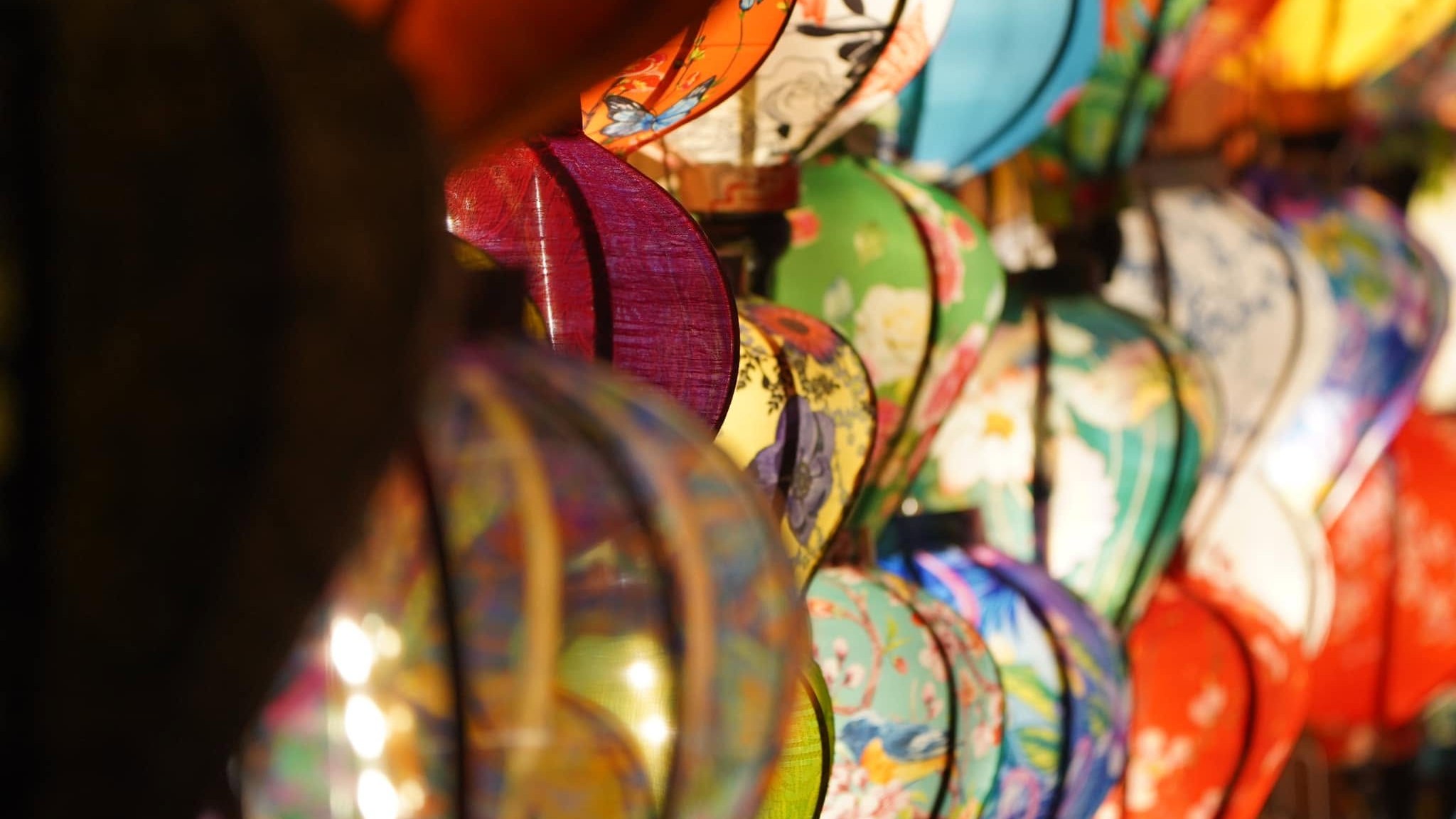
You can't help but get the popular anthems of the region in your head out here: Bollywood, "Awara Hoon," The Jungle Book, Aladdin (geographically questionable, I know), and more. It is inspiring being in such a colorful and vibrant place. A cow strolling down the middle of the road past a sweet shop. A woman and a small boy walking home along the shoulder, each carrying a bundle of fresh-cut grass on their heads, his in a red sack to match his red shirt. A saree shop with fabric stacked to the ceiling, where I let someone wrap me in purple and pink silk and refused to stop twirling.
If you go
- Taj Mahal hours. The gates open 30 minutes before sunrise and close 30 minutes before sunset. It is closed every Friday, when the mosque inside the complex is open only for prayers. Plan around that before you plan anything else.
- Tickets. Foreign visitors pay ₹1,100 to enter, plus ₹200 if you want to go inside the main mausoleum (do it). Buy online on the ASI portal, asi.paygov.org.in, to skip the counter queue, and bring your passport. Fees change; the portal has current rates.
- The other wives. You walk right past their tombs in the forecourt. Look left and right before the great gate.
- Baby Taj (Itimad-ud-Daulah). Across the river, about 4 km from Agra Fort, open every day, ₹310 for foreign visitors, and far quieter than the Taj. Go to see the inlay up close.
- Agra Fort. Go for the view of the Taj across the Yamuna, and keep a hand on your snacks around the macaques.
- Watch the inlay being made. Marble workshops all over Agra demonstrate parchin kari. Expect a showroom at the end of the demonstration.
- Petha. Agra's signature sweet, translucent candied ash gourd. Panchhi Petha has been selling it since 1926.
- Indian Accent. At The Lodhi hotel in New Delhi, with a vegetable-forward tasting menu. Book ahead.
- Eating vegetarian. Look for the green dot on menus and packaging; it marks vegetarian food.
- Getting there. If you are driving from Delhi, budget around four hours by road. For sunrise, that means leaving in the dark. Bring the pillows.
The grand gesture
The Taj Mahal is the most famous love letter in the world, and it was written to someone who could not read it. I am not saying skip the marble. I am saying don't wait. Book the hotel, steal the pillows, and drag the person you love out to see the sunrise while you are both around to be confused about it.
They are stone, set into stone.
Are Shah Jahan's other wives buried at the Taj Mahal?
Two small red sandstone tombs in the Taj Mahal forecourt, known as the Saheli Burj, are traditionally identified as tombs of two of Shah Jahan's other wives. They carry no inscriptions naming who is buried there.
Was Mumtaz Mahal Shah Jahan's third wife?
By wedding date she was his second. He married Kandahari Begum in 1610, Mumtaz Mahal in 1612 and Akbarabadi Mahal in 1617.
What is the Baby Taj?
The tomb of Itimad-ud-Daulah in Agra, built by Empress Nur Jahan for her father between 1622 and 1628. It was the first Mughal building finished entirely in white marble and the first to use pietra dura inlay extensively.
What is pietra dura or parchin kari?
An inlay technique in which semi-precious stones are cut and ground to shape and set into pockets carved in marble, then polished flat. It decorates the Taj Mahal and is still practiced in Agra's workshops.
Is the Taj Mahal open on Fridays?
No. It is closed to general visitors every Friday, when the mosque inside the complex is open only for prayers.
What time does the Taj Mahal open for sunrise?
The gates open 30 minutes before sunrise and close 30 minutes before sunset.
Sources used in reporting this story:
- Taj Mahal, UNESCO World Heritage Centre
- Taj Mahal Complex, Archnet, on the forecourt and the Saheli Burj tombs
- Taj Mahal, Agra district administration, on hours, fees and the Friday closure
- Tomb of Itimad-ud-Daulah, Agra district administration
- Agra Fort, Ministry of Culture, Government of India
- Agra Marble Inlay, Office of the Development Commissioner (Handicrafts), Government of India
- In Perpetual Bloom: Pietra Dura Ornamentation at the Taj Mahal, MAP Academy
- Indian Accent, The World's 50 Best Restaurants
- Yum! Brands opens Taco Bell in India, Baking Business
- Tivoli Gardens, Frommer's
No links in this story are affiliate links.

Traveled with
Every story carries its receipts. Something out of date? Tell the editor and the "Last updated" line changes when we fix it.


Spot a fact that's off? A name we misspelled? Tell us. It gets fixed within 24 hours.
hello@thatlayover.life →