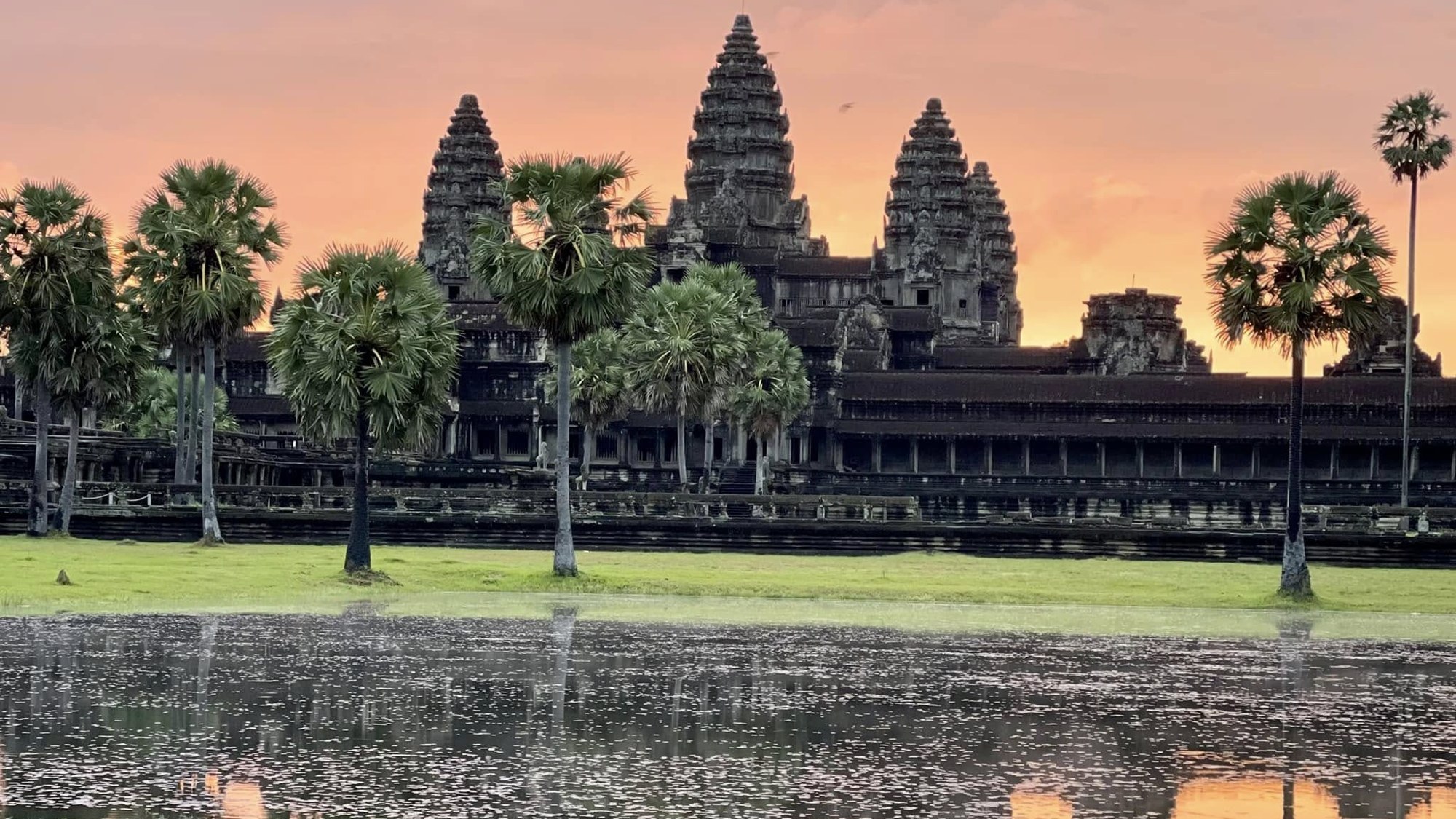
A wedding invitation, a pre-dawn walk through the jungle and a rainstorm at the world's most famous sunrise. Plus why Angkor Wat faces west, and the lake next door that runs backwards every rainy season.
Nancy Carleton visited Angkor Wat in Siem Reap, Cambodia, in August 2022 for a friends' wedding, and walked in before dawn to watch the sunrise in a rainstorm. Unlike most Angkor temples, Angkor Wat faces west, so the sun rises behind its towers. Built by Suryavarman II between about 1113 and 1150 and dedicated to Vishnu, it is aligned so that on the March equinox the sun rises directly over the central tower when seen from the west end of the causeway. Nearby, the Tonle Sap River reverses each wet season, swelling the lake from about 2,500 to as much as 15,000 square kilometers. Reported first-hand for That Layover Life.
The most famous sunrise in the world happens behind a temple that was built facing the wrong way, on purpose.
The most Indiana Jones thing I have ever done
The sunrise at Angkor Wat is often considered the most famous in the world. I did not plan on seeing it the way I did: trekking through the Cambodian jungle before dawn, then entering the temple solo while it was still dark. That was, straight up, the most Indiana Jones thing I have ever done.
Of course, the tourists came. But not before I had a moment alone with the place, time to think about the history of everything around me, with a rainstorm going on outside like white noise.
Why everyone watches the sun come up behind it
Nearly every temple at Angkor faces east, toward the sunrise. Angkor Wat faces west. That one decision is why the famous view works the way it does: the sun comes up behind the temple, and the crowd stands out front on the west side, watching the towers turn into silhouettes.
The king who built it, Suryavarman II, started around 1113, and the work ran to about 1150. He dedicated it to Vishnu, and Guinness World Records lists it as the largest religious structure ever built, enclosing 162.6 hectares. The whole thing is a model of the universe in stone: the five towers stand for the peaks of Mount Meru, home of the gods, and the moat and walls stand for the ocean and the mountain ranges around it.
Why west? Scholars still disagree. West is the direction of the sunset, and of death, so many have concluded Angkor Wat was meant as the king's funerary temple as well as a place of worship. No evidence has ever turned up that he was buried there. Others argue the orientation simply honors Vishnu, a god associated with the west.
Here is the part that gets me. When the art historian Eleanor Mannikka worked through the temple's measurements, she showed that on the March equinox, someone standing at the west end of the causeway sees the sun rise directly over the top of the central tower, roughly 500 meters away. It happens again around the September equinox. The most famous sunrise in the world is not luck. It was designed, nine centuries ago, by people who knew exactly where the sun would be.
Mine came with a rainstorm for a soundtrack, which is one thing the architects did not plan.
Jog the temple complex
And may I say: if you have never jogged the temple complex with your best friend, add that to your bucket list.
There is room. UNESCO puts the Angkor Archaeological Park at some 400 square kilometers, the remains of one Khmer capital after another, built between the 9th and 15th centuries, with forest in between. The stone face towers over the gates watch you go by. In the rain, the road turns into a mirror.
The lake that runs backwards
August is the wet season in Cambodia, which explains the rainstorm. It also explains the boats, the houses on stilts, and the trees standing up to their branches in brown water on the edge of the Tonle Sap.
For most of the year, the Tonle Sap River does what rivers do: it drains the lake south into the Mekong. Then the monsoon arrives, the Mekong swells, and it rises so high that it shoves the Tonle Sap River into reverse. Water that should be leaving the lake pours back into it instead, for months at a time. Researchers measuring the reverse flow found it lasted around 112 days a year in the 2010s.
The lake answers by spreading out. A peer-reviewed study puts it at about 2,500 square kilometers in the dry season and up to 15,000 in the wet, which is why the houses stand on stilts tall enough to look silly in March and sensible in August, and why there is a whole forest out there that spends part of every year underwater. The reversal also carries fish eggs and larvae into the lake, and the Stimson Center describes the Tonle Sap as the largest freshwater fishery in the world.
The reason we were there
We were honored to be invited to Cambodia to celebrate the wedding vows of dear friends. Congratulations, you two. It was lovely to meet some wonderful new humans and share some adventures with them as well.
If you go
- The pass. One Angkor Pass covers the whole archaeological park: US$37 for one day, $62 for three, $72 for seven. Buy it only from Angkor Enterprise, the government body that runs ticketing, at its ticket office or at angkorenterprise.gov.kh.
- Sunrise hours. Angkor Wat opens before dawn for sunrise visitors. Check the current opening time with Angkor Enterprise before you set an alarm, and know that the steep upper level of the temple keeps shorter hours than the rest.
- What to wear. Shoulders and knees covered. The APSARA Authority, which manages the site, has enforced this since 2016, and people in the wrong clothes get sent to change.
- The equinox. If you want the sun on the central tower, aim for the days around the March equinox and stand at the west end of the causeway. September works on paper, but it falls in the rainy season. Ask me how I know about the rain.
- The lake. The Tonle Sap looks completely different depending on when you go. In the wet season the stilt villages sit on the water; in the dry season the same houses stand high above mud. Neither is wrong. Just know which one you are booking.
- Running. If a jog is not enough, the Angkor Wat International Half Marathon runs every December from in front of the temple. It started in 1996 to raise relief for victims of landmines.
The hour before
Angkor Wat was built so the sun would land on it perfectly on two mornings a year. Most visitors get some other morning, plus the tourists, plus the weather. What you get to keep is the hour before all that: the walk in through the dark, the rain, and a twelfth-century temple holding still while you think.
With love from Cambodia!
The most famous sunrise in the world is not luck. It was designed.
Why does Angkor Wat face west?
Scholars disagree. West is associated with sunset and death, which suggests a funerary temple for Suryavarman II, though no burial has been found there. Others link the orientation to Vishnu, a god associated with the west.
When does the sun rise over Angkor Wat's central tower?
Around the March and September equinoxes, seen from the west end of the causeway. September falls in the rainy season, so March is the safer bet for a clear view.
How much is an Angkor Pass?
US$37 for one day, $62 for three days and $72 for seven, sold only by Angkor Enterprise.
What is the Angkor Wat dress code?
Shoulders and knees covered. The APSARA Authority has enforced it since 2016.
Why does the Tonle Sap River flow backwards?
In the wet season the Mekong rises high enough to push the Tonle Sap River into reverse, sending water into the lake for roughly 112 days a year. The lake grows from about 2,500 square kilometers to as much as 15,000.
Sources used in reporting this story:
- Angkor, UNESCO World Heritage Centre, on the park's size and the Khmer capitals
- Largest religious structure, Guinness World Records
- Review of Eleanor Mannikka, Angkor Wat: Time, Space and Kingship, Times Higher Education, on the equinox alignment
- Angkor Wat and Angkor Thom, University of Pittsburgh, on the west orientation and Mount Meru
- Angkor Wat research guide, National Library Board Singapore
- Changes in the Tonle Sap flood pulse, Hydrology and Earth System Sciences, 2022, on reverse flow and lake area
- Mekong Floodpulse, Stimson Center, on the lake's expansion and fishery
- Angkor ticket sales, Phnom Penh Post via The Star, on Angkor Pass prices
- Cambodia says Angkor visitors must dress properly, Associated Press, 2016
- 30th Angkor International Half Marathon, APSARA National Authority
No links in this story are affiliate links.

Traveled with
Every story carries its receipts. Something out of date? Tell the editor and the "Last updated" line changes when we fix it.

Spot a fact that's off? A name we misspelled? Tell us. It gets fixed within 24 hours.
hello@thatlayover.life →