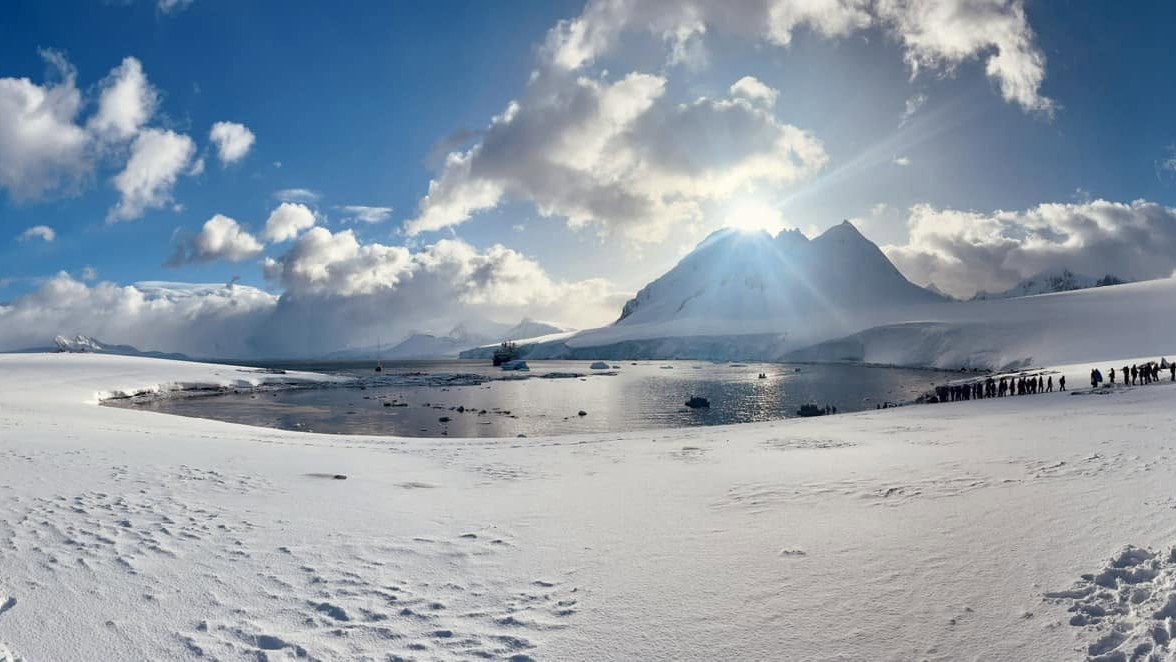
The Antarctica Marathon is a full 42.2km race held each February or March on King George Island, off the Antarctic Peninsula, on gravel roads linking the Russian, Uruguayan, Chilean, and Chinese research bases. It runs as a looped course (ours was six loops), it is self-supported with fuel only where the race provides it, and it has a six-hour cutoff. Entry is by package through Marathon Tours & Travel, roughly $11,000 to $20,300 per person plus a $275 race fee, booked years in advance, with only 100 people allowed ashore at a time. It took us four attempts across four years to reach the start line.
🇦🇶
The Drake Passage crossing was described to us as "gentle." The waves only reached sixty feet.
Take a moment with that. I spent two days horizontal doing the same.
Nobody tells you this, but the running is not the hard part of the Antarctica Marathon. The hard part is showing up at the start line at all. We needed four attempts, four years, a global pandemic, a military quarantine, and one full marathon run inside my own apartment in Copenhagen. By the time my shoes hit that gravel, Antarctica owed me money.
So here it is: the real story, and the answers I wish someone had given me before I signed up.
What the Antarctica Marathon actually is
It is a true 42.2km marathon on King George Island in the South Shetlands, run on rough gravel and dirt roads connecting four research bases: Bellingshausen (Russia), Artigas (Uruguay), Frei (Chile), and Great Wall (China). Marathon Tours & Travel runs it in late February or early March. Because the island is small and the ice is not exactly flexible, it is always a looped course. Ours had six loops, though the number varies by year and weather.
There is also a half marathon (4.5-hour limit) and a 10K (2 hours). The full marathon has a 6-hour cutoff, and most runners take more than 5 hours to finish, which should tell you how tough the course really is.
How do you enter the Antarctica Marathon, and what does it cost?
You do not just sign up. You put your name down years in advance and wait, like a sourdough starter, only with a credit card and considerably more patience.
Marathon Tours & Travel runs it as a package: 13 nights, 3 in Buenos Aires and 10 aboard the ship, with a 35% deposit to hold your place. For 2027, the per-person cost runs roughly $11,000 to $20,300 depending on your cabin, plus a separate $275 race entry. Environmental rules cap the island at 100 people ashore at a time, which is why this thing books out years deep and why they run multiple voyages.
We put our deposit down in 2017 for a 2020 departure. Please hold for plot twists.
The pen incident, 2008
That year I wrote two things on my goals list in pen: Travel the World and Run a Marathon. Pen, not pencil. I was twenty-five, confident, and unaware that stationery could double as a contract.
I ran San Diego. Instead of checking it off, the goal evolved into something far more ambitious and expensive: a marathon on every continent. That is how these things go. The moment you finish, your brain refiles the achievement as a warm-up and starts shopping for the next one.
Enter Jay, dressed as the Anchorman news team
2014, Hood to Coast, my KGW team. Somewhere out on that relay was a fit, hilarious runner whose entire squad was costumed as the cast of Anchorman. You learn a great deal about a man from his commitment to a bit.
We met again in 2015 through our beloved Portland Timbers running club. Sparks did not immediately fly, mostly because I was treating dating as a competitive sport and playing to win. The paths merged anyway. Early on it was clear the continent goal had his attention too, so we pledged to do it together. That is how a personal goal becomes a marriage with a shared spreadsheet.
Four attempts, or: why getting there is the whole story
2017. Joined the 7 Continents Club, put down a deposit, departing 2020. Reader, you already see it.
2019. We got married. Many of our wedding guests put money toward the marathon fund instead of a gravy boat, and we told every one of them the ice would be our honeymoon. Remember that. It gets worse.
March 13, 2020. Copenhagen Airport, bags checked, honeymoon underway. That is where we learned South American airports were holding travelers at the border over a new coronavirus, and that US passport holders could not leave the country. Tour postponed. Honeymoon postponed. Then the large Russian vessel we were meant to sail on became unavailable entirely, and Albatros, being Danish and being heroes, came back offering an icebreaker yacht. I was so delighted that I walked through actual snow to their office carrying a cake, because when I am excited I express it in baked goods, like a Victorian neighbor.
Then Denmark locked down and I ran my marathon inside our apartment. I do not recommend this as a honeymoon. I do not recommend it as an activity.
March 2021. Packed, airport-bound, second year running. Deferment email number two. We were becoming connoisseurs of the deferment email the way other people are about wine.
January 2022. Living in Vietnam, freshly out of four months of military quarantine, which is not a training environment so much as a preservation method. Restrictions eased just enough to catch flights to South America, with strict instructions not to fly with flu-like symptoms. Mine began roughly fifteen hours into the journey, right on brand. Two weeks lost. Boat gone. Friends took us in, handed us medicine, asked no questions.
We got Iguaçu Falls out of it, the finest consolation prize in the Southern Hemisphere. Still not a honeymoon. Still counting.
What is crossing the Drake Passage actually like?
Roughly two days of sailing each way, between Ushuaia and the South Shetlands, across the worst water on the planet.
Ours was gentle. Sixty-foot waves. That is what counts as gentle.
You will hear people say Drake Lake or Drake Shake, and both are true, and you do not get to choose. Some people now fly across to skip it, for a lot more money. I am glad we sailed. The Drake is the toll booth. Paying it is part of the thing.
March 2023. Attempt four.
No expectations, all luggage. Buenos Aires gave us training runs through a city that smells like grilled meat at all hours, a tango show where the dancers did things with their ankles my physical therapist would call a lawsuit, and dinner with the strangers who would shortly become the people we sang with on a boat.
Then Ushuaia. Fin del mundo. The end of the world. We boarded the Ocean Victory under a full rainbow arcing over the harbor, which felt less like weather and more like the universe finally clearing its throat and saying, fine, go.
What is the Antarctica Marathon course like?
Rude. Specifically: rude.
Six loops of frozen gravel between the research bases, with rocks, loose stone, mud puddles, and patches of snow and ice depending on the mood of the day. There are hills. There is wind. Nothing underfoot gives anything back. Marathon Tours calls it very difficult, and that is the organizer talking, not a blogger with sore quads.
It is self-supported in the way that matters: you carry your own bottle, fuel is available only where the race sets it up, and everything you open comes back with you. No wrappers, no trash, boots scrubbed going ashore and coming back, because Antarctica is not a venue. It is a protected place that tolerated us for a morning. There is one porta potty at the finish, and then it is straight back onto the zodiac.
Among us: a man running in a 15kg rhino costume for Save the Rhino, which recontextualizes any complaint you were preparing about your hydration strategy. Costumed penguins. Actual penguins, unbothered, clearly the only professionals present. A Superman. Because the course loops, we passed our own ship friends over and over, cycling through grimace, cheer, grimace, until those became the same face.
The ball to which we were invited
Orcas. Humpbacks. Crabeater and fur seals lounging like they pay rent. Gentoos and chinstraps who stood politely through our renditions of Kiss from a Rose and Ice Ice Baby, which they seemed to enjoy, or at least did not flee. Zodiacs weaving past glaciers and through icebergs the color of pool water. A blizzard and a sunset in the same afternoon. A massage, in the spa, on the boat, in Antarctica. I plan to keep saying that sentence out loud until someone stops me.
What do you call a frozen penguin? A brrrrrr-id. I waited four years to tell that joke on location, and nobody can take it from me.
Then the rest of it, which is the actual point. Friends from the US, New Zealand, Australia, Japan, Scotland, Russia, France, Denmark, the UK, and South Africa. Shared meals, shared coffee, a whiskey poured over ten-thousand-year-old ice, which tastes like whiskey and also like showing off. Dinner cooked on hot stone. Lectures on Antarctic history, wildlife, and knots. Nights of singing and dancing with people who, two weeks before, were just names on a rooming list.
I took my polar plunge directly behind a colony of South African runners in thongs. I did not consent to that view. It is mine forever now.
Is it worth it?
Ten to twenty thousand dollars, four days of open ocean, a six-hour cutoff on gravel, and in our case four separate attempts across four years.
Yes. Obviously yes. Four continents down, three to go, and the penguins finally let us in.
Aspiring Antarctica marathoners might ask
How do you train for the Antarctica Marathon?
Boringly, and then coldly. The base was years of marathons already in the legs, because this is not a first marathon and the six-hour cutoff is not decorative. On top of that came real endurance work, long and slow and unglamorous, and then the specific part: training in the cold on purpose. Running in weather you would normally reschedule around teaches your body how it behaves when it is unhappy, which is the actual skill being tested down there. You cannot simulate Antarctic gravel in Copenhagen, but you can absolutely simulate being wet, cold, and annoyed about it, and that turns out to be most of the job.
What gear do you actually need?
Layers, layers, and one item that saved the entire day: my North 66 kit, which I will recommend until people stop asking. Hokas on the feet, with full credit to my orthopedist, who has opinions about my arches and has been correct every time. The reason layers matter more than any single heroic jacket: our race day started in sunshine and ended in snow. That is not unusual down there, that is Tuesday. Dress for three weathers, carry what you shed, and accept that you will look like a person who packed in the dark. Nobody on that island is judging your outfit. They are judging the wind.
How do nutrition, hydration, and waste work on a self-supported course?
Antarctica has strict anti-pollution rules and you follow them, fully, cheerfully, without negotiating. Everything runs through a wet room and dry room system on the ship. No plastics on the island. Fuel is available only where the race sets it up, so you carry your own bottle and whatever else you want, and everything you open comes back out with you. No wrappers, no crumbs, no exceptions.
The part nobody warns you about is the bathroom math. You spend a genuinely surprising portion of the race thinking about whether you can spit, and what happens if you need to pee, on a continent where the correct answer to both is "not here." Hydrate smart. Plan your morning. This is a protected place, and your body's schedule is not its problem.
Any tips for booking?
Book early, and then book earlier than that. These voyages fill years out because only 100 people are allowed ashore at a time, so the calendar is the actual bottleneck, not your fitness.
Then plan for every possibility, because the thing will move. Ours moved four times across four years, for reasons ranging from a global pandemic to a vessel that stopped existing as an option. The runners who make it are not the luckiest ones, they are the ones who kept pivoting: new dates, new ship, new flights, same goal. Treat the deposit as the start of a long relationship rather than a transaction, and keep your travel insurance and your sense of humor current.
How do you meet the other runners?
Constantly, and with alarming speed. It starts before the ice, with organized events and group training runs through Buenos Aires, which is where you learn who runs your pace and who is going to be funny at kilometer 30. Then you all board the same ship and the Drake does the rest. Two days at sea with no phone signal turns strangers into a small nation. By the time we reached King George Island we had shared meals, lectures, hangovers, and a truly unhinged amount of singing with people from ten countries. You do not have to work at this part. You just have to show up and not be weird about the karaoke.
What goal do you keep going back to, long after the original plan fell apart?
Four attempts. Four years. One apartment marathon. And then, finally, gravel under my shoes, penguins on the course, glacial ice in my glass, and the Antarctic sea on my skin.
How do you enter the Antarctica Marathon?
You book a package through Marathon Tours & Travel with a 35% deposit, usually years ahead. There is no lottery and no walk-up. Environmental rules cap the island at 100 people ashore at once.
How much does the Antarctica Marathon cost?
Roughly $11,000 to $20,300 per person for the 13-night package depending on your cabin, plus a separate $275 race entry.
Where is the Antarctica Marathon run?
King George Island in the South Shetlands, on gravel roads between the Bellingshausen (Russia), Artigas (Uruguay), Frei (Chile), and Great Wall (China) bases.
How hard is the course?
The organizer grades it very difficult. Gravel, rocks, mud, snow patches, hills, wind, a six-hour cutoff, and average finishes over five hours.
How bad is the Drake Passage?
About two days of sailing each way. Ours was called gentle and the waves reached sixty feet. You can now fly instead, for a lot more money.
Is there a half marathon option?
Yes, with a 4.5-hour limit, and a 10K with a 2-hour limit.
How do you train for the Antarctica Marathon?
Years of marathon base first, then endurance volume, then deliberate cold-weather running. The skill being tested is how you function when you are cold, wet, and unhappy.
What should you wear?
Layers above all, because race day can start in sun and end in snow. North 66 kit and Hokas worked for me.
Is the Antarctica Marathon self-supported?
Yes. You carry your own bottle, fuel is available only where the race sets it up, and you pack out everything you open. Strict anti-pollution rules apply, with wet room and dry room protocols on the ship and no plastics ashore.
Spot a fact that's off? A name we misspelled? Tell us. It gets fixed within 24 hours.
hello@thatlayover.life →