Jay turned forty, which by my count is four hundred, so eight of his friends came to Croatia to help him carry it: the waterfalls of Plitvice, a villa in Split with a chef, a coronation of our own, a baklava break in Bosnia, and a final lap of King's Landing.
Nancy Carleton spent a week in Croatia in May 2023 for her husband Jay's fortieth birthday (9 May), with eight friends: Zagreb, Rastoke, Plitvice Lakes and Krka, a villa in Split, a speedboat day to the Blue Cave on Biševo and Komiža on Vis, a detour to Mostar in Bosnia and Herzegovina, and Dubrovnik. Plitvice's lakes exist because of tufa: calcium carbonate in the water crystallizes onto moss, algae and bacteria and builds natural dams that still grow, on average a little over a centimeter a year. About 400 years ago one barrier outgrew another and drowned a waterfall roughly 40 meters high inside Kozjak lake. Swimming is banned at Plitvice and, since 2021, at Krka's Skradinski buk.
How do you celebrate a man who has just turned four hundred?
Happy birthday, old man
You start by telling him, in every language you have. Happy birthday to my favorite husband on this big ol' rock. May the prunes be in total supply as you celebrate. I love you. Te amo, velho. Jeg elsker dig, min gamle mand.
(That is "old man" in Portuguese and then in Danish, in case he missed it the first two times.)
Then you put him on an Adriatic coast with eight of his friends and let the week do the rest.
A whirlwind of reasons
Jay leveling up to numbers of significance (forty, if you are counting, four hundred if you are me) was not even the only thing to celebrate that week. Two of the most brilliant people we know, Allen and Drew, had their civil union just before the trip, and it was an absolute joy and privilege to celebrate with them, giant red LOVE balloons and all. Then came the birthday of one of my dearest friends, Tori (another Taurus, like the birthday boy), which had us all feeling grateful for her adventurous spirit.
A civil union, two birthdays and a man of four centuries. We were going to need a country.
Zagreb, Plitvice, and a lodge in the woods
Eight of Jay's friends joined us in Croatia. We started inland, in Zagreb, then headed south into the hills. On the way we stopped in Rastoke, at the edge of the town of Slunj, where the Slunjčica river spills into the Korana in a tangle of little waterfalls and the old water mills sit right on top of them, like someone built a village first and then turned on the taps. Then on to Plitvice Lakes, where we ate some of the most delicious local food of the whole trip (lamb and potatoes heaped in a clay dish, red wine by the bottle), met some farm animals (a shaggy ewe with a lamb glued to her flank, and one black cat who supervised us from a wooden step), and stayed in a charming rustic lodge.
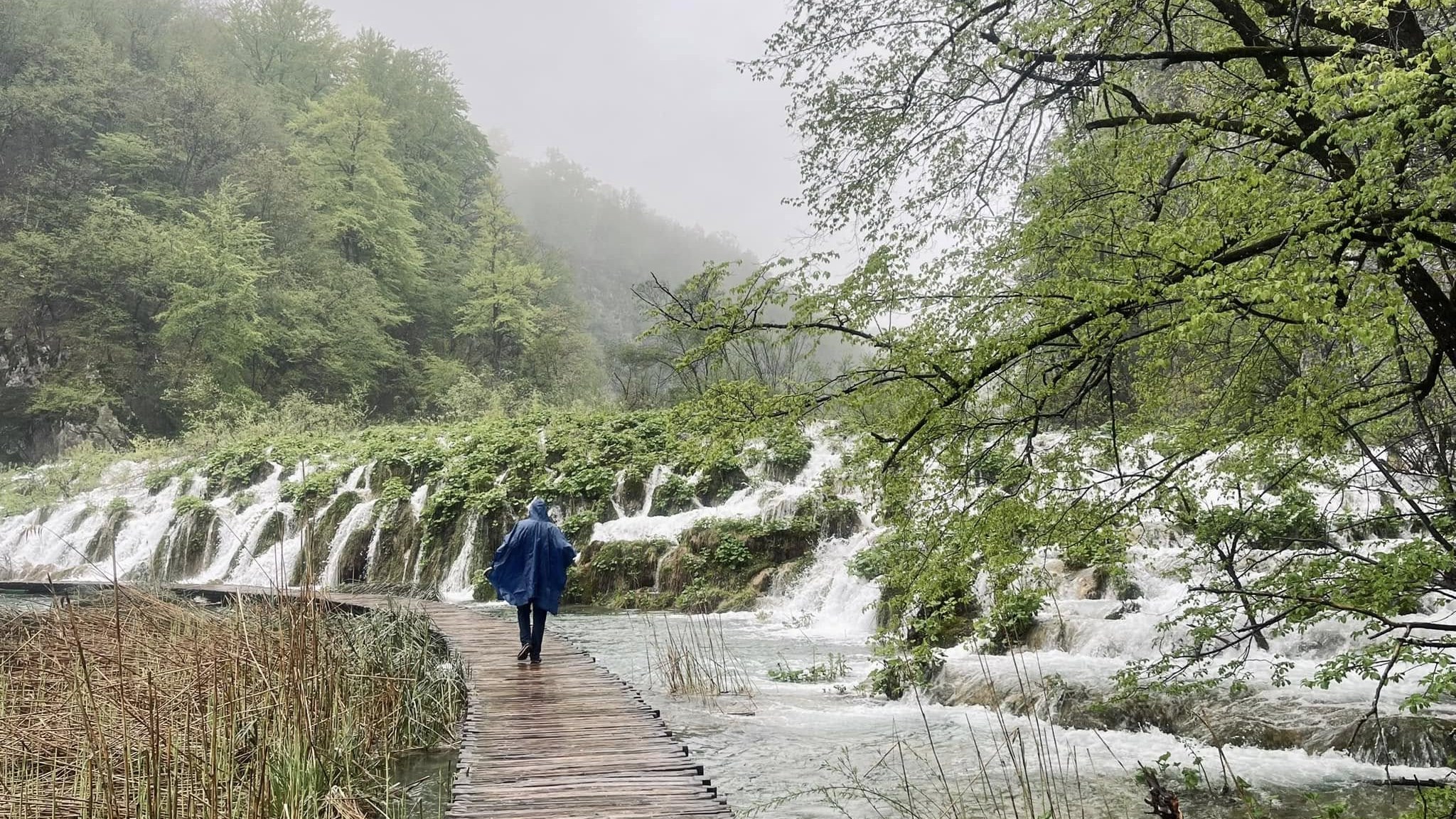
It rained. It rained the way it only rains on the day you booked the national park. We went anyway, in ponchos where we had them, out along wooden boardwalks laid right across the water, with the falls running white and loud beside us. The days went in and out of waterfall sightings: walk, waterfall, walk, bigger waterfall, lodge, repeat.
Why the waterfalls never sit still
Here is the thing about Plitvice that I did not understand until I looked it up afterward: the waterfalls are alive. Not in a poetic sense. They are being built, right now, by moss.
The water running off the surrounding karst is loaded with dissolved calcium carbonate. Every time it tumbles over a ledge, it splashes, loses carbon dioxide, and drops tiny crystals of calcite. On their own those crystals would wash away. But the rock and the moss are coated in a film of algae and bacteria, and the crystals stick to it. More crystals stick to those. The moss keeps growing upward, its lower half turns to stone, and the stone becomes a dam. The park's most common builder is a moss called Palustriella commutata, which petrifies so fast that you can still see the shape of the moss in the rock.
That porous stone is called tufa, or travertine, and it is the whole reason the lakes exist. The 16 named lakes are a river valley that has been dammed, over and over, by its own water. The barriers you walk past today are an estimated 6,000 to 7,000 years old, which makes them younger than the Ice Age they started growing after.
And they are still growing. On average the barriers rise by a little over a centimeter a year, but each one keeps its own pace: the barrier at the outlet of Kozjak, the largest lake, grows about 5.6 millimeters a year, while the one at Prošćansko, at the top of the system, grows roughly three times faster. When a downstream barrier outgrows the one above it, the lake rises and swallows the upstream waterfall whole.
Which is exactly what happened in Kozjak. About four hundred years ago it was two lakes, split by a tufa barrier and a waterfall roughly 40 meters high. The barrier at the lake's outlet grew faster, the water crept up, and the waterfall drowned. It is still down there, submerged, a 40-meter waterfall that the lake simply outgrew.
The catch is that the whole system only works under fussy conditions: very alkaline water, oversaturated with carbonate, and almost no dissolved organic matter. Pollute it, dry it out, or break it, and the building stops. Tufa is fragile enough that a falling tree or spring ice can snap a barrier, which is why the park asks you to stay on the boardwalks and keep your feet, and the rest of you, out of the water.
We got a second helping of the same chemistry at Krka, the other great travertine river, nearer the coast: the same wide curtains of falls, the same impossibly clear pools, the same moss quietly turning into rock. Krka used to let people swim below its most famous falls, Skradinski buk. Since 2021 it doesn't, and the park gives the same reason Plitvice does: the travertine comes first.
Split: a villa, a chef, and a coronation
From the lakes we went to the coast and shared a stunning villa in Split with a fantastic chef, who cooked some of the best Dalmatian food we have ever had. The risotto was a hit, and Jay loved every meat dish that came out of that kitchen. There was a pool, a lavender hedge that caught the last of the sun, and one long table where the whole crew raised a glass at once.
There was a speed boat tour of the local sights: out past bare white islands to the Blue Cave on Biševo, where the water inside glows an electric blue, and on to Komiža, a little stone harbor town on Vis where the water was so clear the boats looked like they were floating on air. And swimming in crystal clear water, obviously.
The Blue Cave, for the record, was not built for tourists. Its usable entrance was enlarged in the 1880s, at the suggestion of Baron Eugene von Ransonnet, who described and painted it in 1884, so that boats could get in. Every glowing selfie since owes him one.
And because King Charles was crowned that weekend, on 6 May 2023, we crowned each other too, like the kings and queens we are. Gold plastic crowns. Tiaras. T-shirts with slogans, including one that said SHAME. and one that said TO REMIND YOU OF MY LOVE. At least one of us honored the British monarchy in an American-flag romper with a bald eagle on the front. Nobody anointed anyone. It was heir-larious anyway.
Mostar, with Tori
Just when we thought it could not get any better, Tori and I escaped across the border to Mostar, in Bosnia and Herzegovina, for mouth-watering baklava and off-road adventures that will stay with us forever. The baklava came in a paper box: little pastry nests filled with chocolate and topped with a hazelnut, squares stained purple and showered with pistachio, and a jelly-filled roll that was more stained-glass window than dessert.
Mostar is the town of the Old Bridge, a single stone arch over the Neretva river finished in 1566. It was shelled into the river on 9 November 1993, during the war, and rebuilt by 2004 with stone from the same local quarry, using the same sixteenth-century methods. UNESCO listed it in 2005. It is a bridge, and it is also proof that some things can be put back.
Dubrovnik, or King's Landing
We wrapped up in Dubrovnik, with great laughs and Game of Thrones-inspired tours. The city's walls, its harbor and Fort Lovrijenac stood in for King's Landing in the series, which made it the second royal capital of the week. It is also the city where the show filmed its most famous walk of shame, which finally explains the T-shirt. Two coronations in one trip is a lot, even for a man of four hundred.
Jay's actual birthday, the 9th, fell in Dubrovnik, inside city walls older than he is, even by my count.
If you go
- Plitvice tickets: buy them online from the park's official webshop. Each ticket is tied to the entrance you choose and a time window, and you validate it at that entrance. You can still buy on site if tickets remain, but expect a wait in high season.
- Pick your entrance: Entrance 1 is by the Lower Lakes, Entrance 2 by the Upper Lakes. There are bus stops at both, and free luggage storage at both.
- Distances: about 140 km from Zagreb and about 219 km from Split, by the park network's figures, so it works as a stop between the two.
- The rules are strict, for a reason: no swimming anywhere in the lakes, no leaving the marked paths, no drones, no feeding the animals, dogs on a leash. Everything above about tufa is why.
- Rastoke is on the road between Zagreb and Plitvice, at the entrance to Slunj, so it makes an easy stop on the way down.
- Krka: no swimming at Skradinski buk since 2021. Bring the same boardwalk manners you learned at Plitvice.
- The Blue Cave on Biševo: go in the morning. The Split tourist board puts the best light between about 9 and 1, depending on the season.
- Mostar makes a cross-border detour from the Dalmatian coast. Bring your passport: Bosnia and Herzegovina is outside the EU, so expect a real border check.
- Dubrovnik: the King's Landing sites (the walls, Fort Lovrijenac, the old harbor) are all in or just outside the Old Town, so you can walk most of them yourself or join a guided tour.
Four hundred
Plitvice builds its waterfalls out of whatever sticks. A little calcite, a little moss, a few millimeters a year, and given enough time you get a dam that can hold back a lake. That is not a bad description of a good life, either: the people who show up, and keep showing up, and hold on.
Life is wonderful, and weeks like this one remind us why we have to be grateful. Here's to more celebrations and more memories with the people we love. Happy four hundredth, velho.
Plitvice builds its waterfalls out of whatever sticks.
How are the Plitvice Lakes formed?
Water rich in dissolved calcium carbonate drops calcite crystals as it splashes over ledges. The crystals stick to algae, bacteria and moss, which petrify into porous tufa barriers that dam the valley into 16 named lakes.
Are the Plitvice waterfalls still growing?
Yes. The park measures barrier growth at about 13.5 mm a year on average, with big differences between barriers, so the lakes keep rising and the falls keep changing.
Can you swim at Plitvice Lakes?
No. Swimming is prohibited throughout the national park.
Can you swim at Krka National Park?
Not at Skradinski buk. The park ended swimming there on 1 January 2021 to protect the travertine.
Do you need to book Plitvice tickets in advance?
It is strongly recommended. Tickets are sold on the park's official webshop for a specific entrance and time window.
Which Plitvice entrance should I use?
Entrance 1 for the Lower Lakes, Entrance 2 for the Upper Lakes.
Where is Rastoke?
At the entrance to Slunj, where the Slunjčica flows into the Korana, on the way from Zagreb to Plitvice.
When is the best time to visit the Blue Cave on Biševo?
Morning. The Split tourist board puts the best light between about 9 a.m. and 1 p.m., depending on the season.
When was Mostar's Old Bridge rebuilt?
The original 1566 bridge was destroyed on 9 November 1993. The rebuilt bridge, made with stone from the same local quarry and sixteenth-century methods, reopened in July 2004 and was inscribed on the UNESCO World Heritage List in 2005.
Where was King's Landing filmed?
In Dubrovnik's Old Town, including its city walls, the old harbor and Fort Lovrijenac.
Sources used in reporting this story:
- Tufa: creator of waterfalls and lakes, Plitvice Lakes National Park
- Rules of conduct, Plitvice Lakes National Park
- FAQ, Plitvice Lakes National Park
- Plitvice Lakes National Park, UNESCO World Heritage Centre
- National Park Plitvička jezera, Parks Dinarides
- Swimming ban announced at Krka National Park, Croatia Week
- Blue Cave, Biševo, Split Tourist Board
- Rastoke in spring, Turističke priče
- The Mostar Bridge, UNESCO World Heritage Centre
- Mostar marks 27 years since its Old Bridge was destroyed, N1
- The City Walls, Society of Friends of Dubrovnik Antiquities
- The Coronation of His Majesty The King, royal.uk
- Fans can get close to world of Game of Thrones, dpa
No links in this story are affiliate links.

Traveled with
Every story carries its receipts. Something out of date? Tell the editor and the "Last updated" line changes when we fix it.


Spot a fact that's off? A name we misspelled? Tell us. It lands on the editor's desk.
hello@thatlayover.life →