Someone was awake before us every morning, making the coffee. That, more than the summit, is what I brought down the mountain.
Nancy Carleton and her husband Jay climbed Mount Kilimanjaro by the Lemosho Route over eight days in August 2025, reaching Uhuru Peak at 5,895 meters, with Much Better Adventures and the Tanzanian operator Ahsante Tours. Their group was nine hikers supported by twenty-eight crew, a ratio she argues is the real and under-told story of the mountain: the Kilimanjaro Porters Assistance Project sets standards of a 20 kilogram maximum load per porter excluding his own kit, three meals a day, proper shelter and gear, and payment of at least the Tanzanian minimum wage within two days of descent. At the summit she found the glaciers more striking than the famous sign, and a 2022 UNESCO and IUCN report finds that Kilimanjaro's glaciers, along with those at every African World Heritage site, will very likely be gone by 2050. Reported first-hand for That Layover Life.
Most mornings began the same way: cold toes, frosted breath, and a warm aluminum cup of Tanzanian coffee delivered quietly to the tent.
It was simple. It was sacred. And it meant that before we had unzipped anything, before we had locked eyes with the beautiful beast that is Kilimanjaro, someone else had already been awake for an hour making it.
That is the part I keep coming back to. Not the summit. The coffee.
We did not conquer anything
Eight days on the Lemosho Route with Much Better Adventures and the team from Ahsante Tours. Nine hikers. Twenty-eight crew.
Sit with that ratio for a second, because it is the real story of this mountain and almost nobody tells it. For every one of us walking up with a daypack, there were three people carrying the tents, the food, the water, the kitchen, and the toilets, moving faster than us, usually past us, often singing.
There is an organization called the Kilimanjaro Porters Assistance Project that exists because this ratio has historically been easy to abuse. Their standard is that a porter's load should not exceed 20 kilograms on top of his own kit, that he should get three adequate meals a day, proper shelter and sleeping gear, and care if he gets sick or hurt, and that he should be paid at least the Tanzanian minimum wage within two days of coming down. None of that is exotic. All of it has to be said out loud, which tells you something.
So if you go: ask your operator where they stand on this before you book, not after. Ask how many crew, ask what the tipping procedure is, and ask for it in writing. We did not conquer the mountain. We were carried up it by people who were very good at their jobs, and the least you can do is know their terms of employment.
Team Sexy Awesome
Nine of us. Five Americans, three Brits, and one beloved Tanzanian teammate named Melvin, going for his first summit.
We named ourselves Team Sexy Awesome. Obviously.
Alan, king of washy-washy, boisterous and affectionate, lit up the mess tent and the trail. A quiet Alan was a cause for concern. We called him The Honey Badger, because he took on the rules the way one does, which is to say not at all. Fittingly, Jay and I later saw an actual honey badger on our post-trek safari.
Nicole, full of warmth and wisdom, brought the quiet can-do calm, and grounded Alan in the best possible way.
Tom, also known as The Count, counted out loud at random with deep commitment. For science? For vibes? Never established. He could also be heard singing in the loo and recounting vivid dreams about washing his car.
Sarah, a doctor, dispensed mountain medical advice with the authority of a saint. But it was the Mars Bar that told you that you had made the inner circle.
Charlotte is living in Tanzania teaching business for a while. She led our stretchy-stretchy routines with Cha Cha Slide energy and was rumored to be sitting on a private supply of the good peanut butter.
Emily introduced us to the hot water Nalgene trick, which Jay had fully stolen by the last day. She also brought the most nostalgic playlist in existence for the long cold hours, and won the local team over with Jolly Ranchers.
Melvin was the youngest and the bougiest of us, and would switch into Swahili when he wanted extra pampering from the crew. We were on to him. Summit day was the first time he had ever seen snow, and the first time he learned what it actually does to your hands.
And us. Jay crab-walked into the tent more than once. I apparently muttered "gross" while sleep-snuggling, our first camping trip as a couple, which means the unshowered stench made it all the way into my dreams.
The numbers
- Days on trail: 8
- Highest point: 5,895 meters
- Flush toilet tents: 2
- Number of Kevins in our group: 0, though we were assured he existed
- Uno games lost to the crew: painful
How it actually went
Day 1. Moshi. Kilimanjaro beer. Fruit markets, and an avocado I still think about. Coffee tastings. Happy birthday, Alan.
Day 2. We sing into the forest. No cell service. We chase skunky monkeys. We are the playlist.
Days 3 to 5. Clear the tree line. WiFi at Lizard Rock, of all places, and porters scrolling on their phones in the sun with an ocean of cloud behind them. Across the Shira Plateau. Up through Lava Tower and into the altitude-induced silence.
Day 6. The Barranco Wall. Made out with the Kissing Rock. Braved what we named Kama Sutra Pass, and no, don't ask.
Day 7. Rest, pack, hydrate. Watch Jay enter the tent like a man who lost a fight with gravity. Early night, warmed by drinking chocolate.
Summit night
Cold. Quiet. A very long think, broken only by the crew's chants of "more fire, more water" as we climbed into the sky.
We reached Uhuru Peak at a bright orange sunrise. My fingers were ice. The view was worth every one of them.
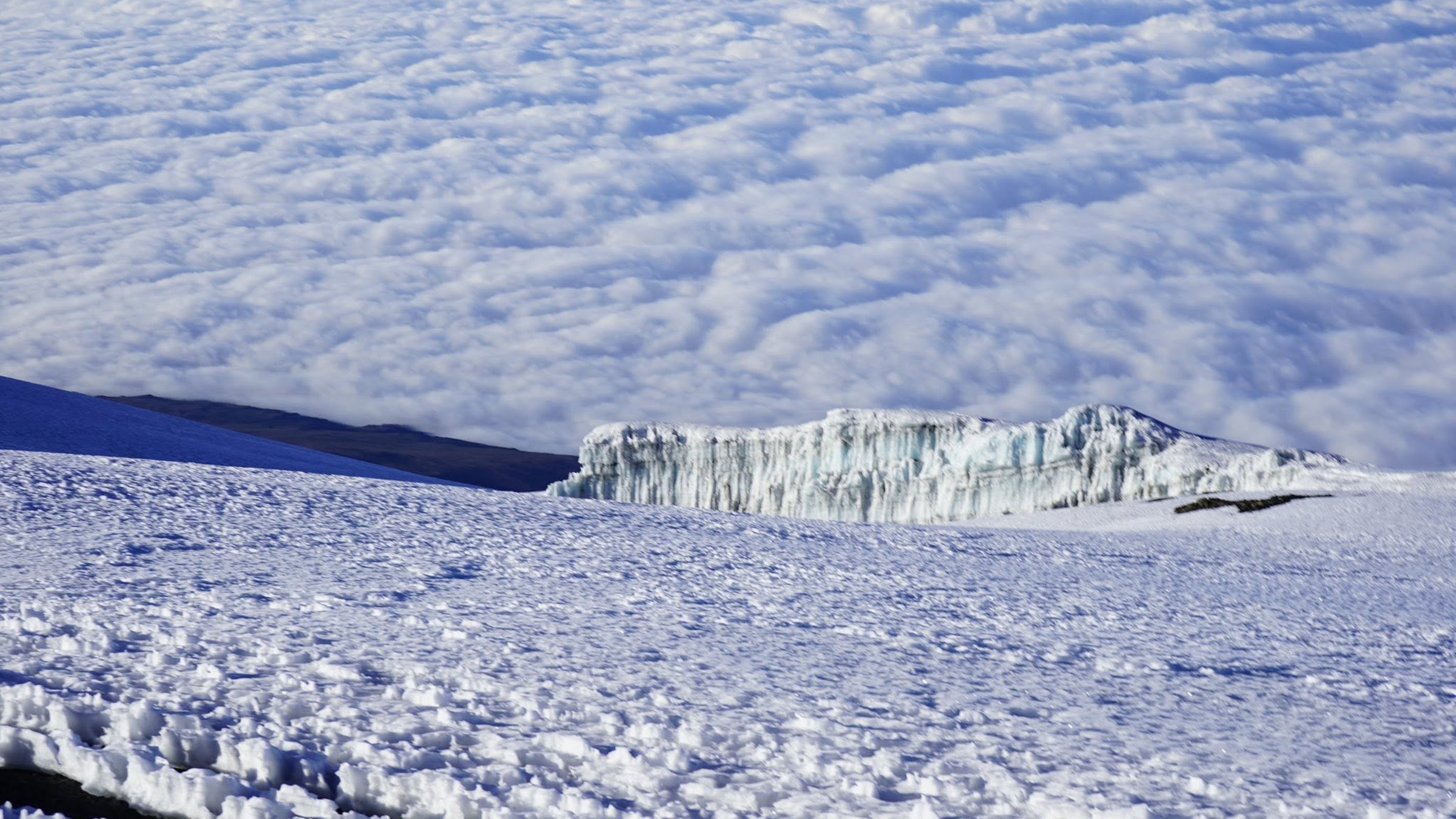
And here is the thing nobody photographs properly. That sign, the wide-angle one in every advertisement in town, is cute. It is not the story. The story is up and to the left: glassy, jagged, silent fields of ice, sharp shelves of it standing in the open like walls, and a crater view that does not fit in a frame.
Look at them while you can. In November 2022 UNESCO and the IUCN published a report finding that glaciers in a third of the fifty World Heritage sites that have them will disappear by 2050 no matter what anyone does now. Every glacier in an African World Heritage site is on that list. Kilimanjaro is on that list.
The ice I stood next to at sunrise is scheduled to be gone within my lifetime, and the sign at the top will still be there, and the photographs in the shop windows in Moshi will still show the white summit, and that is a strange thing to carry down a mountain.
We hugged. We scree-skied back down the gravel with legs like overcooked spaghetti. We were rewarded with chairs and Tang, which at that moment was the finest beverage ever devised.
Coming down
On the last day Melvin sprinted through the jungle in a neon poncho like a SpongeBob-quoting starfish.
We skipped through puddles and ferns and rain. The trail started to feel like home: moss, mud, and the sound of water.
That night we watched acrobats limbo under fire. A contortionist nearly gave Sarah a full panic attack, and we learned she is considerably more afraid of spider-shaped humans than of actual spiders. We swam. We toasted. We ate. We slept like bricks.
To the people who made it possible
To Musa, The Professor, and Eddie: asante. You led with humor and knowledge and care. You sang, you coached, and you held the mountain steady for us.
To the twenty-eight: you showed up for us before we knew what we needed. You cleaned our boots, brought popcorn, hauled the tents, and cheered every single step.
Next time: more socks, fewer clothes, face masks for a tent-side spa night, and considerably more Mars Bars.
This was not just a trek. It was trust. It was laughter at altitude. It was holding each other up through desert and steep walls and sleep-muttered snuggles.
To anyone dreaming about this mountain: say yes. You will come home changed. That is the whole point.
And someone will already be awake, making your coffee. Learn his name.
P.S. Narwhal!
We did not conquer the mountain. We were carried up it by people who were very good at their jobs.
How long does the Lemosho Route take?
This trek was eight days on the trail, summiting at Uhuru Peak, 5,895 meters. Lemosho approaches from the west and crosses the Shira Plateau, which gives more time to acclimatize than the shorter routes.
How many porters and crew does a Kilimanjaro climb use?
On this trip, nine hikers were supported by twenty-eight crew, roughly three crew per client. That is normal. The crew carry tents, food, water, the kitchen and the toilets, and typically move faster than the clients.
What are the standards for porter treatment on Kilimanjaro?
The Kilimanjaro Porters Assistance Project sets out that a porter's load for the company should not exceed 20 kilograms on top of his own kit, that he should receive three adequate meals a day, proper shelter, sleeping equipment and gear, care if sick or injured, and at least the Tanzanian minimum wage paid within two days of descent. They also advise asking your operator for the crew count and the tipping procedure in advance, to avoid extra people appearing at the tipping ceremony to claim a share.
Are the glaciers on Kilimanjaro disappearing?
Yes. In November 2022 UNESCO and the IUCN published World Heritage Glaciers: Sentinels of Climate Change, which found that glaciers at a third of the fifty World Heritage sites that have them will disappear by 2050 regardless of emissions action, and that glaciers at every African World Heritage site, Kilimanjaro National Park included, will very likely be gone by then.
How high is Uhuru Peak?
5,895 meters above sea level, which is the figure on the summit sign and the standard published height. It is the highest point in Africa.
Operators on this trip: Much Better Adventures, with the Tanzanian ground team from Ahsante Tours.
Sources used in reporting this story:
- UNESCO finds that some iconic World Heritage glaciers will disappear by 2050, UNESCO World Heritage Centre, 3 November 2022, on the report with the IUCN and the African World Heritage glaciers
- Porter Treatment and Tipping Guidelines, Kilimanjaro Porters Assistance Project, on load limits, wages, payment timing and tipping practice
No links in this story are affiliate links.

Traveled with
Every story carries its receipts. Something out of date? Tell the editor and the "Last updated" line changes when we fix it.

Spot a fact that's off? A name we misspelled? Tell us. It gets fixed within 24 hours.
hello@thatlayover.life →