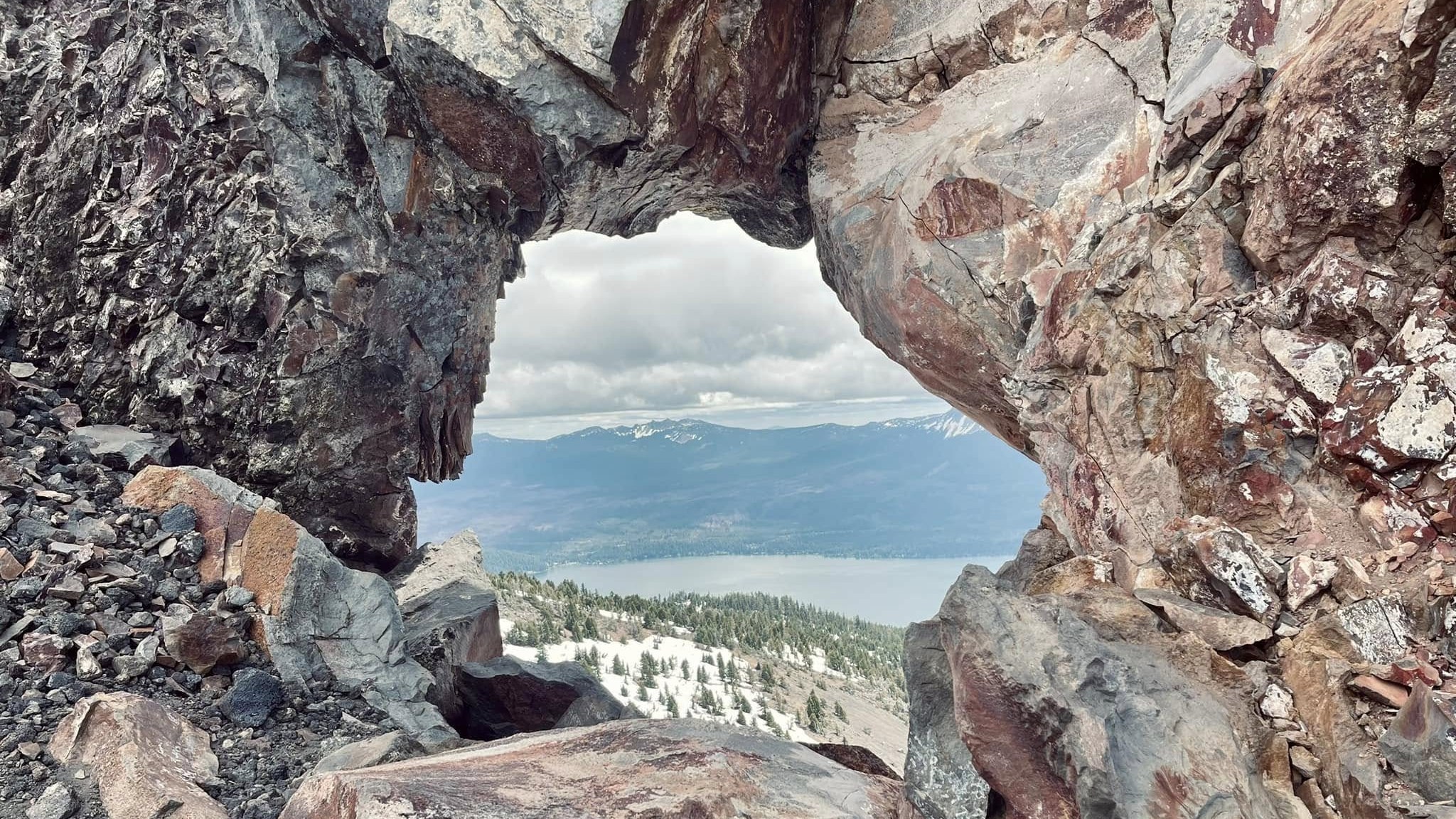
A wedding with the Oregon Duck, Baby Jack, Mt. Bailey still holding June snow, Umpqua Hot Springs and an oversized dog couch: a homecoming to Rip City and the forests next door.
Umpqua Hot Springs sits on a travertine mound about 150 feet above the North Umpqua River in Oregon's Umpqua National Forest. Hot water rises through an active fault at 100 to 115°F; at the surface it loses carbon dioxide and deposits calcium carbonate as travertine, the rock the soaking pools are carved from. The site is day-use only and reached by a steep 0.3-mile trail. Nearby Mt. Bailey is a long-quiet shield volcano, active roughly 100,000 to 11,000 years ago, climbed on Trail #1451 from Diamond Lake.
The strangest part of flying home to Portland was the nagging sense that I needed a visitor's badge.
Rip City, with feeling
We had just touched down from Rip City and its forested neighbors, and the trip had been a rollercoaster: nostalgia, imposter syndrome, laughter and pure joy, often in the same afternoon. Going home after years away does that. Everything is familiar, and you are not entirely sure you still qualify.
The region was full of incredible people. We snapped pictures with about half of them. Our memory game was not on point, and the camera roll is missing some of the best faces of the trip. The memories are not.
A wedding and a Baby Jack
First, congratulations to Laura and Trent, aka Shortrib and Husband, on a magical wedding. We danced our hearts out and celebrated their love umbrella style, white umbrellas held high on the lawn, complete with the moves of the Oregon Duck. The Duck himself turned up to sign the guest book.
Then there were Doug and Kristin, who had a fantastic first year of marriage and welcomed Baby Jack to their musical beach crew. New beginnings and growing families have a way of rearranging a trip around them, and we let them.
Reconnecting, ferries included
We spent a lot of the trip reconnecting with old(er) friends and meeting the newest additions to their lives, including the families that expanded during the reign of the virus-that-shall-not-be-named. There were nostalgic ferry rides, one with the Seattle skyline sitting on the horizon, and high school graduations to celebrate. Every visit was full of love, and every one ran long.
Mt. Bailey, the hot springs, and the people formerly known as Loveland
The outdoor adventures were off the charts. Em, Lindsey and I conquered Mt. Bailey, which was still holding snow on its upper slopes, and near the top found the natural rock window that frames the lake far below. Then we went looking for the reward and found it at Umpqua Hot Springs. After that came a camping expedition with childhood friends, "those formerly known as Loveland," with breathtaking views and campfire games.
How a hot spring builds its own bathtub
Umpqua Hot Springs sits on a cliff about 150 feet above the North Umpqua River, and nobody poured the tubs. The springs built them.
The water starts as rain and snowmelt in the Cascades and works its way down through the rock until it is heated at depth, then finds a way back up. At Umpqua, the Forest Service says the way back up is an active fault, and the water arrives at somewhere between 100 and 115°F. On the way it picks up dissolved minerals and carbon dioxide; US Geological Survey sampling of Oregon's thermal springs found that Cascade spring waters tend to run high in carbon dioxide.
The interesting part happens at the surface. Underground, pressure keeps that carbon dioxide dissolved, the way a sealed bottle of soda holds its fizz. When the water spills out into open air, the pressure drops and the gas escapes. Losing carbon dioxide shifts the water's chemistry so it can no longer hold all its dissolved calcium carbonate, and the excess comes out of solution as a pale mineral called travertine. The same process, described by the USGS at Yellowstone's Mammoth Hot Springs, builds terraces, rims and dams wherever the water runs.
At Umpqua that slow, steady deposit has built a mound of multicolored travertine down the slope. The main soaking tub, roughly 3 by 5 feet and 2.5 feet deep, was hewn out of it, and the lower pools fill from the main tub, cooling as they step down toward the river. Every soak is happening in a bathtub the spring is still, very slowly, building.
Mt. Bailey, for the record, has the opposite energy. The Smithsonian's Global Volcanism Program lists it as a shield volcano that was active in the late Pleistocene, between roughly 100,000 and 11,000 years ago, with no known eruptions since. It does its work these days as a summit, not a heater.
The quiet bits
Our downtime was extra special because of coffee tastings, wine meet-ups, beach walks among the sea stacks, dinners and hugs. At some point we also stood very small under the redwoods. There was also a bee rescue mission. We attempted to save the day.
Delicious dinners, laughter-filled excursions and some much-needed haircuts rounded things out. And an oversized dog couch made its way home with me, which is the kind of souvenir you do not plan for and do not regret.
If you go
- Umpqua Hot Springs is day-use only, open sunrise to sunset, year-round. Overnight camping and overnight parking are prohibited in the closure area, and the parking lot holds only about 10 vehicles, so be ready to park farther out and walk.
- The trail is short and steep: 0.3 miles up to the pools. The travertine gets slippery between them.
- Pay before you lose signal. Since April 2026 the trailhead is cashless. Display an America the Beautiful pass, or buy a day pass in the Recreation.gov app before you head out, because cell service is limited.
- Winter changes the walk. In winter weather the Forest Service gates the road about 3 miles before the parking area, which turns a 0.3-mile stroll into a 3-mile approach. Check Umpqua National Forest alerts before you go.
- Mt. Bailey (Trail #1451) starts from Forest Road 4795-300 near Diamond Lake. The Mountaineers list about 10 miles round trip and 3,100 feet of gain to an 8,300-foot-plus summit. Timberline arrives about a mile from the top, and the last half mile is steep and rocky. On a clear day you look across Diamond Lake to Mt. Thielsen, with Mt. Shasta to the south.
Grateful
The trip ran on love, laughter, and a camera roll with more gaps than proof. It was a reminder that you can feel like a guest in your own hometown and still be exactly where you belong, as long as the people are the right ones. Cheers to them, to Jay for coming along, and to many more unforgettable journeys.
Every soak is happening in a bathtub the spring is still, very slowly, building.
How hot is Umpqua Hot Springs?
The Forest Service lists the water at 100 to 115°F where it emerges, cooling in the lower pools that step down toward the North Umpqua River.
Can you camp at Umpqua Hot Springs?
No. It is day-use only, sunrise to sunset, and overnight camping and overnight parking are prohibited in the closure area.
Do you need a pass for Umpqua Hot Springs?
Yes. Since April 2026 the trailhead is cashless: display an America the Beautiful pass or buy a day pass in the Recreation.gov app before you arrive, since cell service is limited.
How hard is the Mt. Bailey hike?
Strenuous. The Mountaineers list about 10 miles round trip with roughly 3,100 feet of gain on Trail #1451, and the Forest Service notes a steep, rocky final half mile.
Why is Portland called Rip City?
Trail Blazers broadcaster Bill Schonely shouted it after a long Jim Barnett shot against the Lakers on 18 February 1971, in the team's first season.

Traveled with
Every story carries its receipts. Something out of date? Tell the editor and the "Last updated" line changes when we fix it.



Spot a fact that's off? A name we misspelled? Tell us. It gets fixed within 24 hours.
hello@thatlayover.life →