The Transpantaneira is a 147 km raised dirt road running from Poconé to Porto Jofre through the northern Pantanal in Mato Grosso, crossing about 120 wooden bridges. It was drawn up in the 1970s; the plan to pave it was dropped to protect the wetland, and it dead-ends at Porto Jofre. It can be driven in an ordinary car and makes an effective wildlife corridor, because the causeway sits at the water's edge. Porto Jofre is the most reliable place on earth to see wild jaguars, and the main reason is not the dry season but recovery and habituation: poaching had nearly eliminated jaguars from the region by the 1980s, and the Jaguar ID Project counted 29 habituated individuals in 2013 against 130 in 2023. Jaguars can be reliably seen in under five percent of the species' remaining range. Jaguar tourism here is valued at roughly US$6.8 million a year, and boat traffic rises from about four a day in low season to around thirty in high season, which researchers warn is unsustainable without new rules. We drove from São Paulo in October 2025, self-organized, and hired a boat and guide at Porto Jofre.
There is a word going around for the small flashes of joy that show up even when everything else is a mess. Glimmers. I went looking for a few and came back with a jaguar, a linguistic disaster involving a hat, and the smell of a stork that has not entirely left me.
The Pantanal is the largest tropical wetland on earth. Most of it sits in Mato Grosso do Sul, but the part everyone photographs, the part with the road and the jaguars, is up in Mato Grosso. Embrapa's revised checklist puts 470 bird species on the floodplain, which is a lot of birds, and a good number of them look like they were designed by a committee that had been left alone with the coffee.
Almost everyone who goes does it the same way: a week-long guided safari, a lodge, a tracker, sundowners at golden hour, a lens the size of a fire extinguisher. Sami and I drove.
Sami is a historian, a fantasy author, and the best road snack strategist I have ever shared a car with. Neither of us had done this before. Neither, it turns out, had many people, which we learned gradually from the faces of everyone we met along the way.
Day one: red lightning and the long nothing
Eighteen hours of highway out of São Paulo. Tolls, soy fields that go past the horizon in every direction, and roadside statues so large and so unexplained that they felt like the Corn Palace having a fever dream.
Red lightning cracked across the sky somewhere in the dark while Welcome to Night Vale played through the speakers, which is either perfect or a warning, and I have decided it was perfect. Carlos would have approved.
Zebu cattle with their shoulder humps strolled the verge like they had somewhere better to be. Rheas, which are essentially emus with fewer career prospects, sprinted off through the tall grass. We passed a sign for a town called Coxim and both said it out loud at the same time, for reasons I will not be defending here.
We collapsed in Rondonópolis, which by then we were calling Ridonculous, delirious and extremely pleased with ourselves.
The road that ends on purpose
The Transpantaneira runs 147 kilometers from Poconé to Porto Jofre, and it crosses about 120 wooden bridges on the way.
That number is the whole personality of the road. It was drawn up in the 1970s, and the plan to pave it was abandoned to protect the wetland, so what got built instead was a raised dirt causeway with water on both sides and bridges spaced along it to let the floodwater pass underneath during the wet season. Then it simply stopped at Porto Jofre, where it still stops.
The result is the best wildlife corridor in South America, arrived at mostly by accident. Everything that lives in the water comes to the edges. The road is at the edge. You drive at twenty kilometers an hour and the Pantanal arranges itself along your window.
The bridges are wooden, individually numbered, and in widely varying states of opinion about your vehicle. You slow down for each one. One hundred and twenty times.
Before we started it, we stopped at the Cuiabá market for mystery snacks and a hat. More on the hat.
Kilometer 42
At Pousada Rio Claro we found tired mama monkeys hauling babies through the treetops, jabirus posing like they were being paid by the hour, and one capybara who came to our door and knocked. Not metaphorically. It wanted friendship and would not be rushed.
An old man walked past with a bucket, and a jabiru followed him at a respectful distance in what appeared to be an ongoing dispute about union benefits, the benefit in question being fish.
Jabirus, for the record, deserve the attention they give themselves. They are the tallest flying bird in the Americas, standing up to about five feet, with a wingspan that can reach nine. Remember this. It becomes relevant.
The pousada staff looked politely baffled that we had driven here ourselves. I assumed the bafflement was about the driving.
The hat
At the market I had bought a cap reading "Xô Cesso," which Google Translate had assured me meant something like "shoo, mosquito." Practical. Thematic. I wore it all afternoon through a crowded market, pleased with my own cultural integration.
Later, someone kindly took me aside and explained that the phrase does not refer to mosquitoes. It refers, with some specificity, to male anatomy.
So I had spent an entire afternoon walking around northern Mato Grosso wearing a hat that politely requested every man in the vicinity keep his anatomy at a respectful distance. To the tourists: sensible insect advice. To everyone who actually speaks Portuguese: a woman making a very bold opening statement.
I have never been prouder of a purchase.
Why the jaguars let you watch
Here is the thing about Porto Jofre that nobody tells you until you are already in the boat.
Jaguars are famously impossible to see. People spend years in the Amazon and never manage it, and researchers estimate that jaguars can reliably be seen in less than five percent of the range the species still occupies. And yet here, on this one floodplain where the Cuiabá River braids out into a hundred channels, you can reasonably expect to.
I had assumed this was about the dry season pushing prey onto the riverbanks. That is part of it, and season does show up in the models. But it is not the main thing, and the main thing is better.
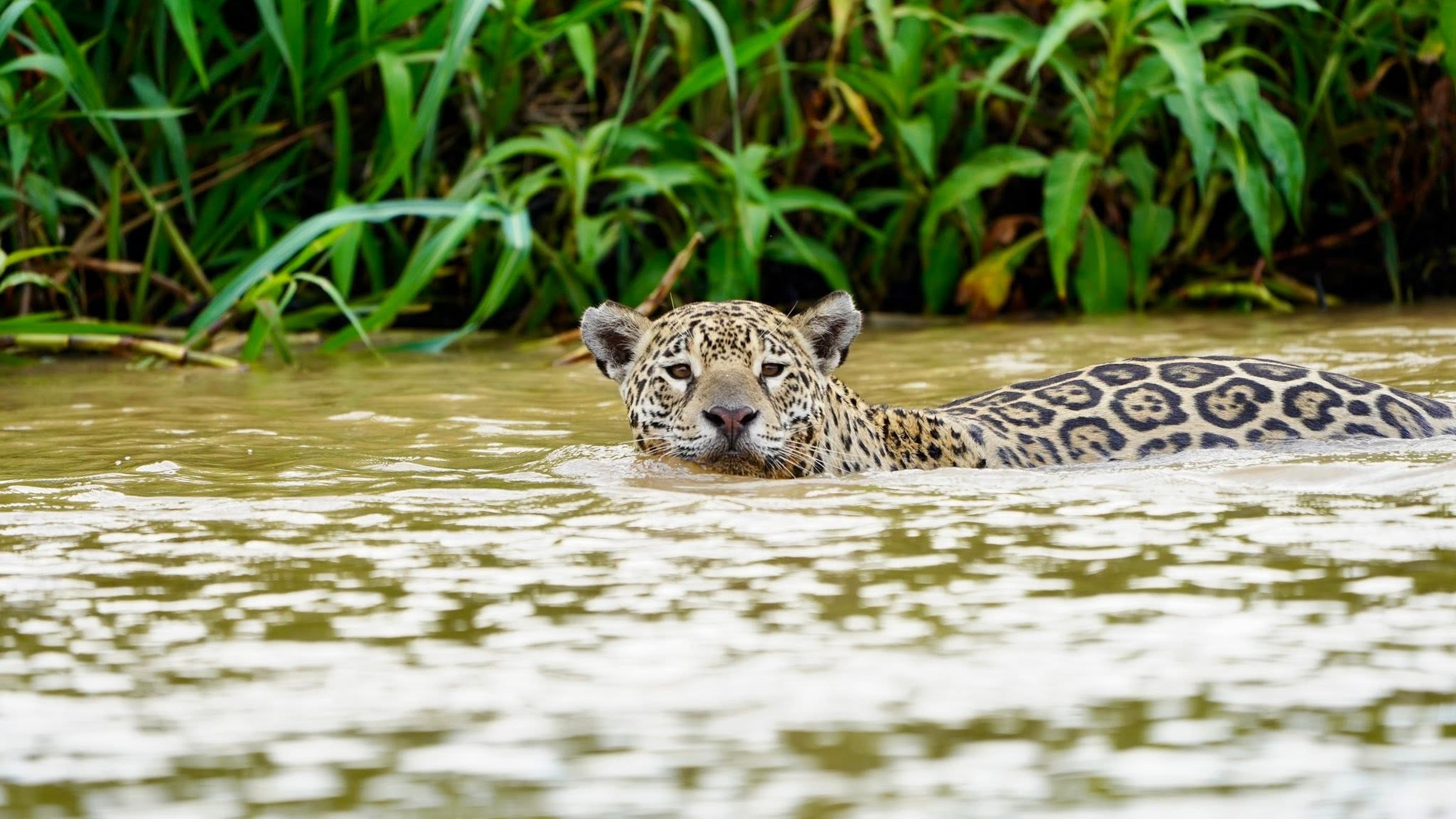
In the 1960s and 1980s, poaching had very nearly wiped jaguars out of this region. What has happened since is a slow recovery, and alongside it something stranger: the cats have decided we are furniture. The Jaguar ID Project counted 29 habituated jaguars here in 2013. By 2023 it counted 130. That is not 130 more jaguars appearing from nowhere. That is 130 individual animals who have independently concluded that a boat is a boring and harmless feature of the river.
So the honest version is this. The jaguars are visible because people stopped shooting them, and because enough generations have now grown up with boats drifting past that watching one no longer costs it anything. That is the whole mechanism, and it took forty years.
It is also, now, worth money. Jaguar tourism here generates an estimated 6.8 million US dollars a year, which is the argument that keeps the cats alive in a landscape otherwise given over to cattle. And it is under strain. Researchers counted roughly four boats a day on the river in low season and around thirty in high season, and a 2025 study argued the whole thing needs new rules before it collapses under its own popularity.
We went in October, which is high season. We found that out from behind.
Our first jaguar was asleep and so motionless that we spent a genuinely long time debating whether he was taxidermied. He was not. He was just extremely comfortable.
Then, further down the river, we were the first boat to find one moving: a golden shadow cutting a line through the current, swimming. We had fifteen minutes alone with him before the other boats found us and queued up behind, the photographers with the enormous lenses and, inexplicably, a group of shirtless frat boys. The jaguar swam, climbed out, strutted the bank, pooped with great ceremony, and did a lap of what I can only describe as zoomies. Fifteen minutes of a wild apex predator auditioning for Dancing with the Predators.
A heron caught a fish, dropped it theatrically, and then looked directly at me for applause.
We also beached our boat on a submerged log at a forty-five degree angle in a stretch our guide cheerfully called Caiman Alley, and spent roughly thirty seconds doing math about our odds while the caimans watched with what I would characterize as interest. Another boat pulled us off.
The stork, concluded
On the drive back down the Transpantaneira, with the windows open, a jabiru passed overhead and delivered directly into the car.
My arm. The windshield. A substantial quantity.
Recall that this is a bird standing five feet tall whose diet runs to fish, frogs, snakes, snails and, when the season turns hard, whatever has already died. The scent profile was exactly what that sentence implies. We laughed until we could not see, which is a poor condition for driving, and then we bought an air freshener.
No giant anteater. No giant otter. Those were the two I wanted most and the Pantanal declined to provide them.
Chapada, and down
We came off the road into Chapada dos Guimarães at sunset, red rock and canyon, and the hotel we had booked on points turned out to be genuinely beautiful. Purple sky, limoncello spritz, fresh fish.
Morning was bananas with cinnamon and dulce de leche, which I recommend as a way of being alive. Then the Morro do Vento overlook, red cliffs in gold light, and a search for a waterfall that Google Maps had invented. The dirt road ended instead at a vegetarian restaurant in the middle of the jungle. No regrets at all.
Then Campo Grande, where the hotel staff greeted us in flawless English learned entirely from Call of Duty. Then pig statues, unexplained farm smells, and Três Lagoas, which lived up to its name only barely.
What I would tell you
You can do this without a guide. We did. But be honest with yourself about which parts you are actually doing alone, because we were not: we drove ourselves and booked ourselves, and then we got in a boat with a man who knew exactly where the jaguars were. The driving is the DIY part. The jaguars are not.
Track your fuel like you are running a space program. Gas stations vanish for hours at a time on the Transpantaneira and do not come back until you have driven the whole thing and returned.
Go in the dry season, roughly June through October. Go late in it if you can stand the company, and know that in high season you are one of about thirty boats and the etiquette matters: engines off, keep your distance, and do not ask your guide to push in.
Drive it slowly. Twenty kilometers an hour is not a limitation, it is the entire product.
And this is the part I actually came back with. I went looking for glimmers, which is a small and manageable ambition, the kind you set when you are tired. What I got was a week of them stacked end to end: lightning, a capybara at the door, a terrible hat, a jaguar doing zoomies, a bird emptying itself into my car. Joy did not arrive quietly on this trip. It arrived at volume, slightly damp, and smelling strongly of stork.
Twenty kilometers an hour is not a limitation, it is the entire product.
How long is the Transpantaneira and how many bridges does it have?
147 kilometers, from Poconé to Porto Jofre in Mato Grosso, crossing about 120 wooden bridges. It is dirt, raised on an embankment, and it dead-ends at Porto Jofre.
Can you drive the Transpantaneira in a normal car?
Yes, in the dry season. We did it in a standard rental. Drive slowly, take the wooden bridges one at a time, and plan fuel carefully, because there are no gas stations along the road itself.
Do you need a guide to visit the Pantanal?
Not for the driving, the lodges or the road itself, all of which you can arrange yourself. You do need a boat and a local guide to see jaguars at Porto Jofre, and that part is not worth improvising.
Why can you see jaguars at Porto Jofre when they are invisible everywhere else?
Mainly because the population recovered after poaching nearly eliminated it, and because the cats have become habituated to boats over decades. The Jaguar ID Project counted 29 habituated jaguars in 2013 and 130 in 2023. Season, river proximity and weather also affect sighting odds, but habituation is the core of it. Jaguars can be reliably seen in less than five percent of their remaining range.
When is the best time to see jaguars in the Pantanal?
The dry season, roughly June through October. Water levels drop, access improves and sighting rates are at their highest.
How crowded does it get?
Researchers recorded roughly four boats a day on the river in low season and around thirty in high season. A 2025 study argued that jaguar tourism here needs new rules to stay sustainable. In high season expect to share a sighting and to queue.
How many bird species live in the Pantanal?
Embrapa's revised checklist for the Pantanal floodplain records 470 species.
What is a jabiru?
A very large wetland stork, the tallest flying bird in the Americas, standing up to about five feet with a wingspan reaching nine. They are common along the Transpantaneira.
How do you get to the Pantanal from São Paulo?
Fly to Cuiabá and drive south, or do what we did and drive the whole way, which is about eighteen hours to Rondonópolis on the first day before continuing to Poconé and the Transpantaneira.

Every story carries its receipts. Something out of date? Tell the editor and the "Last updated" line changes when we fix it.
Spot a fact that's off? A name we misspelled? Tell us. It gets fixed within 24 hours.
hello@thatlayover.life →