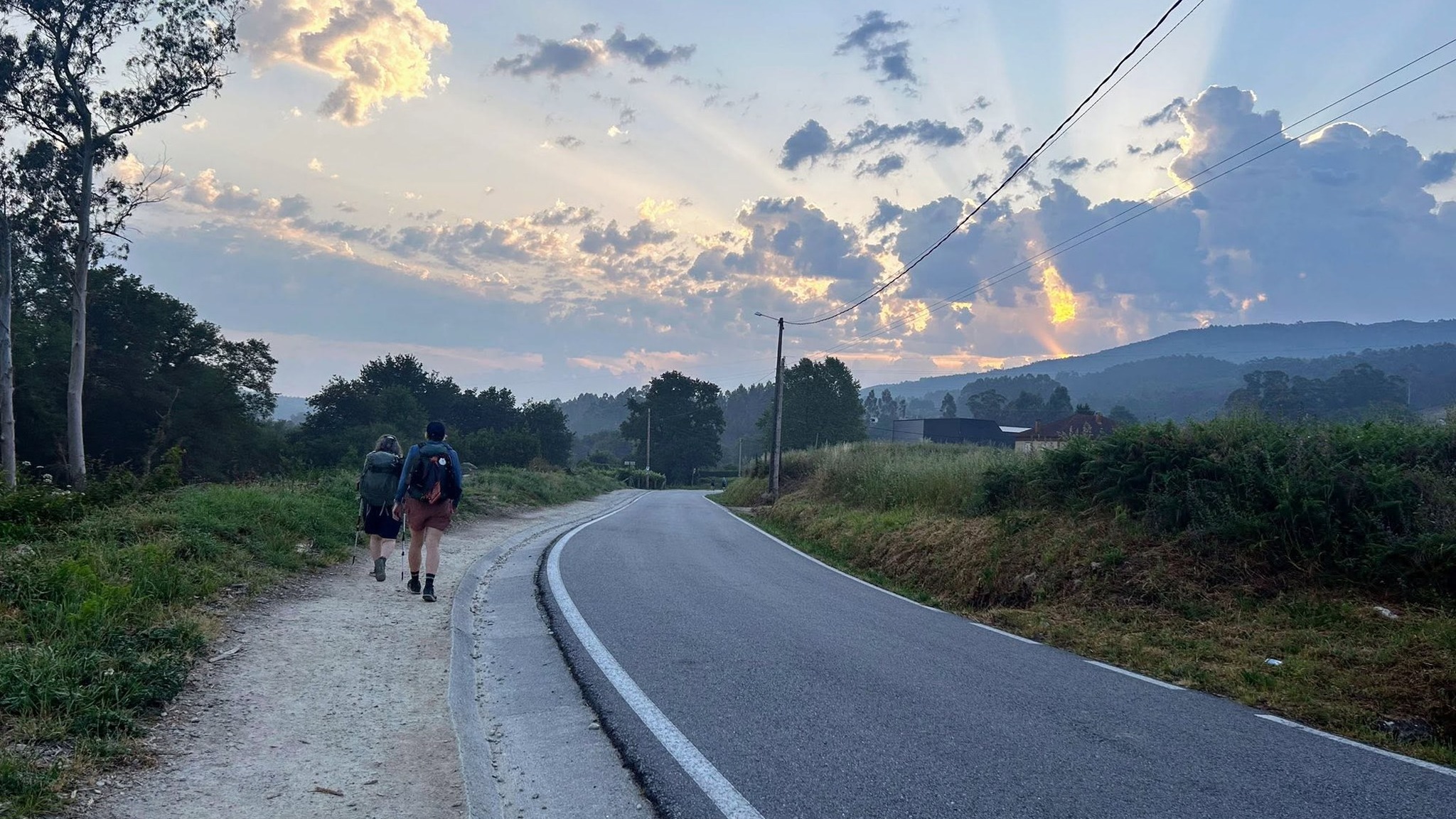
You only have to walk a hundred kilometers to be called a pilgrim. We walked two hundred and sixty.
Nancy Carleton walked the Portuguese Coastal Camino from Porto to Santiago de Compostela over ten days in May 2025 with three friends, covering 260 kilometers. The Compostela certificate requires only 100 kilometers on foot, plus at least two stamps a day in the pilgrim credencial over that final stretch, and the route must be geographically continuous rather than walked in one unbroken trip. The Coastal Way has no bridge into Spain: pilgrims cross the Minho river by boat from Caminha to A Guarda, on a service that runs with the tides. From A Guarda it is about 83 kilometers of coast path to Redondela, where the Coastal and Central routes join. Reported first-hand for That Layover Life.
You only have to walk a hundred kilometers to be called a pilgrim. We walked two hundred and sixty.
The Portuguese route, in May, with some creative detours. Two countries, ten days, and four now-certified pilgrims.
What follows is the whole chaotic, beautiful, espresso-fueled, Compeed-covered thing. If you are planning your own, consider it both a love letter and a cautionary tale.
And mad respect to you French Route legends. You are keeping us motivated for round two.
When they say walk, you walk
When one of your hippest friends invites you on a pilgrimage, you do not question it. You pack snacks, you put on your favorite "Oregon is above California" hat, and you start Googling "what is the Camino, and do I need trekking poles."
After a midnight drive from Lisbon to Porto, we held our own shell ceremony on the beach. Then we wandered the winding streets of that extremely fetching city, entirely unaware of how many muscles were about to revolt.
We were not sure what we were walking into. We walked anyway.
The stats, because you know I dig data
- 10 days on the trail
- 260 km, or 161.8 miles for my fellow Americans
- 61 hours and 44 minutes logged on foot
- Countless blisters and emergency xixi stops
- One boat across the river into Spain, which yes, counts
- Espresso stops: at least four a day, minimum
What the Compostela actually certifies
Here is the part nobody explains before you go, and it turns out to be the thing that makes the whole exercise make sense.
To earn the Compostela, the certificate they hand you in Santiago, you only have to walk the last 100 kilometers. That is it. One hundred, on foot. Two hundred if you are on a bike, or 100 nautical miles if you arrive by sea, in which case you still have to walk the last stretch from Monte do Gozo like everyone else.
What you do have to prove is that you were actually there. You carry a credencial, the pilgrim passport, and over that final 100 kilometers you have to collect at least two stamps a day. Churches, guesthouses, cafés, anywhere that has a stamp and will press it into your little book.
And the route has to be geographically continuous. Not continuous in time, which surprised me. You can walk it in pieces across years if you want. But you have to pick each section back up where you dropped the last one.
We walked 260 kilometers. We more than doubled the requirement, which felt excellent right up until I understood that the number was never the point. The credencial is. By the end ours were layered in ink and pastry crumbs, which is holy in its own way.
Albergues: bunk beds, shower sandals, and unexpected friendships
We mostly stayed in albergues, the communal pilgrim hostels. Think bunk beds, shower sandals, and a room full of sore-footed strangers trying unsuccessfully not to snore.
Try scaling a top bunk with blistered feet and humility. Honestly? Weirdly peaceful.
We hung our underwear off our backpacks like prayer flags, daily, sometimes with a baguette in tow. We refilled water bottles at public fountains in fishing towns. We became very comfortable being a little grimy.
Somewhere in the middle of all that I met a Brazilian man who looked visibly relieved when I spoke Portuguese. He quietly admitted he had been walking with a group of Spanish pilgrims for three days and had not understood a single word any of them said.
Same, my guy. Same.
Obrigada, F*
Which brings me to my accidental Camino catchphrase.
I live in Brazil. "Obrigada" rolls off the tongue without thinking. Halfway through Spain it stopped making any sense at all, and my brain did not notice.
So I would smile, accept a café or some blessed Compeed, and blurt it out anyway.
"Obrigada. F*."
Every single time. The pilgrims laughed. We laughed. Nobody cared. We were trying.
Which is the Camino, really. Connection without perfection. Effort, kindness, a little grace, and some ibuprofen.
Coastal or Central? We walked both, badly
We were not purists. At all.
After a few days on the coast, a charming Canadian pilgrim suggested we try the Central Route to spot "roosters." It was mainly for the euphemism, but we went looking anyway, and here is the thing: we found one. The Central Route runs through Barcelos, and the galão de Barcelos, the painted ceramic rooster with the red comb, is the town's emblem and arguably Portugal's. So we went looking for roosters as a joke and got a real one, two meters tall, staring down at us against the sky.
Then we did the math, worked out it would not add many miles to Uber back to the coast, and did that too. Zero regrets.
If you are weighing the two: the Coastal Way keeps the Atlantic on your right for most of a week, with fishing towns, dunes and more open horizon. The Central Route is the older, more historic line, and it goes through Barcelos. They converge at Redondela, and plenty of people cross between them before that. We did. Nobody stopped us.
Some days we walked twenty-plus miles. Others we lingered at every mercado, padaria and forest stand.
One day Melinda got a spider bite that needed urgent care. So there was a clinic, and there was my tragic Portuguese doing its very best in a situation that frankly deserved better Portuguese. She powered through like the champ she is and was back on the trail.
We hiked through vineyards glowing in golden light, wildflower-covered sand dunes, ancient forests and seaside cliffs. We crossed streams. We danced unapologetically, once at a local wine festival for Nancy T.'s birthday, which ended with wine and laughter by the pool at sunset. There was sangria. There were heritage dinners. There was a certain song about not talking about a certain Bruno, permanently lodged in all of our heads. If you know, you know.
The boat into Spain: there is no bridge at Caminha
The crossing into Spain deserves its own paragraph, because it is the strangest and best piece of logistics on the whole route.
At Caminha, the Portuguese coast runs out at the mouth of the Minho river. There is no bridge for pilgrims. So the Coastal Way simply puts you on a boat, across the river, into A Guarda, and you are in Galicia.
The crossing runs on the tides, which means the route has a timetable set by the moon rather than by anybody's app, and you are advised to check the day before. From A Guarda it is roughly 83 kilometers of coast path to Redondela, where the Coastal Way finally meets the Central Route and everyone walks the last stretch together.
A pilgrimage with a ferry in the middle of it should feel like cheating. It does not. It feels like the oldest possible way to get across a river.
Food was a love language
We were not calorie-restricted pilgrims.
Breakfasts were pastéis de nata, buttery multigrain buns, or pastries the size of our faces. Lunch was paella, or fish, or whatever the café could get out fast. Dinner was sacred.
There was cheesy grilled octopus in O Porriño. Basque steaks. Titula cheese. Everything toasted with fizzy water and red wine. And one night, completely unaware of what we had walked into, we ate Michelin-recognized food in a tiny Portuguese restaurant in our sweaty hiking clothes.
The vibe was sweaty but satisfied.
Arriving in Santiago de Compostela
By the time we reached Santiago de Compostela, emotions were high. We crossed into the city on the heels of a bike race, as a collective.
The plaza in front of the cathedral is the best people-watching any of us has ever done. Some pilgrims cried. Some dropped their packs and lay flat on the stones. Others hugged, or danced, or stood very still and took it in. No two arrivals looked the same.
Ours was more of a looking-for-gelato type of celebration. We clapped, we posed, we popped a bottle of champagne.
Then hugs and goodbyes, and we turned south. Our final celebrations were a stunning golden hour in Parque Nacional da Peneda-Gerês, which is the only protected area in Portugal classified as a national park, roughly 70,000 hectares of waterfalls and free-roaming garrano ponies and a Roman road with milestones nearly two thousand years old.
And then peacock chasing in Lisboa.
Would we walk the Portuguese Camino again?
Absolutely.
Next time: fewer outfits, more undergarments. Less worry, more wonder. Maybe the French Route. Or maybe just show up again, the way we did the first time.
The Camino is a reminder that life is better experienced.
If you are thinking about it, go. You will laugh. You will ache. You will eat gelato every day and call it spiritual healing. You will learn how to say "bathroom" in three languages. You will come home a little more grounded, a little more grateful, a little more of you.
And if you accidentally yell "Obrigada, F*!" at a kind stranger, you are doing it right.
Connection without perfection. Effort, kindness, a little grace, and some ibuprofen.
How many kilometers do you have to walk to get the Compostela?
100 kilometers on foot or horseback, 200 by bicycle, or 100 nautical miles by sea followed by the final walk from Monte do Gozo.
How many stamps do you need in the pilgrim passport?
At least two a day over the final 100 kilometers on foot. The credencial is issued by the Pilgrim Office, and also by confraternities, hostels and parish churches along the way.
Does the Camino have to be walked in one continuous trip?
No. It must be geographically continuous, meaning you resume each section where the last one ended, but it can be spread across years.
Is there a bridge from Portugal into Spain on the Coastal Way?
No. You cross the Minho by boat from Caminha to A Guarda. The service runs on the tides, so check the day before.
How long is the Portuguese Coastal Camino from Porto?
About 280 kilometers by the official reckoning: roughly 80 km from Porto to Caminha, 83 km of coast path from A Guarda to Redondela, and about 67 km on the Central Way into Santiago.
Can you switch between the Coastal and Central routes?
Yes. They converge at Redondela, and many pilgrims cross between them earlier. We walked parts of both.
What are albergues actually like?
Communal pilgrim hostels: bunk beds, shower sandals, shared bathrooms, and a room of sore-footed strangers trying not to snore.
Coastal or Central, which should you walk?
The Coastal Way keeps the Atlantic beside you for most of a week, with fishing towns, dunes and open horizon, and is generally less crowded. The Central Route is the older, more historic line and passes through Barcelos. The Coastal has more sun and wind exposure, fewer places to stay, and less consistent signage.
Sources used in reporting this story:
- The credential and Compostela, Way of Saint James in Galicia, the official site, on distance minimums, stamp requirements and geographic continuity
- The Coastal Path, the official Caminho Português de Santiago site, on the Caminha ferry, the tides, stage distances and the junction at Redondela
- Parque Nacional da Peneda-Gerês, Visit Portugal, on the park's status, size and features
No links in this story are affiliate links.

Traveled with
Every story carries its receipts. Something out of date? Tell the editor and the "Last updated" line changes when we fix it.

Spot a fact that's off? A name we misspelled? Tell us. It gets fixed within 24 hours.
hello@thatlayover.life →