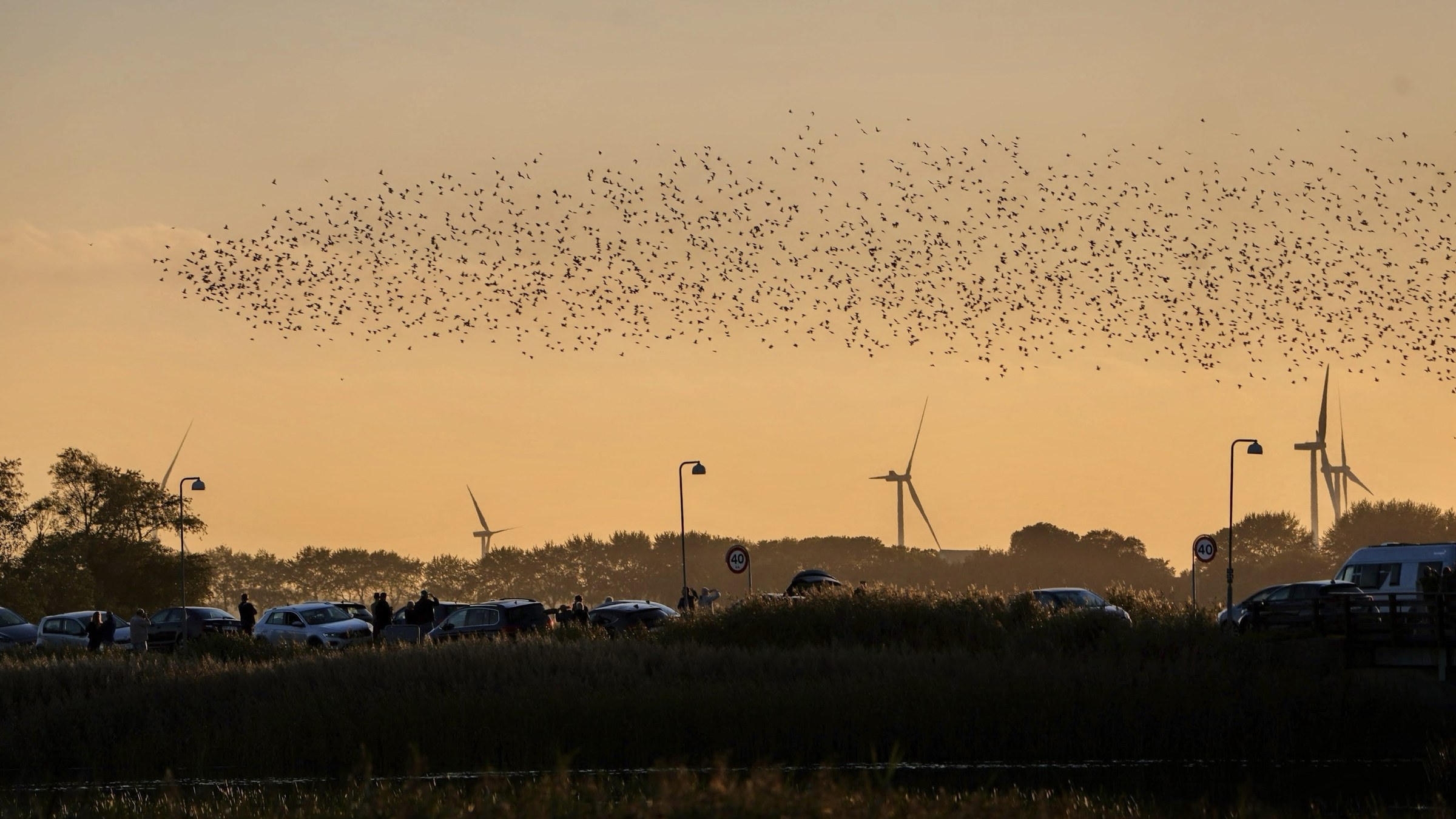
Sort Sol, the Black Sun, is a starling murmuration that happens in the marshlands of southwestern Jutland and northern Germany in spring and autumn, as up to a million birds gather at dusk to roost in the reeds. The famous liquid shapes only form when a predator such as a falcon attacks and the flock tightens, with each bird tracking roughly its seven nearest neighbors, so a still evening means arrival without spectacle. The flocks move around the wider Tønder marshlands night to night, so last night's roost is not a guarantee. Local operators run evening bus tours from the area and are the most reliable way to find the birds. We drove down from Copenhagen for a weekend in late September 2026, watched from Grænsekro in Rudbøl, and car camped nearby for about 90 kroner.
Here is what nobody tells you about the Black Sun: it is a bedtime.
Up to a million starlings (iridescent, loud, and far better looking than their reputation) spend the day eating their way across the marshes of southern Denmark, and then, in the twenty minutes after sunset, every one of them goes to sleep in the same patch of reeds. That is the event. That is what people drive in from many countries to see. Birds, turning in.
I am officially one of those people now. I would do it again. This is how birdwatching becomes a recurring appointment in your calendar.
I planned this one as a solo trip. My main squeeze, Jay, got in the car anyway, and the pack dog was close behind. No RSVP, just seatbelt.
Here is my actual method for finding somewhere new in a country I have already seen a lot of: I open Google Photos, stare at the heat map, and hunt for the blank spots. Denmark is small enough that the blank spots are now a competitive sport, and I am in aggressive cost-saving mode, which means the search radius is whatever I can drive before my coffee wears off. There was one blank patch left, down by the German border in Jutland. When I went looking for what was in it, I found out that in late September, the sky down there fills up.
They call it Sort Sol, the Black Sun.
What Sort Sol actually is
Starlings gather in the marshlands of southern Denmark and northern Germany on their way south, feeding in the fields all day and coming in at dusk to roost in the reeds. When enough of them arrive at once, they blot out the light. Hence the name.
The part nobody tells you until you are standing in a wet field: the famous shapes only happen when the birds are frightened. A falcon comes in, the flock tightens, and every bird starts tracking the seven or so birds nearest to it, which is enough to turn hundreds of thousands of individual animals into one object that moves like liquid and reads, to a predator, as something much too large to eat. No falcon, no shapes. Just a great deal of arriving.
We got a great deal of arriving. I am not going to pretend we got a cathedral in the sky, because we did not, and half the people standing near us were on night three of trying. The birds clocked in, did their shift, and went to bed. I will take it.
Getting there, and the windows-down thing
We crossed onto Fyn in the middle of the afternoon, and I did what I always do on that bridge: I put every window down.
Nobody taught me this. You can see the wind sail along the span, and on a real day the gusts will shove the car sideways enough that you have to hold the wheel like you mean it. So I open every window, let the wind slap me awake until my eyes water, and sing over it badly. Regular readers know there is already a Fyn bridge tradition here, involving humming "Tequila" about two dozen times on a previous crossing. This was the sequel. At this rate, that bridge is getting its own tag.
Somewhere on the drive we stopped to charge, and because a charge stop is twenty-five minutes of standing in a field pretending to look at your phone, Magnus and I sang to a herd of cows. The cows were unmoved. Magnus was delighted. I maintain this is the correct use of the time.
Just after the bridge we stopped at Café Stribo for lunch, where the owners were the loveliest people we met all weekend, and that includes the birds. Jay raved about his milkshake online, which for him is a formal review.
Finding the birds
Most guides will tell you to book a local nature guide, and you should. Tour operators run evening buses out into the marsh; they know the roosts, and these are small businesses in a very small corner of the country. We were not trying to dodge that. I was just last-minute enough that everything was full.
So I did it the other way: there is a roost map online that shows where the flocks came down the night before, and I used that, plus a lot of searching, to pick a target, which is a fine plan as long as you understand the catch. These birds short-term migrate around the wider Tønder marshlands. They don't commute to the same address every evening. They are looking for safe reeds and good feeding, and if the falcons found them last night, they will be somewhere else tonight. Yesterday's roost is a hint, not a reservation.
Driving in, we started seeing starlings on the power lines and little twisting drops into the fields, and we were thrilled, because we assumed that was the show. Reader, that was the parking lot.
We pulled in first at a little marina about a kilometer from Aventoft, set out our chairs and blankets and drinks, and felt very clever. Then the tour buses went past, in a convoy that made our cleverness look like amateur hour. We packed up and followed them. They took us to Grænsekro in Rudbøl, a cafe and restaurant sitting on the water in the marsh.
Which is exactly where I had been headed in the first place.
That is the whole lesson, honestly. Trust your research until the buses disagree with you, then follow the buses. The buses have a guide on board who has been doing this since before you knew what a starling was.
Every starling in Denmark clocks out at 6:45
By 6:15, thousands of people were on the bridges and the banks. By 6:45 there were hundreds of thousands of birds.
They come in from every angle in separate flocks, and here is the detail I was not ready for: as they beat their wings, catching the last of the light, the whole flock glitters like someone shook out a sheet of sequins over the marsh. It is the kind of sparkle you do not expect from a bird that spends its day in a ditch.
We watched them stack up, circle, and pour down into the reeds, surrounded by people from what sounded like a dozen countries, all making the same noise. I also received several unsolicited comments about the size of my telephoto lens. All of them were, I want to stress, entirely sincere. Birdwatchers are a direct people.
Dinner in another country
Aventoft is about a kilometer over the border, so we drove into Germany for dinner. Jay had schnitzel. I had salmon and a baked potato. There is something deeply satisfying about watching a marsh full of birds go to bed, crossing an international border for dinner, and being home in Copenhagen by the following evening. To be fair, that is roughly what the birds do this time of year too. Cross the border for some eats before bedtime.
Car camping, with one complication
I had booked Brændebro Camping for about 90 kroner, roughly thirteen USD, purely because I wanted somewhere I could legally car camp. It turned out to have outdoor cooking areas, bathrooms, showers, and a fitness facility across the road. That is an absurd amount of infrastructure for the price. Denmark does not mess around with campsites.
A note on this, because I do not want to oversell it: Denmark is not a park-anywhere country. What Denmark is very good at is affordable, well-run pitches, and if you are willing to pay for a spot, you will usually find a good one for a tent, a car, or an RV. The caveat is that during Sort Sol season, everything near the marshes sells out, which was my first real clue that this bird thing was a much bigger deal than I had understood. Book something.
Now the complication. This was Magnus's first car camp. The back of our Mercedes GLB 350 4MATIC sleeps one adult comfortably, two adults less comfortably, and that math does not survive adding a 35-kilo Samoyed who installs himself down the center. The upside: we barely touched the climate controls all night, because we had a living heated blanket. The downside: rolling over became a negotiation involving three parties, one of whom does not speak and none of whom were prepared to compromise.
We are upgrading the setup this week and going out again next weekend.
Sunday
We drove onto the beach at Rømø, which you can do, because it is a drive-on beach and it is enormous. We made coffee on the sand and ate pastries from a local bakery while the dog lost his mind about the horizon. There is a specific joy in drinking coffee on a beach you drove onto yourself.
Then Esbjerg, because Jay had somehow never seen Men at Sea, the four enormous white figures staring out at the water. Then home, with a stop at Apoli in Nyborg and a look at the castle and its moats.
We had meant to stop in Odense for lunch. On the drive out, Jay had asked, apropos of nothing, when the Hans Christian Andersen Marathon was and whether we should sign up. We drove into Odense on Sunday to find the city closed for the Hans Christian Andersen Marathon.
We did not get lunch. We are signing up for next year.
What I would tell you
Book a guide if you can. Book a pitch either way. Hold the location loosely, because the birds are not holding it at all. Get there by six and stay past sunset. And if you are driving over Fyn to get there, put your windows down.
Two days, one country border, one very cheap campsite, one dog who is now a permanent fixture of the bed.
Yesterday's roost is a hint, not a reservation.
What is Sort Sol?
Sort Sol, or the Black Sun, is the name for the huge starling murmurations that gather over the marshlands of southwestern Jutland at dusk, when enough birds arrive at once to darken the sky before they drop into the reeds to roost.
When can you see the Black Sun in Denmark?
Spring and autumn, while the starlings are migrating between southern Europe and Scandinavia. We went in late September. It happens in the hour or so after sunset.
Where do you see it?
The marshlands of southwestern Jutland, especially around Tønder and Ribe, and across the border into northern Germany. We watched from Grænsekro in Rudbøl, right on the Danish-German border.
Why don't you always see the famous shapes?
The shapes are a defense. When a falcon or other predator attacks, the flock tightens and each bird tracks roughly the seven birds nearest to it, which turns the group into one large shifting object. On a night with no predator, you get the arrival and the roosting but not the sculpture.
Do you need a guide?
You do not strictly need one, but local operators run evening buses, know the current roosts, and are small businesses worth supporting. Book ahead, because they fill up in season.
Will the birds be in the same place two nights running?
Not reliably. They short-term migrate around the wider marshland looking for safe reeds and good feeding, so a roost map tells you where they were last night, not where they will be tonight.
What does it cost?
Very little if you drive and camp. Our campsite was about 90 kroner, roughly 13 US dollars. Guided bus tours and accommodation in the area cost more and sell out during the season.
Can you car camp in Denmark?
Not anywhere you like. Denmark is not a park-anywhere country, but it has plenty of affordable, well-run campsites that take tents, cars and RVs. In Sort Sol season the ones near the marshes sell out, so book something.

Every story carries its receipts. Something out of date? Tell the editor and the "Last updated" line changes when we fix it.
Spot a fact that's off? A name we misspelled? Tell us. It gets fixed within 24 hours.
hello@thatlayover.life →