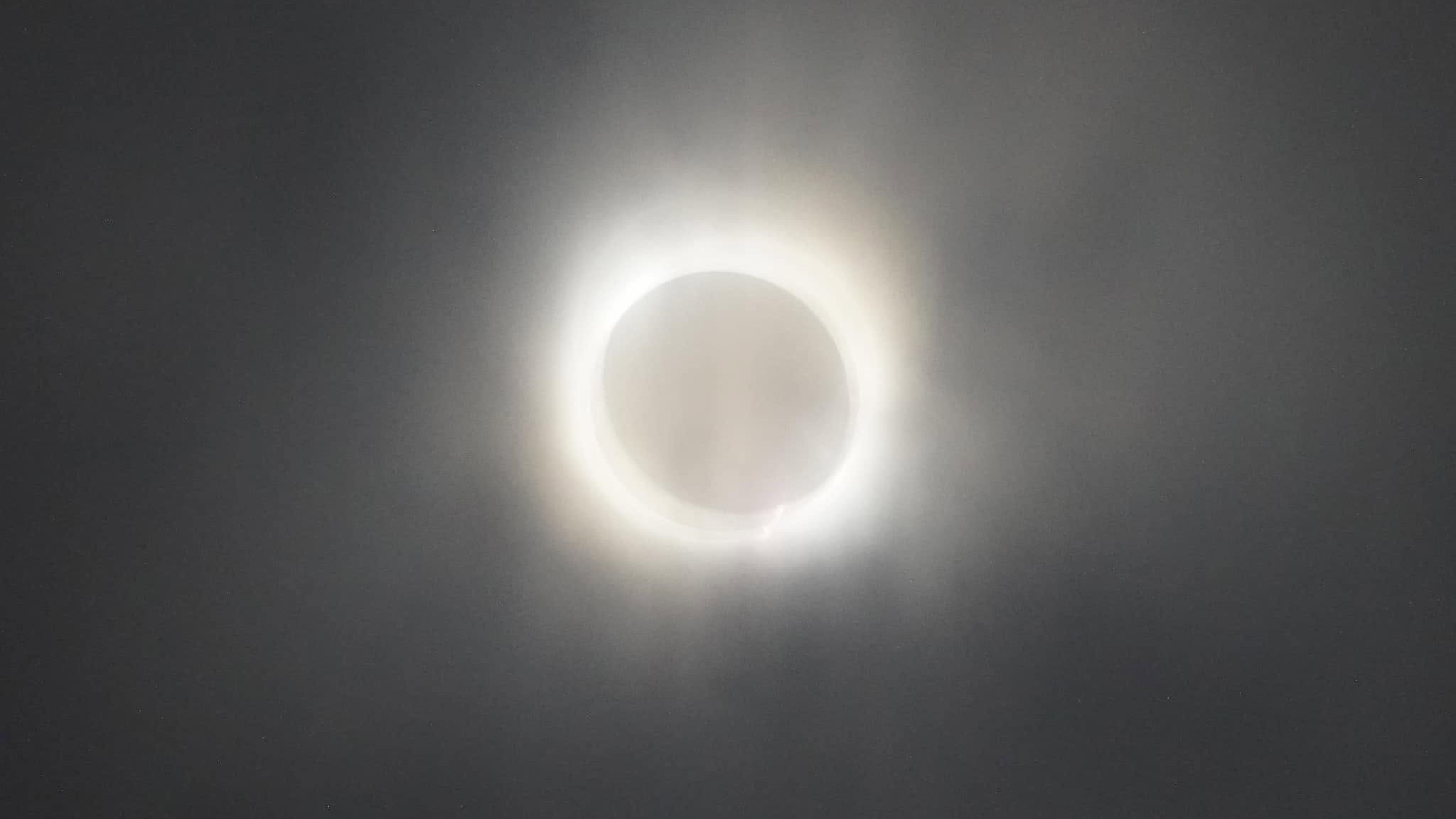
Florida by way of the Everglades at 4 a.m., a half marathon called Run for Donuts with no donuts, a Bruton family fajita feast, and the 2024 total solar eclipse under Texas clouds, fifty-eight years after my grandfather took a better picture of one.
On April 8, 2024, a total solar eclipse crossed the Texas Hill Country. Boerne got about three and a half minutes of totality; Comfort, Kerrville and Fredericksburg got more than four. Despite cloud cover, the phases and totality were visible from the Boerne and Kerrville area. The astronomer Gordon Allen Newkirk Jr., director of the High Altitude Observatory from 1968 to 1979, designed the radially graded camera that first photographed the whole white-light corona, at the Bolivia eclipse of November 12, 1966. The next total solar eclipse in the United States is August 23, 2044.
The best photograph of a total solar eclipse in my family was taken in Bolivia in 1966, and it is not mine.
Fort Myers, by way of the Everglades at 4 a.m.
From the sun-kissed shores of Fort Myers to the rugged beauty of Texas Hill Country, my spring tour through the USA was a boot scootin' boogie.
It kicked off with a 4 a.m. rendezvous through the Everglades. In Fort Myers I joined forces with the fabulous Yvonne, one of her besties, Erin, and her entourage, for lavender matcha lattes and some seriously indulgent cinnamon toast.
Naples was next on the agenda. I had the pleasure of rubbing elbows with the one and only Tim Heine, and of meeting Robbin at a birthday bash at the local watering hole (otherwise known as "the country club"). Seeing Sherwood, Oregon's once-dapper gent swap his suits for southern Florida polos was a sight to behold.
There was no raccoon tour for me. Viator canceled on me. Cue the dramatic sigh. But South Beach was calling my name before my next flight, so I answered.
San Antonio, and a half marathon on a whim
In San Antonio I embarked on a hilariously impromptu half marathon called the Run for Donuts. There were no donuts. There was, however, a surprise: my dear young Dad turned up and joined in on the fun.
After a quick rinse-off came a mouthwatering breakfast with Aunt Vee and Margie, followed by a quest to retrieve the world's most absurd Amazon locker order. Because who doesn't need Brazilian essentials in the Lone Star State? By which I mean expat essentials: cold meds, macaroni and cheese, and cleaning products. God, everything.
A stroll through the San Antonio Botanical Garden with Dad and my in-laws, Jim and Janice Carleton, was the perfect warm-up for a Bruton family fajita feast. I finally got to meet Ginger, Keegan and little Walker, and enjoyed the company of the new arrivals, Kimie and Jessica, and our hosts, Bobbi, Randy and company.
Street corn, HUGE boots, and Hill Country
The next morning was coffees and brunch on the River Walk with Jazzy. Domingo has the best fancy street corn. Then a pair of HUGE boots, and some final shopping.
With everyone now in tow, our motley crew set off for Hill Country, armed with anticipation for the eclipse. We were all connected by Grandma Annie, Grandpa JH, and the company that they kept.
Hill Country, mostly eaten
Vineyards. Wildlife, including a fox on my morning run, which is a wild way to start a day. Space-snack bags, which I made for everyone: MoonPies, Moon Cheese, astronaut ice cream, Sun Chips, Eclipse gum, and a pair of eclipse glasses each. And copious amounts of Fickle Pickles (a local brand), pecan pie, Dalton's famous cookies, and Korean noodles. Those were the edible highlights. The only thing that beat them was the conversation, and the only thing that beat the conversation was the main event.
The eclipse, through the clouds
On April 8, 2024, the Moon's shadow crossed Texas on its way northeast, and we had cloud cover. We saw it all anyway. The phases. About four minutes of darkness. The eclipse glasses dance.
And the whole time, I was thinking about my grandpa.
How Grandpa photographed what film could not see
My grandfather was Dr. Gordon Allen Newkirk Jr., a solar astronomer who spent his career on the Sun's corona, the faint outer atmosphere you only get to see with your own eyes during totality. From 1968 to 1979 he directed the High Altitude Observatory in Boulder, Colorado.
Here is the problem he solved. The corona glows with roughly a millionth of the brightness of the Sun's visible surface, which is why you need the Moon to block the rest before it shows up at all. Worse, it is wildly uneven. It is brightest right at the edge of the Sun and fades steeply the farther out you look. Your eyes can take in that whole range at once. Film could not. Expose for the bright inner corona and the long outer streamers disappear. Expose for the streamers and the middle burns out to white.
His fix was a filter graded like a target: darkest in the center, where the corona is brightest, and gradually clearer toward the edges, where it fades. One exposure could now hold the entire corona, traced from just above the Sun's surface out to four and a half times the Sun's radius. He built the camera with his colleague Lee Lacey, and its first outing was the total eclipse of November 12, 1966, at Pulacayo, Bolivia, about 13,000 feet up. A 2023 paper on coronal imaging says the picture arguably showed more detail than the eye could see.
The camera went on to work eclipse after eclipse across a nineteen-year span, and the design kept going after that: a Newkirk camera photographed the 1991 eclipse from Mauna Loa. The original sits in the lobby of the NCAR Mesa Lab in Boulder. Digital photographers now get the same effect by stacking several exposures, but scientists who model the corona still run their predictions through a "Newkirk filter" to approximate what a person would see.
He also has a comet. In July 1949, at Harvard's observatory, he and Bart Bok confirmed the comet that a young Indian astronomer, Vainu Bappu, had spotted on a photographic plate, and it carries all three names: Comet Bappu-Bok-Newkirk.
And he had a Texas chapter. In March 1964, his Coronoscope II went up on a balloon from Palestine, Texas, and took the first images of the outer corona without an eclipse at all.
So yes, his photos from 1966 put mine from Hill Country seriously to shame. In fairness to me, he built his own camera for the job. What an impressive man.
Last call at the Pearl
What better way to bid farewell to the Lone Star State than a tour of Pearl Brewing in San Antonio. Pearl was brewed on that site from the 1880s until the brewery closed in 2001, and the old complex is now a neighborhood of restaurants and shops, with a hotel in the 1894 brewhouse. We capped it off with a meal that could make even the most discerning food critic weak at the knees, and reminisced about our loved ones, the ones still here and the ones we have lost.
If you go
- Get to the centerline. Inside the path of totality, how long the dark lasts depends on how close you are to the middle. In 2024, Boerne got about three and a half minutes; Fredericksburg, Comfort and Kerrville got more than four. Check an eclipse map for the exact town, not just the region.
- The next big ones. On August 2, 2027, totality crosses southern Spain, Gibraltar and North Africa, peaking at about six minutes 23 seconds near Luxor, Egypt. In the US, the next total eclipse is August 23, 2044 (a short path through Montana and North Dakota), followed by August 12, 2045, coast to coast from California to Florida.
- Glasses on, glasses off. Wear certified eclipse glasses (ISO 12312-2) for every partial phase. Take them off only once the Sun is completely covered, and put them back on the moment it starts to reappear. The dance is optional.
- Domingo is on the River Walk at the Canopy by Hilton, 123 North St. Mary's Street. Order the elote street corn.
- The Pearl sits just north of downtown, close to the River Walk. It is free to wander.
- Run for Donuts is a small, capped-wave event in San Antonio with 5K, 10K and half marathon distances, held several times a year. Donuts at the finish are the stated plan. Results, as I can confirm, may vary.
Everything lining up
A total eclipse only works when three bodies that are usually nowhere near each other line up exactly. So, it turns out, does a family like mine: Florida friends, a Dad who crashes your half marathon, in-laws, people I was meeting for the first time, all pulled into one place by Grandma Annie, Grandpa JH, and a shadow crossing Texas. The corona needs the Moon. We needed an eclipse.
So here's to the USA, a land of endless surprises and unforgettable moments. Until next time, 'murica!
The corona needs the Moon. We needed an eclipse.
How long was totality in Boerne, Texas on April 8, 2024?
About three and a half minutes (3 minutes 34 to 36 seconds). Towns closer to the centerline, such as Comfort, Kerrville and Fredericksburg, got more than four minutes.
Who was Gordon Newkirk?
Dr. Gordon Allen Newkirk Jr. was a solar astronomer who directed the High Altitude Observatory in Boulder, Colorado, from 1968 to 1979. He designed the radially graded camera that first photographed the white-light corona in full detail, at the Bolivia eclipse of November 12, 1966.
What is a radially graded filter?
A filter that is darkest in the center and clearer toward the edges, matching how the corona's brightness falls off with distance from the Sun. It lets a single exposure capture both the bright inner corona and the faint outer streamers.
Why can you only see the corona during totality?
The corona glows with roughly a millionth of the brightness of the Sun's visible surface, so it is drowned out until the Moon completely blocks that surface.
What is Comet Bappu-Bok-Newkirk?
Comet C/1949 N1, found on a photographic plate at Harvard's observatory in July 1949 by Vainu Bappu and confirmed by Bart Bok and Gordon Newkirk. It carries all three names.
When is the next total solar eclipse in the United States?
August 23, 2044, on a short path through Montana and North Dakota, followed by a coast-to-coast eclipse on August 12, 2045.
Is the Pearl in San Antonio still a brewery?
No. Pearl was brewed there until the brewery closed in 2001. The complex is now a neighborhood of restaurants, shops and a hotel in the 1894 brewhouse.

Traveled with
Every story carries its receipts. Something out of date? Tell the editor and the "Last updated" line changes when we fix it.



Spot a fact that's off? A name we misspelled? Tell us. It gets fixed within 24 hours.
hello@thatlayover.life →