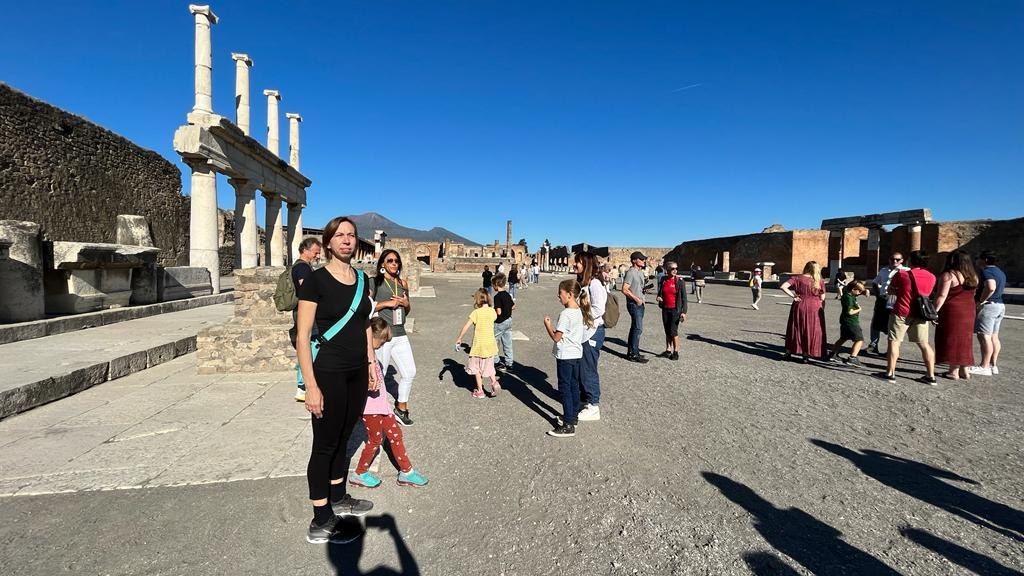
After forty years of anticipation, I finally explored Pompeii—and made it my perfect day. From entering first at sunrise to wandering its ancient streets until sunset, here’s how to experience the Roman city at its most magical.
I waited forty years for Pompeii. Not out of procrastination, but out of reverence. The love I have for Roman history—the empire, the infrastructure, the architecture, the ever-present attention to balance and beauty— is total, and Pompeii sits at the absolute summit of my fascination: a city returned almost intact from the past, paused mid-gesture, mid-sentence, mid-life. Nothing else comes close. So, when the moment finally arrived, I had to make sure it would be flawless.
I watched the weather for days because Pompeii demands sun. These are solar lands, shaped by light and shadow, and I wanted the stones to glow. I also wanted time—maximum time—so I planned my day around the switch to daylight saving time, which gave me a quiet advantage. I arrived fifteen minutes before opening, heart racing like before a front-row concert (and yes, I barely slept the night before). It was worth every second.
A Compressed History of Pompeii, From Prosperity to Ash
Oh, Pompei. Well, you know the story. Founded in the 7th century BC and shaped by Oscans, Greeks, Samnites, and Romans, Pompeii flourished under Roman rule. By the 1st century AD, it was a fully functioning city with paved streets, running water, bath complexes, theaters, temples, and a daily rhythm that blended business, leisure, and ritual with astonishing sophistication. Everything stopped in the fall of AD 79, when Mount Vesuvius erupted. Ash and pumice buried the city under roughly 13 to 20 feet of debris, sealing houses, objects, food, graffiti, and people in place. Lost for centuries and rediscovered in the 18th century, Pompeii returned not as a reconstruction but as a time capsule.
Today, about 170 acres are excavated—roughly two-thirds of the ancient city—with more than 8 miles of streets. Walking Pompeii means crossing an entire urban system at human scale, which explains why it still feels shockingly alive nearly two thousand years later. So, yes, you have to walk, and you have to walk a lot, and come across homes, shops, bars, brothels, warehouses, gardens, and public buildings. And yes, you will be amazed.
The Art of Arriving First
Ok, so there I was, at the entry of Piazza Anfiteatro, ready for the run of my life. A little man approached and opened the gates. And I did something radical: I ditched the rest of my party. I wanted to enter first, alone, focused, undistracted. And I did. I crossed the threshold of Pompeii as the very first visitor of the day. A custodian looked at me: “Signora, ha dormito dentro?” Had I slept inside? It felt like it.
I had chosen the Piazza Anfiteatro entrance with intention: it allowed me to walk the entire length of Via dell’Abbondanza, Pompeii’s main artery, east to west, and reach the Forum organically, the way a Roman citizen would have, the sun rising behind me. I was elated. I walked alone through thermopolia just kissed by the new light, their counters still cool, frescoes waking up slowly. The silence was total. When I reached the Forum, the emptiness began to soften. A few figures appeared in the distance. The city felt as if it were stretching after sleep, resuming a normal Roman morning.
Get a Guide and Wait for the Sunset
Later in the morning, after regaining my party, we joined a guided visit, and this is non-negotiable advice: get a guide. A great guide knows which domus are open that day, how to anticipate crowds, and when to move fast or linger. They unlock houses you would otherwise walk past, explain symbols hidden in mosaics, decode political graffiti, and share the small, delicious secrets that turn ruins into lived space. If you have a specific obsession—baths, frescoes, domestic architecture—a guide will tailor the route. Pompeii rewards curiosity, and expert knowledge multiplies joy.
When the tour ended, we stepped outside the site to breathe, hydrate, recalibrate. The ticket allows re-entry, and I took full advantage. I went back in alone again, determined to stretch the day until its final light. I don’t know how much I walked. Afternoon slid into evening, and Pompeii slowly emptied. This was my favorite moment. With fewer people, the scale shifts. Streets feel narrower, houses more intimate. I wandered without urgency, retracing routes, discovering a domus I had missed, lingering in the palestra (gym), stopping in front of a mosaic just because the light had changed. As the sun lowered, everything softened—the colors, the air, the mood. Happiness settled in, pure and physical. I walked and walked, aware that this was a once-in-a-lifetime rhythm. I was the last one out. Another custodian smiled: “Signora, vuole rimanere chiusa dentro?” Did I want to stay locked in? Part of me absolutely did.
Two Things You Must Never Skip
First: the Villa of the Mysteries. Reached by walking past the necropolis, it feels like crossing into another dimension.
For forty years, Pompeii lived in my imagination. Then, one spring morning, I stepped through its gates before anyone else, walked its ancient streets in silence, and stayed until the last light faded. Some places are worth waiting a lifetime for.

Traveled with
Every story carries its receipts. Something out of date? Tell the editor and the "Last updated" line changes when we fix it.

Spot a fact that's off? A name we misspelled? Tell us. It lands on the editor's desk.
hello@thatlayover.life →