King Tut was the poor one, Ramesses put his name on everything, Hatshepsut got chiseled out, and our felucca sat still in the Nile for a very ancient reason.
Nancy Carleton spent a week in Egypt in October 2022 with her husband Jay and two friends, from Giza and Cairo to Luxor, Aswan and Abu Simbel. The Nile flows north, so upriver means south, and for much of the year the wind blows from the north, letting boats sail south and drift north on the current; the ancient hieroglyph for traveling south is a boat with its sail up, and for traveling north a boat with its sail down. The Unfinished Obelisk at Aswan, believed commissioned by Hatshepsut for Karnak, would have stood about 42 meters and weighed about 1,168 tonnes before the granite cracked.
King Tut, it turns out, was the poor one.
Egypt History 101, by us
King Tut was the poor one. He is only famous because his tomb was intact. Tutankhamun was a fairly minor king with a short reign, buried in a tomb so small that the roughly 5,000 objects inside had to be stacked tight. Every bigger, richer royal tomb in the Valley of the Kings was robbed in antiquity. His entrance got buried under debris and forgotten, so his was the one Howard Carter found nearly whole in 1922. Egypt's own antiquities ministry calls his fame one of history's great ironies. We call it winning the lottery by being overlooked.
HRH Rami numero II is the true baller of the Pharaohs. Ramesses II ruled for about 66 years, built more than any pharaoh before or after him, and when he ran out of his own monuments, he carved his name onto other kings' monuments. At Abu Simbel he had four colossal seated versions of himself carved straight out of the mountain. A man who knew his brand.
Age is relative. The oldest rocks we stood next to are about 4,500 years old, which makes anything from seven hundred years ago suddenly seem like the young one. Even Jay looks young here.
Respect your moms, fools. Hatshepsut ruled Egypt as pharaoh for about twenty years, first as regent for her young stepson, then as king in her own right. She sent a famous trading expedition to the land of Punt, which came home with myrrh trees, and her reign was peaceful and rich enough to pay for some of the most daring buildings in Egypt. We stood in front of the best of them, her temple at Deir el-Bahri, three terraces built straight into the cliffs on Luxor's west bank. A boss b*tch, in other words.
She was not technically the one and only female pharaoh. Sobekneferu ruled centuries before her, and Twosret and Cleopatra came after. But Hatshepsut was the most successful of them, and you have still probably never heard of her, because men. One man in particular: about twenty years after she died, that same stepson, Thutmose III, had her statues smashed and her name and image chiseled off the monuments. Nobody is entirely sure why. Historians are still arguing about it. I have a theory, and it is "men."
Surviving the Sahara: important must-knows
- Camels still like scritches behind their ears.
- Download the local Egyptian Spotify hits to confuse the locals.
- Sand.
- Remember the '80s? Yeah, everyone still smokes here. Everywhere.
- The weather forecast is useless.
- If you have a chance to go through dark underground tunnels playing the Indiana Jones theme, do it.
- Insert puns. All of them. Who's your mummy?
- An unfinished obelisk lying on the ground is just a rock, kids. (A very ambitious rock. More on that below.)
- Always give the little kids on paddle boards money if they sing "Despacito."
Bartering tips
- When offered books to buy, ask the vendor, "Do I look like someone who reads?"
- Security guys, with or without guns, will still try to hustle you. So will the casino.
- Speaking of hustling: we accidentally bought a frequent potty punch card at a pay restroom, because change is not always a thing.
- Always negotiate, except for electronics and cars.
Other worldly advice
- The Egyptians don't walk like that.
- Nails fix sandals. I don't recommend it.
- Find yourself the kind of friends who order extra falafel at breakfast.
- Everyone tells you that you are beautiful. You are!
- Every day, regardless of the original start time, will somehow start at 3 a.m.
- Vegetarians are not a thing here. Chicken broth is still not vegetarian. Nor is ham.
- Not all Egyptian SIM cards are made alike.
- Technically, Heineken is a local beer. Egypt's big brewer, Al Ahram Beverages, the maker of Stella and Sakara, has been owned by Heineken since 2002.
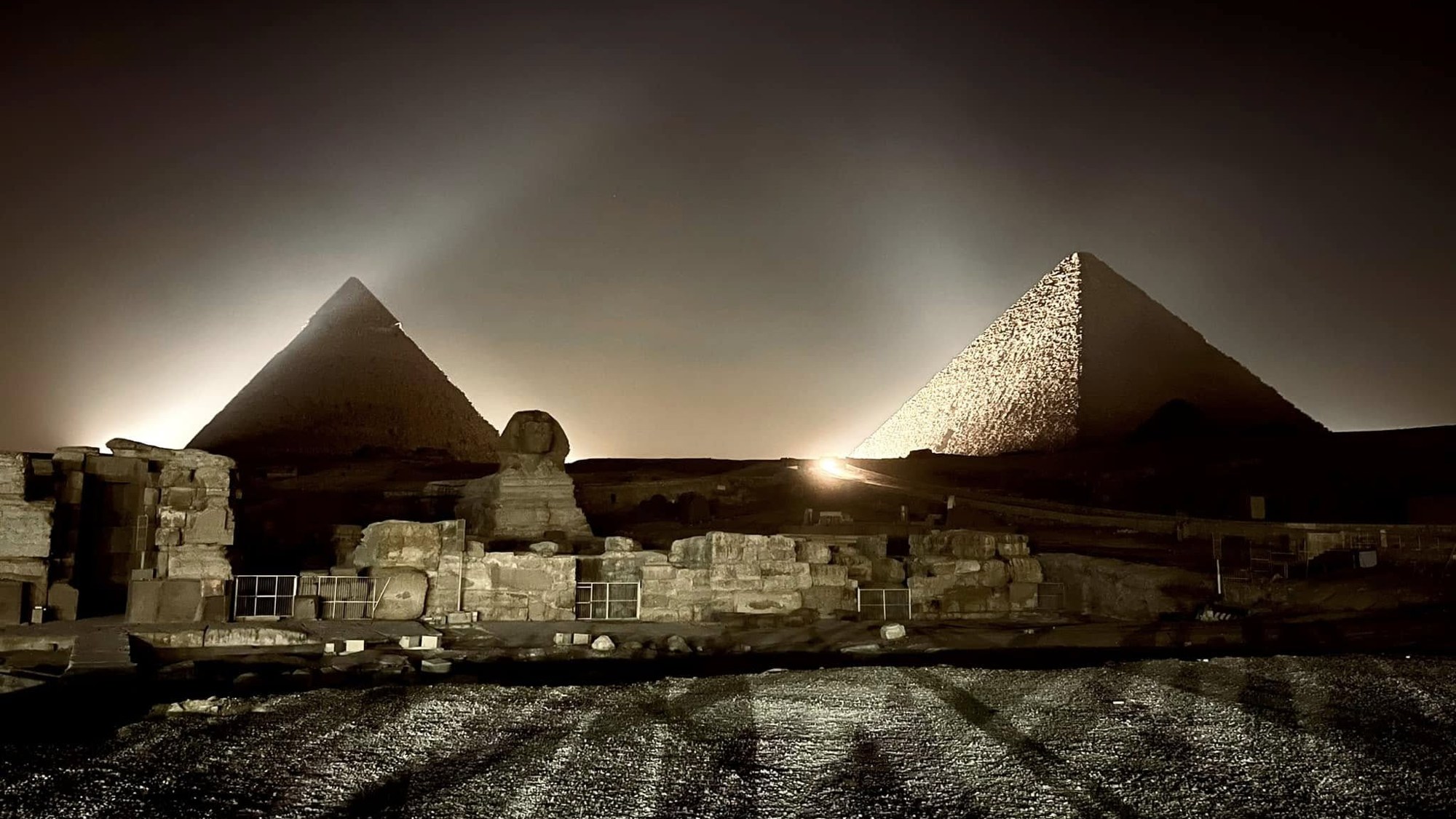
- Check out the MGM-style light show over the Giza pyramids. You will be nostalgic for old-timey movies.
Over the Nile
- Upriver is south, and downriver is north.
- Your felucca relies on wind, and if there is none, you sit in the Nile.
- In a hot air balloon, you can charge your phone when crossing a power line.
- The Nile is bigger than you expect. Yes, even bigger than that. Still bigger.
Why upriver is south
That first one broke my brain, so here is how it works.
The Nile flows north. It rises far to the south and runs the length of Egypt to the Mediterranean, which means "up" the river is south and "down" the river is north, the opposite of every map on every classroom wall. It is why Upper Egypt is at the bottom.
Now the good part. For much of the year, the wind on the Nile blows the other way, from north to south. So the river is a two-way road with a built-in engine for each direction. Going north, you take the sail down and let the current carry you. Going south, you put the sail up and the wind pushes you against the current. That is it. That is the system. It moved grain, stone, armies and, eventually, us.
The ancient Egyptians thought this was so fundamental that they wrote it into their script. The hieroglyph for traveling south is a boat with its sail up. The hieroglyph for traveling north is a boat with its sail down.
It also explains the unfinished obelisk. Hatshepsut is believed to have ordered it from the granite quarries at Aswan, in the far south, for the temple of Amun at Karnak, downriver. Had it been finished, it would have stood around 42 meters tall and weighed about 1,168 tonnes, taller than any obelisk Egypt ever raised. The plan was to cut it free, float it north with the current, and stand it up in front of a temple. Then the granite cracked, and it has been lying in the quarry ever since. Just a rock, kids. A rock that was supposed to ride the Nile.
So when our felucca sat dead still in the middle of the river, we were not broken down. We were experiencing ancient Egyptian logistics exactly as designed: no wind, no south.
If you go
- The Unfinished Obelisk is in the northern granite quarries at Aswan. Egypt's Ministry of Tourism and Antiquities lists it as open daily from 7 a.m. to 4 p.m., with a foreign adult ticket at EGP 220 at the time of writing. Check before you go; prices change.
- Feluccas run on wind. Build slack into anything scheduled after a sail.
- Vegetarians: ask what the soup is made with. Then ask again.
- Negotiate for nearly everything, except electronics and cars.
- Carry small change. Or prepare to become a loyalty-card member of a public restroom.
What I'm taking home
Egypt is one long argument about who gets remembered. Tut, by accident, for a tomb nobody got around to robbing. Ramesses, by volume, for putting his name on everything, including other people's things. Hatshepsut, in spite of a chisel.
And the river only goes one way. If you want to go the other, you put up a sail and wait for the wind.
I highly recommend grabbing some of your favorite friends on the planet and heading out on a historical adventure. My joyous heart is boarding a flight, still full of a week of beautiful memories.
Egypt is one long argument about who gets remembered. No wind, no south.
Why is Upper Egypt in the south?
The Nile flows north to the Mediterranean, so upstream is south. Upper Egypt is the upstream, southern part of the valley.
How did ancient Egyptians sail up the Nile?
The current carries boats north, and for much of the year the wind blows from the north, so boats raised a sail to travel south. The hieroglyph for traveling south is a boat under sail.
Why is King Tut so famous?
Tutankhamun was a minor king, but his small tomb was the only royal tomb in the Valley of the Kings found relatively intact, discovered by Howard Carter in 1922.
Was Hatshepsut the only female pharaoh?
No. Sobekneferu ruled earlier, and Twosret and Cleopatra VII later, but Hatshepsut was the most successful, ruling for about twenty years.
How big is the Unfinished Obelisk in Aswan?
Had it been finished, about 42 meters tall and about 1,168 tonnes, according to Egypt's Ministry of Tourism and Antiquities. It was abandoned when the granite cracked.
Is Stella beer owned by Heineken?
Yes. Its maker, Al Ahram Beverages, has been owned by Heineken since 2002.
No links in this story are affiliate links.
Sources used in reporting this story:
- Egypt Ministry of Tourism and Antiquities, The Unfinished Obelisk
- Egypt Ministry of Tourism and Antiquities, Tomb of Tutankhamun
- Ancient Egypt Online, Tomb of Tutankhamun (KV 62)
- Metropolitan Museum of Art, Hatshepsut: From Queen to Pharaoh
- Artnet News, on the destruction of Hatshepsut's statues
- Ancient Egypt Online, Female Pharaohs
- Ohio State University eHistory, Ramses II
- Houston Museum of Natural Science, Boat Model
- PBS NOVA, Mysteries of the Nile
- BAR Publishing, Sails and Rigging of Ancient Egyptian Ships (introduction)
- Al Ahram Beverages, History
- MEED, Heineken bids for Al-Ahram Beverages (2002)

Traveled with
Every story carries its receipts. Something out of date? Tell the editor and the "Last updated" line changes when we fix it.


Spot a fact that's off? A name we misspelled? Tell us. It gets fixed within 24 hours.
hello@thatlayover.life →