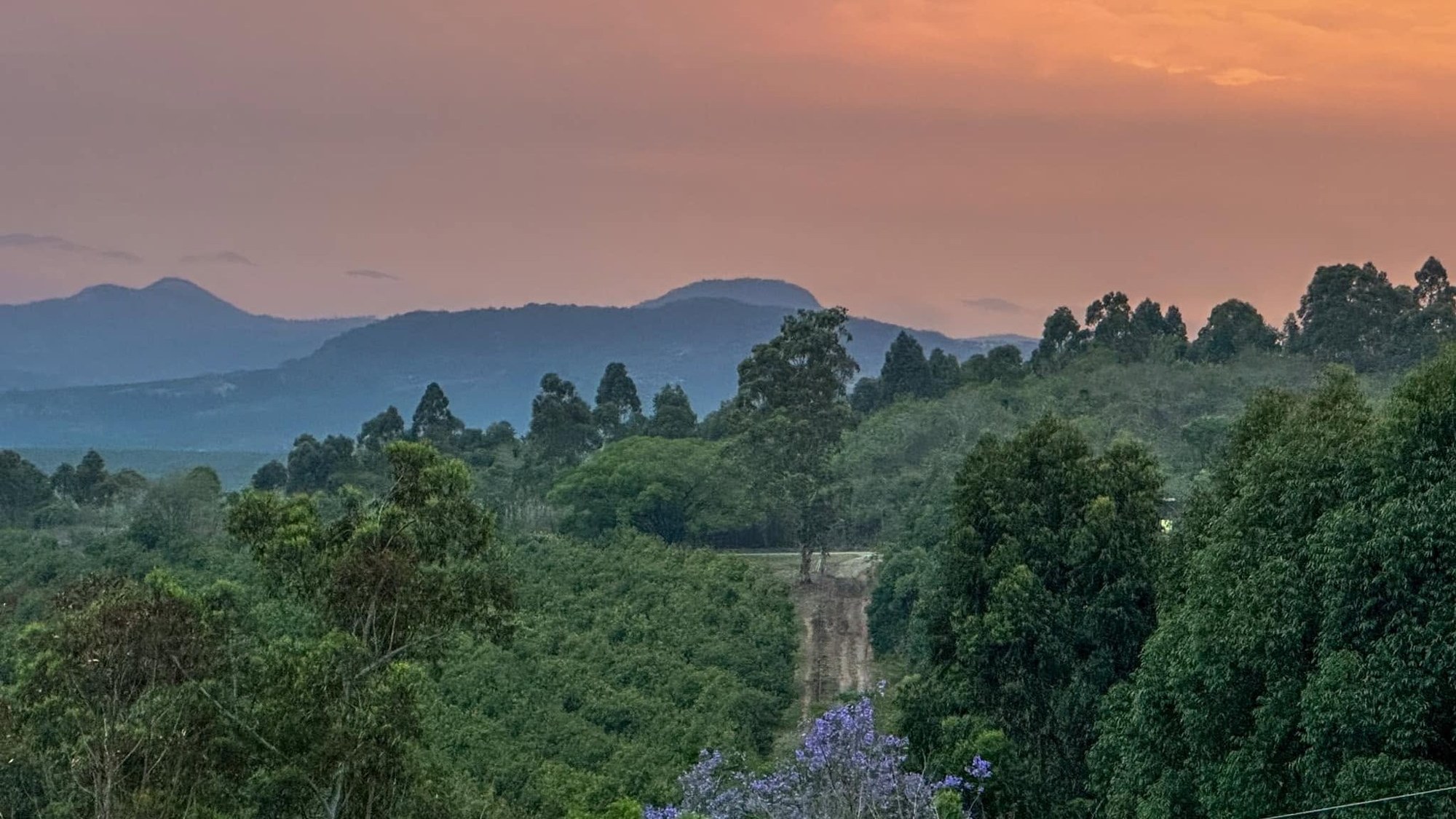
A remote-work trip through Cape Town, Kruger, Eswatini and Lesotho, with a marathon, a leopard's pantry, a guide who tried to sell me at a border, and one small car whose passenger count I am still processing.
Nancy Carleton's October 2024 trip ran from the Sanlam Cape Town Marathon to Kruger National Park, then into Eswatini and Lesotho, the two countries inside or mostly inside South Africa. Lesotho is an enclave entirely surrounded by South Africa, and its lowest point, 1,400 meters at the junction of the Orange and Makhaleng rivers, is the highest low point of any country. Eswatini borders South Africa on three sides and Mozambique on the east. In Kruger, a leopard had hoisted an impala into a tree: research in the neighboring Sabi Sand reserve found leopards hoist about half their kills, mainly to stop spotted hyenas stealing them.
I booked this trip before I took a new job, which is the only defense I can offer for the 4 a.m. alarms.
Same time zone, technically. In practice, it meant meetings in the morning, wildlife in the margins, and a lot of coffee in between. Future travel will be booked differently, for my sanity.
Cape Town, I'm falling hard for you
Jay and I opened with the Sanlam Cape Town Marathon, because who doesn't love a little self-punishment on holiday.
The rituals were observed. Sacred pasta carb-loading at a trendy spot the night before. A celebratory fancy multi-course dinner on the waterfront after, where we watched Instagram hotties do their best model face in front of harbor seals who wanted no part of it.
Then water taxis, the rainbow streets, and a little shopping. I bought a lovely bread bowl cover, because Nara Smith's TikToks had convinced me that if I owned a pretty one, I would finally start baking. I will still never make Jay bread. But the cover is beautiful.
This wasn't my first time in South Africa. On the last visit, in classic American-geography fashion, I discovered that there were two entire countries tucked inside it. In even more classic American-geography fashion, I was half right. Lesotho is completely surrounded by South Africa. Eswatini is mostly surrounded, with a short border with Mozambique on its east side. Either way, I had never been to either, and that was not going to stand.
Detour: Kruger, and the leopard's pantry
Inspired by Ricky, I made a quick safari stop in Kruger National Park.
The adventure started with a bang, literally. Lightning struck our lodge and killed the hot water pump. Cold showers have never once looked glamorous, but the storm was stunning, and the rain made for the best white noise ever.
Then the animals. On top of the Big 5, I added a mongoose, hyena pups, and a sable antelope to my lifetime list. And a leopard had carried an un-alive impala up into a tree, which, as murder goes, was pretty cool to see.
Why the impala was in the tree
Here is the part I did not understand until later: the leopard was not being dramatic. It was protecting its groceries.
Leopards are solitary, and in a place like Kruger they share the ground with lions and with spotted hyenas, which hunt in groups and are very, very good at stealing. A leopard that makes a kill and eats it on the ground is a leopard that is about to lose it.
So they hoist. A long-running study in the Sabi Sand Game Reserve, which borders Kruger, found that leopards hauled 51 percent of their kills into trees, and that at least 21 percent of kills were stolen anyway, mostly by spotted hyenas. Leopards were more likely to hoist when competitors were around, and they could feed on a hoisted kill for longer. The cost of not hoisting turned out to be real: female leopards that lost more kills raised fewer cubs.
The tree is not a stage. It is a pantry with a lock on it, and the lock works because hyenas cannot climb.
Which puts the hyena pups in a different light. Fluffy, curious, and, statistically, the future reason that impala is up a tree.
Eswatini: enter Crazy Dave
Eswatini was a vibe.
I toured with Crazy Dave, whose nickname, by his account, comes from running from Nelspruit to Cape Town in 40 days. If you need humility, that's how you get it.
First stop was a school, where I was swarmed with tiny hugs and fist bumps. Then a cultural center, where I learned about cattle as bride wealth and polygamy, and performed a spear dance. (A correction I owe the people who taught me: the bride wealth, called emalobolo or emabheka, is very much a living practice, and polygamy is still legal under Swazi customary law, though cattle prices keep it rare.)
Also, Dave tried to sell me to border control. It was framed as a joke. I am not fully convinced it was a joke.
After that came the makers. Candle-making at Swazi Candles in Malkerns, where artisans borrowed a technique from Italian glasswork called millefiori: patterned wax is built up into rods, sliced thin like veneer, and wrapped around a plain core, so the design glows like stained glass as the candle burns. Then glass-blowing at Ngwenya Glass, where everything is made from recycled bottles collected locally, in furnaces fueled by used cooking oil.
I drooled over African textiles, gushed over peacocks, and came home with a glass-blown warthog bottle stopper. Pumbaa is life.
Lesotho: born in the mountains
True story: I have used the Lesotho flag emoji for years, because it looks like the Cascadia flag. Blue, white and green, with a black emblem in the middle. Portland Timbers fans, you know the one. (If you want to fully nerd out on all things flags, the word you are looking for is vexillology.)
It turns out the resemblance runs the other way. Portland's Alexander Baretich designed the Cascadia "Doug" flag in the mid-1990s. Lesotho's current flag, with the black mokorotlo, the traditional Basotho straw hat, was unfurled in October 2006 for the country's 40th year of independence. Blue for rain, white for peace, green for prosperity. Beyond the emoji, though, I knew zilch about the place. And wow, was I missing out.
The whole country sits above 1,000 meters. Its lowest point, where the Orange and Makhaleng rivers meet, is 1,400 meters up, which is the highest low point of any country on earth. Even the bottom of Lesotho is a mountain.
The town was bustling with a military festival: parades, and a great deal of partying. I wandered through town, chatted with locals, and swapped stories over Maluti beers. The highlight was the pure, collective shock when I explained that yes, our dog does have a Halloween party to attend.
It was chaotic, vibrant, and beautifully random, the way the best travel always is.
If you go
- The Cape Town Marathon has moved. It now runs in May, and as of 2026 it is the first World Marathon Major in Africa. The first official Major edition is 23 May 2027. Check the new date before you plan around October.
- Eswatini from Kruger is doable in a long day. Day tours run out of Nelspruit (Mbombela). You will only scratch the surface, but you will scratch it well.
- Swazi Candles is in Malkerns, and Ngwenya Glass is at Motshane. Both let you watch the work being done. Budget suitcase space for something breakable.
- Lesotho is high. Pack layers even when South Africa is warm.
What I'm taking home
I came looking for two countries inside another one and got the geography half wrong. Lesotho is surrounded on every side by somewhere else, and it still made a stranger feel like she was the one who had been missing out. She was.
Another stamp in the passport, another plane ride, and a much richer set of memories.
Until next time, my fellow wanderers.
P.S. If you made it this far for the goat intel, you're welcome: fourteen live goats, one small car. I didn't believe it either, but here we are.
The tree is not a stage. It is a pantry with a lock on it. Even the bottom of Lesotho is a mountain.
Why do leopards put their kills in trees?
To stop them being stolen. In the Sabi Sand Game Reserve next to Kruger, leopards hoisted 51 percent of their kills, and at least 21 percent of kills were still stolen, mostly by spotted hyenas, which cannot climb. Females that lost more kills raised fewer cubs.
Is Eswatini inside South Africa?
Mostly, not entirely. Eswatini borders South Africa on three sides and Mozambique on the east. Lesotho is the country completely surrounded by South Africa.
Why is Lesotho called the Kingdom in the Sky?
Its lowest point, where the Orange and Makhaleng rivers meet, is 1,400 meters above sea level, the highest low point of any country.
What do the colors of Lesotho's flag mean?
Blue for rain, white for peace and green for prosperity, with a black mokorotlo, the traditional Basotho straw hat, in the center. The current flag dates from October 2006.
Is polygamy legal in Eswatini?
Yes, under Swazi customary law, though it is rare, largely because of the cost of bride wealth paid in cattle.
When is the Cape Town Marathon?
It has moved from October to May. It became Africa's first World Marathon Major after the May 2026 race, and the first official Major edition is on 23 May 2027.
Can you visit Eswatini on a day trip from Kruger?
Yes. Day tours run from Nelspruit (Mbombela). It is a long day and covers only part of the country.
Places named in this story: Swazi Candles (Malkerns) and Ngwenya Glass (Motshane), Eswatini. No links in this story are affiliate links.
Sources used in reporting this story:
- Balme et al. (2017), Caching reduces kleptoparasitism in a solitary, large felid, Journal of Animal Ecology
- CIA World Factbook, Lesotho
- CIA World Factbook, Lesotho flag
- SANBI Red List of South African Species, Sable Antelope
- Eswatini High Court, Dlamini v Public Service Pension Fund (2008), on emalobolo
- The New Humanitarian, on polygamy and lobola in Eswatini
- Cascadia Department of Bioregion, history of the Doug flag
- Homo Faber, Swazi Candles
- Homo Faber, Ngwenya Glass
- SAnews, Cape Town Marathon earns World Major status

Traveled with
Every story carries its receipts. Something out of date? Tell the editor and the "Last updated" line changes when we fix it.

Spot a fact that's off? A name we misspelled? Tell us. It gets fixed within 24 hours.
hello@thatlayover.life →