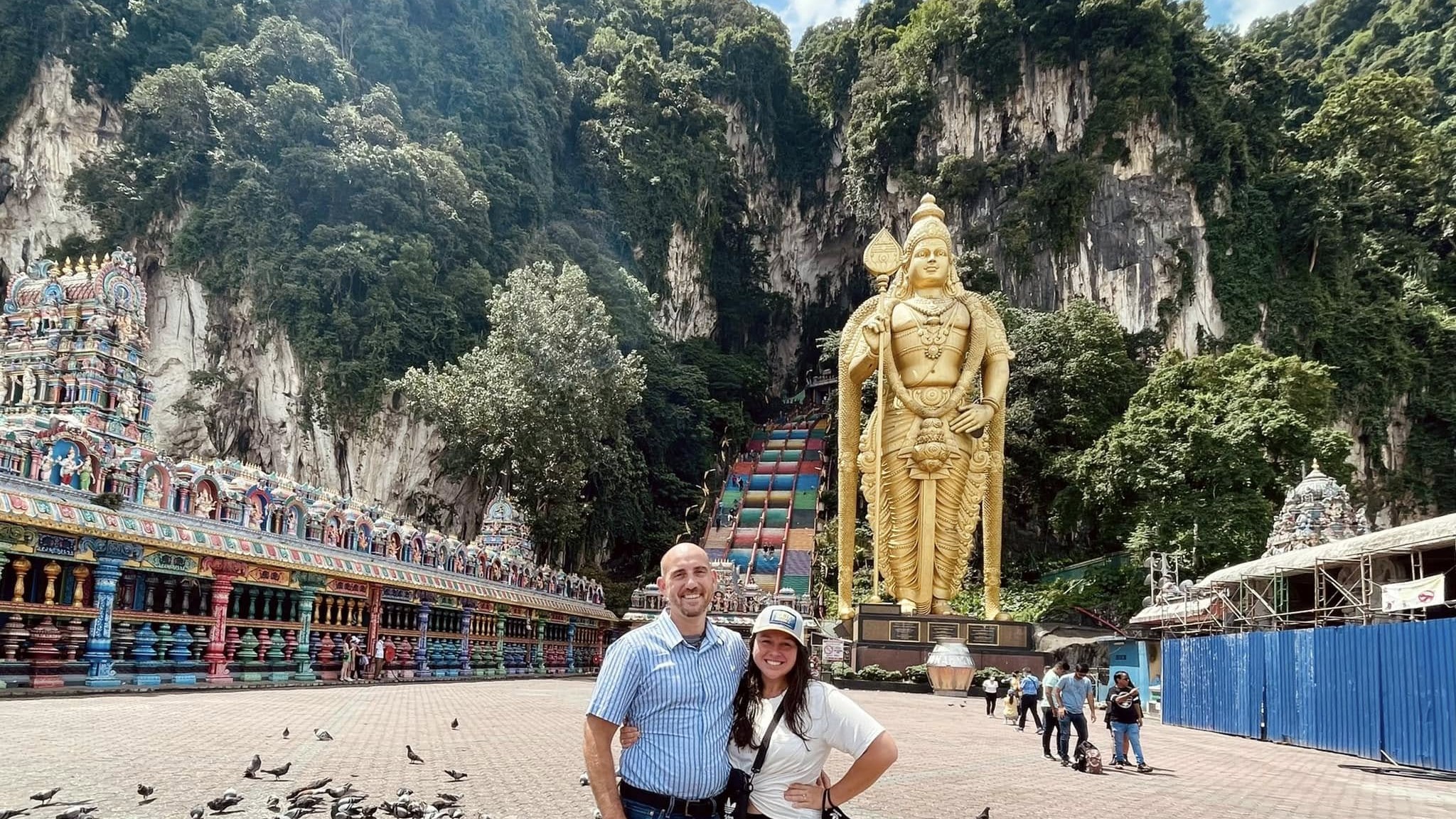
Jay went to Kuala Lumpur without me, and I could not let it go. One shared carry-on, two days, 272 rainbow steps, monkey babies all over, and the reason a city is named for mud.
Nancy Carleton and her husband Jay spent a weekend in Kuala Lumpur, Malaysia, in July 2022, visiting the Batu Caves, the Royal Selangor pewter visitor center and a batik museum. Kuala Lumpur means "muddy confluence" in Malay: the city began around 1857 where the Klang and Gombak rivers meet, as the landing point for Chinese miners sent to open tin mines. By the late nineteenth century Malaya was the world's largest tin producer, and Royal Selangor, founded in 1885 by the pewtersmith Yong Koon, grew into the world's biggest pewter maker. Reported first-hand for That Layover Life.
Jay went to Kuala Lumpur once without me, and I could not let it go.
FOMO is real, y'all
A few years back, when Jay was based in the Philippines, he hopped over to Malaysia for a dose of something new. He came home with stories. I came away with a condition. I could not get it out of my head that I needed to see it too.
So we packed one shared carry-on and took a weekend road trip via the skies to Kuala Lumpur. Two jam-packed days: scrumptious food, temple tours at the Batu Caves, batik and pewter museums, monkey babies all over, and an ongoing search for Natalie Liew.
272 steps and a lot of monkey babies
The Batu Caves sit in a limestone hill on the northern edge of the city, and you know you have arrived when a gold statue the height of a twelve-story building is looking down at you. That is Lord Murugan, unveiled in 2006, 42.7 meters tall, standing guard at the foot of the staircase.
The staircase is the other headline: 272 steps up to the Temple Cave, repainted in 2018 in every color a paint store sells. Somewhere on the way up I threw both arms in the air, which is the correct response to 272 steps.
Inside, the cave opens straight up to the sky, with light pouring down through a hole in the roof onto one more flight of stairs. Outside, stalls hang marigold garlands in yellow, orange, red and blue, next to bundles of peacock feathers and bubble wands for the kids.
And then there are the monkeys. Long-tailed macaques run the place. They sit on the gold finials of the railings like they were installed there, and they look at you like you owe them rent. The mothers were the best part: babies tucked under their arms, babies on the steps chewing on bits of string, babies with ears that were somehow pinker than anything else in the cave. Monkey babies all over. I did not stop taking pictures.
The city named for mud
Here is a thing I did not know until after: Kuala Lumpur is named for mud, and it exists because of tin.
In Malay, kuala is the place where two rivers meet, and lumpur is mud. Around 1857, a Selangor chief, Raja Abdullah, raised money from Chinese merchants in Malacca to send miners up the Klang River looking for tin. The muddy confluence of the Klang and the Gombak was as far upriver as boats could conveniently bring supplies, so that is where the miners landed, and where the town began. You can still see the confluence behind Merdeka Square, at the Masjid Jamek.
Tin made the place. Chinese miners poured into Perak and Selangor through the second half of the nineteenth century, and by the end of it, Malaya had overtaken Britain as the world's largest tin producer. In 1885 a young pewtersmith named Yong Koon sailed from Shantou to the tin town, opened a shop on Cross Street, and started making incense burners and candlesticks for temples and wealthy mine owners. His touchmark translated as "Jade Peace, Pure Tin." His business became Royal Selangor, now the biggest pewter maker in the world.
Pewter is mostly tin. Royal Selangor's is 92 to 97 percent tin, with a little copper and antimony added because pure tin is soft. Pure tin also has a party trick: below 13.2°C, it can slowly rearrange its atoms from silvery metal into brittle gray powder. Conservators call it tin pest, and it spreads once it starts. Some elements dissolved into tin can hold it off. Kuala Lumpur, conveniently, is not a 13-degree kind of town.
Jay and the world's largest tankard
Out front of the Royal Selangor Visitor Centre stands a pewter tankard almost two meters tall, made in 1985 for the company's 100th birthday and certified by Guinness as the largest in the world. Jay posed with it like he had personally ordered it and was waiting for the refill.
Batik, or how to paint with wax
The batik museum was the quiet surprise. Batik works backwards from how you would expect: the artist draws in hot wax wherever the color should not go, dyes the cloth, and the wax keeps those lines clean. Layer by layer, wax and dye and wax again, until you get florals in pinks, purples and blues so saturated they look lit from behind. Our demonstrator made it look easy. It is not easy.
Still looking for Natalie
Natalie is still not to be found. (I do miss her.) But I had a grand ol' time on the hunt.
If you go
- Batu Caves is free to enter. The KTM Komuter train runs from KL Sentral straight to Batu Caves station.
- Dress for a temple. It is an active Hindu shrine; cover shoulders and knees.
- The monkeys want your snacks. Do not carry food or plastic bags up the stairs.
- Go early. Those 272 steps are steep, and the day gets hot fast.
- Royal Selangor's Visitor Centre is in Setapak, at the company's headquarters, with a gallery on tin and pewter history and the giant tankard out front.
- Batik: the National Textile Museum on Merdeka Square has galleries on batik and Malaysian textiles, and is a short walk from the river confluence the city is named for.
- Entry: US citizens can visit visa-free for up to 90 days, but you must complete the free Malaysia Digital Arrival Card online within three days before you land.
The case for FOMO
FOMO gets a bad rap. Mine got me a city built on mud and tin, a hill full of monkey mothers, and a weekend with my favorite person out of one carry-on. Sometimes the fear of missing out is just your travel planner, being right.
Kuala Lumpur is named for mud, and it exists because of tin.
Why is it called Kuala Lumpur?
In Malay, kuala means the place where two rivers meet and lumpur means mud. The city began around 1857 at the muddy confluence of the Klang and Gombak rivers, where tin miners landed.
How many steps are there at Batu Caves?
272 steps lead up to the Temple Cave. They were repainted in rainbow colors in 2018.
How tall is the Lord Murugan statue at Batu Caves?
42.7 meters (140 feet). It was unveiled in 2006.
What is pewter made of?
Mostly tin. Royal Selangor's pewter is 92 to 97 percent tin, with small amounts of copper and antimony to strengthen it.
Do US citizens need a visa for Malaysia?
No, for stays of up to 90 days, but every visitor must complete the free Malaysia Digital Arrival Card online within three days before arrival.
Sources used in reporting this story:
- About tin mining, Economic History of Malaysia
- The Soul of Tin, Museum Volunteers JMM
- Kuala Lumpur at the beginning of the 20th century, Pictures from History
- Crafting 135 Years of History, Royal Selangor
- About Pewter, Royal Selangor
- Pewter Power: Royal Selangor, Luxurious Magazine
- Tin, University of Oxford Mineral Care, on tin pest
- Investigation of allotropic beta to alpha Sn transition, Illés et al., Acta Materialia Turcica, 2020
- Batu Caves sports colourful new look, New Straits Times, 2018
- National Textile Museum, Visit Selangor
No links in this story are affiliate links.

Traveled with
Every story carries its receipts. Something out of date? Tell the editor and the "Last updated" line changes when we fix it.

Spot a fact that's off? A name we misspelled? Tell us. It gets fixed within 24 hours.
hello@thatlayover.life →