
A Copenhagen to Luxembourg road trip with a Samoyed: cranes at golden hour, 100,000 pumpkins, and a half marathon along the Moselle to the village that gave Europe its open borders.
Schengen is a real place: a small wine-growing village in Luxembourg on the Moselle, at the point where Luxembourg, Germany and France meet. The Schengen Agreement that opened Europe's internal borders was signed there on June 14, 1985, aboard the river boat Princesse Marie-Astrid, which now sits in Schengen as a floating museum. We drove there from Copenhagen with our Samoyed in October 2026, stopping for cranes at the Rehdener Geestmoor in Lower Saxony and the pumpkin show at the Krewelshof Eifel, then ran a half marathon from Remich along the Moselle to Schengen, crossing into France and Germany on foot. Public transport in Luxembourg is free for everyone, including tourists.
Magnus Waffles, my land cloud and a deeply opinionated Samoyed, has never once offered to drive on our road trips, but he did get us out of a corn maze in Germany, which is more than I managed. That maze was one stop on the long way to Schengen: a ferry, a lake, a bog full of cranes, and roughly 100,000 pumpkins between Copenhagen and the village that gave Europe its open borders.
The plan, if you could call it that
Years ago, I watched a Yes Theory video about running across Luxembourg, and the idea lodged itself in my brain. Luxembourg is small, but it packs more history per square kilometer than countries with their own Netflix category. I wanted to see it the slow way: on foot. Really slow, in my case. This was not the full crossing. This was the reconnaissance.
For someone who needs each day to feel at least slightly different from the last, a new country is not a treat. It is basic maintenance. Luxembourg sits wedged between Belgium, France, and Germany, three places I know well enough to have opinions about (and snacks I can rank), and somehow I had never managed to get that final checkmark on the map.
So I loaded the Mercedes 4MATIC with two foam pads for car camping and installed Magnus in the front seat, where he sits upright, attentive, and radiating the self-satisfaction of the nepo-doggy that he is. Germany lets you sleep in your car to restore your fitness to drive, which meant I had a backup plan if no campsite would take us. I took my business meetings from the road, dialing in from rest stops and parking lots.
Day one: the ferry
We had pre-booked the Rødby to Puttgarden ferry and drove straight on. Timing could not have been better. I had a coffee, Magnus supervised, and we watched the sea together; on the German side, the light turned golden over fields of sunflowers. We celebrated with sparkling water and dried mangoes, because this is how we party now.
Cloppenburg, swans, and a Yorkie named for a queen
Next stop: Cloppenburg, where my friend Eileen lives. We met during my first Copenhagen era. She is German, an impressive lawyer, and everything she touches is professional and elegant. She is also, crucially, the kind of person who will let you show up with a Samoyed who must jump in the lake, despite her immaculate home.
Eileen has a seven-year-old Yorkie named Margrethe, like Denmark’s former queen who abdicated the throne and occasionally gets caught with a cigarette and a hot dog in her hands. Margrethe the Yorkie, a diva in her own right, wasn’t entirely convinced by a three-year-old land polar bear that invaded her home. Magnus took several dips in the lake chasing swans and geese, emerged covered in mucky mud, dug holes just in case he didn’t have enough dirt on him, then ate one of Margrethe’s tiny silicone balls and spent the afternoon regretting his life choices. On our way home, he brought her a replacement toy. I am choosing to believe it was an apology.
Cranes at golden hour
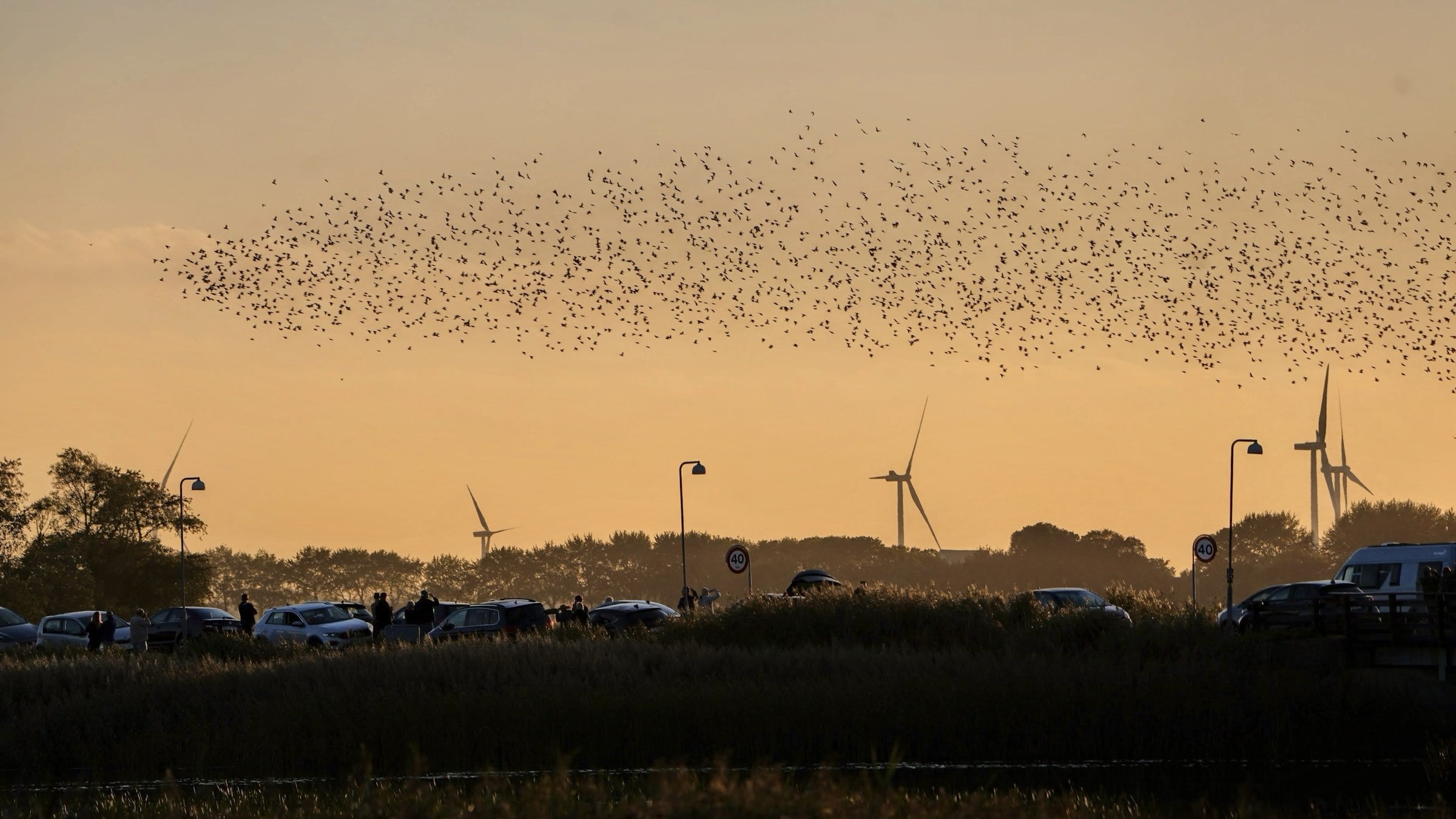
About thirty minutes from Cloppenburg is the Rehdener Geestmoor, a bog outside the village of Rehden where cranes stop and roost on their way south. I got there at golden hour, wind turbines turning on the skyline, and watched the cranes come in while I was on the phone with my second cousin Sam. We talked about family, and it felt good to hear from home, with all its mess and compassion, while the sky put on a show.
That night was the RV lot beside the Nettebad, Osnabrück’s enormous swimming and sports complex: 15 euros, paid at the pool reception, for a spot to sleep in the car, plus showers, a pool, and bathrooms. An absurd value for someone who usually lives in the Marriott and considers a mint on the pillow a basic human right.
How Cranes Choose a Hotel Room
The cranes are the reason that corner of Lower Saxony is worth the detour. Common cranes heading from Scandinavia and the Baltic to winter in France and Spain fly a narrow corridor, and they need specific places to stop. A rest site needs two things: shallow water to sleep in and stand up in, and nearby harvested fields to refuel on what the combines left behind.
The Diepholzer Moorniederung, a chain of bogs between Bremen and Osnabrück, has both. Over the past few decades, many of its old peat-cut bogs have been rewetted, and the cranes have noticed. It has become one of Germany’s largest crane stopovers, with more than 50,000 birds counted in the area on a single autumn day. Rehden is its busiest bog: BUND, which runs the counts, says no bog in Lower Saxony or Central Europe has recorded more resting cranes, and on a typical autumn evening 10,000 to 20,000 fly in. Before dusk they gather in the fields, then fly into the bog in long skeins to sleep. That is the moment worth standing in the cold for.
Day two: pumpkins on the way south
Friday morning, on the drive south, we stopped at the pumpkin show at the Krewelshof Eifel in Mechernich, which was the most autumn-harvest thing I have ever seen in the German countryside. This year’s theme was the jungle, which Magnus, being Brazilian, took as a personal invitation. There were pumpkins sculpted into parrots, cartoon characters, and at least one questionable likeness of a militant tiki man. A pumpkin pyramid, a tunnel of rainbow pinwheels, and a pumpkin disco. Every kind of squash: green and spiky, tiny and orange, giant ones everywhere you looked. Small children kept coming up to rub Magnus’s fluff, and he let them because he knew he was adorable.
Nothing is more entertaining than letting your dog choose the route through a corn maze. Once he decided the walk was over, he sniffed his way to the exit and led us straight out. I had no idea which way was out. He did.
Lunch was squash-filled pasta, a little like ravioli, with mashed potatoes, cranberries, and rhubarb soda (because I jam out to Barbaras Rhabarberbar, thank you, TikTok). It tasted exactly like October, if October were edible and slightly overachieving.
Luxembourg City
We reached Luxembourg that afternoon and went straight into the center. The narrow alleys are wonderful, and from the bridges you look down into the valleys and see openings in the rock: the casemates. I had assumed these were Roman. They are not. The first tunnels were dug in 1644 under Spanish rule; the French and Austrians later extended them until the city earned the nickname “Gibraltar of the North.” When they dismantled the fortress after 1867, they couldn’t remove the tunnels without taking part of the city with them, so about 17 kilometers remain. They are part of the UNESCO World Heritage listing.
The Luxembourg Marriott Hotel Alfa deserves a shout-out. They were dog-friendly, generally friendly, and genuinely unfazed by a very large white dog who considers himself a minor celebrity and expects a welcome gift.
That evening, my better half, Jay, flew in. I had booked a sitter through Pawshake for the next day: Çağatay, who handled Magnus like a pro. Would trust again.
Running to the town that named the border
Luxembourg made all public transport free in 2020, including for tourists. The buses are bright, colorful, and on time, and they took us east to the Moselle.
We started late because of technical issues at Remich and headed south through wine country along the river toward Schengen. Yellowing vines climbed the slopes on one side, the Moselle slid by on the other, and herons worked the riverbank.
Here is the thing we both knew without knowing it: we had spent years talking about ‘Schengen countries’ and ‘Schengen visas,’ and neither of us had clocked that Schengen is a real place. An actual, small, wine-growing village where Luxembourg, Germany, and France meet and politely ignore each other’s border signs.
Why Europe’s Open Borders Were Signed on a Boat
On June 14, 1985, representatives of five countries (Belgium, France, West Germany, Luxembourg and the Netherlands) gathered aboard a river cruise boat, the Princesse Marie-Astrid, moored on the Moselle at Schengen. They signed an agreement to abolish checks at their shared borders gradually.
The setting was the point. Schengen sits at the tripoint, so signing on a boat there put the ceremony almost on the border itself. A second document, the convention that turned the promise into working rules, was signed in the same village in 1990 and took effect in 1995. Today the Schengen Area covers 29 countries.
The boat is back, too. The Marie-Astrid was restored and returned to Schengen as a floating museum for the agreement’s 40th anniversary in 2025.
So we crossed into France at Apach, delightfully decorated for cross-border visitors, then over the bridge into Germany, which wasn't prepared for the party: three countries in a morning run without showing anyone anything. Our alarm delay shortened our planned run into a half marathon. We settled for that, plus bread and Nutella from the hotel, which is the only finish line I have ever respected.
The long way home
We came back, collected Sr. Waffles who had slept all day, and had a California burrito, which is the law if you are married to a Californian who insisted on reviewing it. Then we started north. We stopped in Cloppenburg for pastries and coffee with Eileen (this is when Magnus delivered the toy), and we car-camped our last night at Campingplatz Göken. It was dark and a little rainy, which, for reasons I cannot explain, made it the perfect end.
If you go
- Getting there from Copenhagen: the Rødby to Puttgarden ferry takes about 45 minutes. Pre-book and you drive straight on.
- Sleeping in the car in Germany: an overnight stop to get fit to drive again is generally tolerated. For a planned night, a paid pitch is better. Ours was the Wohnmobilstellplatz am Nettebad (Im Haseesch 6, Osnabrück): 15 euros for up to 24 hours, paid at the pool reception, with toilets and showers, and the ticket includes a 5-euro coupon for the pool.
- Cranes: the Rehdener Geestmoor near Rehden is best from October into November. Go for the evening fly-in and bring binoculars; there is an observation tower.
- Luxembourg transport: buses, trains and trams are free throughout the country. Only first class on trains costs extra.
- Where we stayed: Luxembourg Marriott Hotel Alfa, across from the main train station. Dog-friendly and lovely about it.
- Pet sitting: we used Pawshake for the run day.
- Pumpkins: the Krewelshof Eifel pumpkin show (Mechernich-Obergartzem) runs from late August to mid-November, daily 10:30 to 17:30. Tickets start at 8.90 euros on weekdays and include the corn maze and the indoor light show. Leashed dogs are welcome. In 2026, the theme was the jungle, built from more than 100,000 pumpkins.
- Schengen: the European Museum and the Marie-Astrid are both on the riverfront. The run from Remich to Schengen along the Moselle is a beautiful, flat stretch.
The close
The reconnaissance worked. Luxembourg is small enough to cross on foot and full enough that I will want to stop every kilometer. A whole country I had circled for years turned out to be where Europe agreed to stop asking for papers, which feels about right for someone who has never liked standing still. Country 88 for me, 14 for Magnus, who would like it noted that he crossed every border without a single document check and expects a medal.
We had spent years talking about Schengen countries, and neither of us had clocked that Schengen is a real place.
Where was the Schengen Agreement signed?
In Schengen, a small village in Luxembourg on the Moselle where Luxembourg, Germany and France meet. Belgium, France, West Germany, Luxembourg and the Netherlands signed it on June 14, 1985, aboard the river cruise boat Princesse Marie-Astrid, moored at Schengen.
Is Schengen a real place?
Yes. It is a wine-growing village in southeastern Luxembourg, at the tripoint with Germany and France. The European Museum and the restored Marie-Astrid are both on the riverfront.
Is public transport free in Luxembourg?
Yes. Since February 29, 2020, buses, trains and trams have been free nationwide for residents and tourists alike. First-class train travel is the only exception.
Can you run from Remich to Schengen?
Yes. The route follows the Moselle south through vineyards and is almost flat. From Schengen you can cross the bridges into France and Germany on foot.
Can you sleep in your car in Germany?
An overnight stop to restore your fitness to drive is generally tolerated, but for a planned night a paid pitch is better. We used the RV lot beside the Nettebad pool in Osnabrück, 15 euros for up to 24 hours.
When can you see cranes in Lower Saxony?
From October into November, when cranes migrating from Scandinavia and the Baltic stop in the Diepholzer Moorniederung. The Rehdener Geestmoor near Rehden often sees 10,000 to 20,000 fly in to roost on an autumn evening.
Are dogs allowed at the Krewelshof Eifel pumpkin show?
Yes, leashed dogs are welcome. The show runs daily from late August to mid-November, and the ticket includes the corn maze and the indoor light show.
- Krewelshof Eifel: Kürbisschau
- stellplatz.info: Stellplatz am Nettebad, Osnabrück
- BUND Diepholzer Moorniederung: Kraniche im Rehdener Geestmoor
- NABU: Kranichzug
- CVCE: The Schengen Agreement and implementing Convention
- POST Philately Luxembourg: 40 years of the Schengen Agreement
- Luxembourg.public.lu: Public transport
- History Hit: Bock Casemates
- Pawshake

Traveled with
Every story carries its receipts. Something out of date? Tell the editor and the "Last updated" line changes when we fix it.
Spot a fact that's off? A name we misspelled? Tell us. It gets fixed within 24 hours.
hello@thatlayover.life →